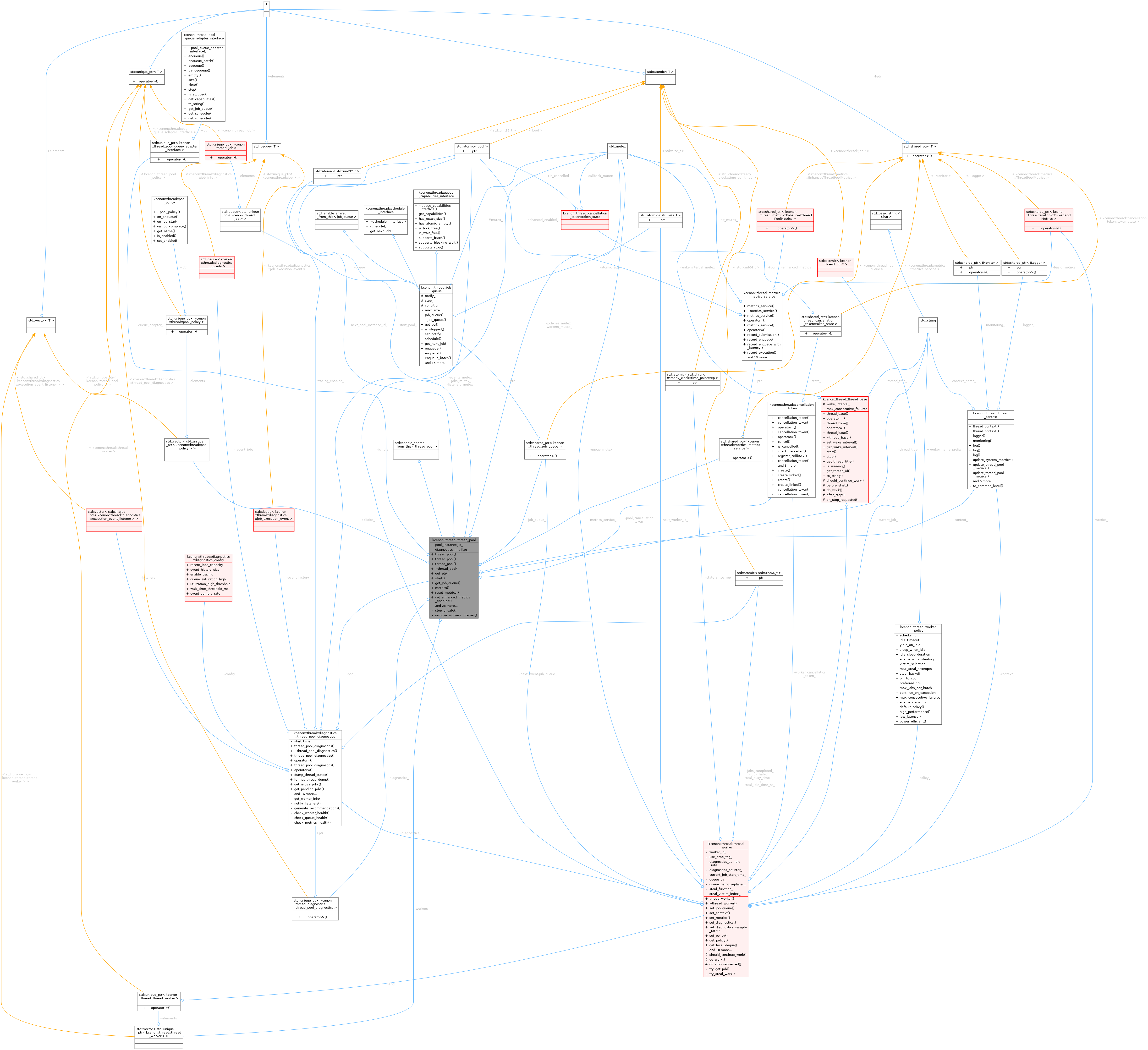
A thread pool for concurrent execution of jobs using multiple worker threads. More...
#include <thread_pool.h>

Public Member Functions | |
| thread_pool (const std::string &thread_title="thread_pool", const thread_context &context=thread_context()) | |
Constructs a new thread_pool instance. | |
| thread_pool (const std::string &thread_title, std::shared_ptr< job_queue > custom_queue, const thread_context &context=thread_context()) | |
Constructs a new thread_pool instance with a custom job queue. | |
| thread_pool (const std::string &thread_title, std::unique_ptr< pool_queue_adapter_interface > queue_adapter, const thread_context &context=thread_context()) | |
Constructs a new thread_pool instance with a policy_queue adapter. | |
| virtual | ~thread_pool (void) |
| Virtual destructor. Cleans up resources used by the thread pool. | |
| auto | get_ptr (void) -> std::shared_ptr< thread_pool > |
Retrieves a std::shared_ptr to this thread_pool instance. | |
| auto | start (void) -> common::VoidResult |
| Starts the thread pool and all associated workers. | |
| auto | get_job_queue (void) -> std::shared_ptr< job_queue > |
Returns the shared job_queue used by this thread pool. | |
| const metrics::ThreadPoolMetrics & | metrics () const noexcept |
| Access aggregated runtime metrics (read-only reference). | |
| void | reset_metrics () |
| Reset accumulated metrics. | |
| void | set_enhanced_metrics_enabled (bool enabled) |
| Enable or disable enhanced metrics collection. | |
| bool | is_enhanced_metrics_enabled () const |
| Check if enhanced metrics is enabled. | |
| const metrics::EnhancedThreadPoolMetrics & | enhanced_metrics () const |
| Access enhanced metrics (read-only reference). | |
| metrics::EnhancedSnapshot | enhanced_metrics_snapshot () const |
| Get enhanced metrics snapshot. | |
| auto | enqueue (std::unique_ptr< job > &&job) -> common::VoidResult |
Enqueues a new job into the shared job_queue. | |
| auto | enqueue_batch (std::vector< std::unique_ptr< job > > &&jobs) -> common::VoidResult |
Enqueues a batch of jobs into the shared job_queue. | |
| auto | enqueue (std::unique_ptr< thread_worker > &&worker) -> common::VoidResult |
Adds a thread_worker to the thread pool for specialized or additional processing. | |
| auto | enqueue_batch (std::vector< std::unique_ptr< thread_worker > > &&workers) -> common::VoidResult |
Adds a batch of thread_worker objects to the thread pool. | |
| auto | stop (const bool &immediately_stop=false) -> common::VoidResult |
| Stops the thread pool and all worker threads. | |
| auto | to_string (void) const -> std::string |
Provides a string representation of this thread_pool. | |
| std::uint32_t | get_pool_instance_id () const |
| Get the pool instance id. | |
| void | report_metrics () |
| Collect and report current thread pool metrics. | |
| std::size_t | get_idle_worker_count () const |
| Get the number of idle workers. | |
| auto | get_context (void) const -> const thread_context & |
| Gets the thread context for this pool. | |
| template<typename F , typename R = std::invoke_result_t<std::decay_t<F>>> | |
| auto | submit (F &&callable, const submit_options &opts={}) -> std::future< R > |
| template<typename F , typename R = std::invoke_result_t<std::decay_t<F>>> | |
| auto | submit (std::vector< F > &&callables, const submit_options &opts={}) -> std::vector< std::future< R > > |
| template<typename F , typename R = std::invoke_result_t<std::decay_t<F>>> | |
| auto | submit_wait_all (std::vector< F > &&callables, const submit_options &opts={}) -> std::vector< R > |
| Submit a batch and wait for all results. | |
| template<typename F , typename R = std::invoke_result_t<std::decay_t<F>>> | |
| auto | submit_wait_any (std::vector< F > &&callables, const submit_options &opts={}) -> common::Result< R > |
| Submit a batch and return first completed result. | |
| auto | is_running () const -> bool |
| Check if the thread pool is currently running. | |
| auto | get_pending_task_count () const -> std::size_t |
| Get the number of pending tasks in the queue. | |
| auto | check_worker_health (bool restart_failed=true) -> std::size_t |
| Check health of all worker threads and restart failed workers. | |
| auto | get_active_worker_count () const -> std::size_t |
| Get the current number of active (running) workers. | |
| void | add_policy (std::unique_ptr< pool_policy > policy) |
| Add a policy to the pool. | |
| auto | get_policies () const -> const std::vector< std::unique_ptr< pool_policy > > & |
| Get all registered policies. | |
| template<typename T = pool_policy> | |
| auto | find_policy (const std::string &name) -> T * |
| Find a policy by name. | |
| auto | remove_policy (const std::string &name) -> bool |
| Remove a policy by name. | |
| auto | diagnostics () -> diagnostics::thread_pool_diagnostics & |
| Get the diagnostics interface for this pool. | |
| auto | diagnostics () const -> const diagnostics::thread_pool_diagnostics & |
| Get the diagnostics interface for this pool (const version). | |
| auto | collect_worker_diagnostics () const -> std::vector< diagnostics::thread_info > |
| Collects diagnostics information from all workers. | |
Private Member Functions | |
| auto | stop_unsafe () noexcept -> common::VoidResult |
| Stops the thread pool without logging (for use during static destruction). | |
| auto | remove_workers_internal (std::size_t count, std::size_t min_workers=1) -> common::VoidResult |
| Internal method to remove workers from the pool. | |
Private Attributes | |
| std::string | thread_title_ |
| A title or name for this thread pool, useful for identification and logging. | |
| std::uint32_t | pool_instance_id_ {0} |
| Unique instance ID for this pool (for multi-pool scenarios). | |
| std::atomic< bool > | start_pool_ |
| Indicates whether the pool is currently running. | |
| std::shared_ptr< job_queue > | job_queue_ |
The shared job queue where jobs (job objects) are enqueued. | |
| std::unique_ptr< pool_queue_adapter_interface > | queue_adapter_ |
| Queue adapter for unified access to different queue types. | |
| std::vector< std::unique_ptr< thread_worker > > | workers_ |
| A collection of worker threads associated with this pool. | |
| std::mutex | workers_mutex_ |
| Mutex protecting concurrent access to the workers_ vector. | |
| thread_context | context_ |
| The thread context providing access to logging and monitoring services. | |
| cancellation_token | pool_cancellation_token_ |
| Pool-level cancellation token. | |
| std::shared_ptr< metrics::metrics_service > | metrics_service_ |
| Centralized metrics service for all pool and worker metrics. | |
| std::unique_ptr< diagnostics::thread_pool_diagnostics > | diagnostics_ |
| Diagnostics interface for this pool. | |
| std::once_flag | diagnostics_init_flag_ |
| Once flag for thread-safe lazy initialization of diagnostics_. | |
| std::vector< std::unique_ptr< pool_policy > > | policies_ |
| Registered pool policies for extending thread pool behavior. | |
| std::mutex | policies_mutex_ |
| Mutex protecting concurrent access to the policies_ vector. | |
Static Private Attributes | |
| static std::atomic< std::uint32_t > | next_pool_instance_id_ {0} |
| Static counter for generating unique pool instance IDs. | |
Friends | |
| class | numa_thread_pool |
| class | autoscaler |
| class | diagnostics::thread_pool_diagnostics |
Detailed Description
A thread pool for concurrent execution of jobs using multiple worker threads.
The thread_pool class manages a group of worker threads that process jobs from a shared job_queue. This implementation provides:
- Efficient reuse of threads to reduce thread creation/destruction overhead
- Controlled concurrency through a fixed or dynamic thread count
- A simple interface for submitting jobs of various types
- Graceful handling of thread startup, execution, and shutdown
The thread pool is designed for scenarios where many short-lived tasks need to be executed asynchronously without creating a new thread for each task.
Design Principles
- Worker Thread Model: Each worker runs in its own thread, processing jobs from the shared queue.
- Shared Job Queue: A single, thread-safe queue holds all pending jobs.
- Job-Based Work Units: Jobs encapsulate work to be executed.
- Non-Blocking Submission: Adding jobs to the pool never blocks the caller thread.
- Cooperative Shutdown: Workers can complete current jobs before stopping.
Thread Safety
All public methods of this class are thread-safe and can be called from any thread. The underlying job_queue is also thread-safe, allowing multiple workers to dequeue jobs concurrently.
Performance Considerations
- The number of worker threads should typically be close to the number of available CPU cores for CPU-bound tasks.
- For I/O-bound tasks, more threads may be beneficial to maximize throughput while some threads are blocked on I/O.
- Very large thread pools (significantly more threads than cores) may degrade performance due to context switching overhead.
IExecutor Interface
For IExecutor compatibility, use thread_pool_executor_adapter:
- See also
- thread_worker The worker thread class used by the pool
- job_queue The shared queue for storing pending jobs
- adapters::thread_pool_executor_adapter For IExecutor compatibility
- typed_kcenon::thread::typed_thread_pool For a priority-based version
- Examples
- crash_protection/main.cpp, thread_pool_sample.cpp, typed_thread_pool_sample.cpp, and typed_thread_pool_sample_2.cpp.
Definition at line 181 of file thread_pool.h.
Constructor & Destructor Documentation
◆ thread_pool() [1/3]
| kcenon::thread::thread_pool::thread_pool | ( | const std::string & | thread_title = "thread_pool", |
| const thread_context & | context = thread_context() ) |
Constructs a new thread_pool instance.
Constructs a thread pool with adaptive job queue.
- Parameters
-
thread_title An optional title or identifier for the thread pool (defaults to "thread_pool"). context Optional thread context for logging and monitoring (defaults to empty context).
This title can be used for logging or debugging purposes. The context provides access to logging and monitoring services.
Implementation details:
- Initializes with provided thread title for identification
- Creates adaptive job queue that automatically optimizes based on contention
- Pool starts in stopped state (start_pool_ = false)
- No workers are initially assigned (workers_ is empty)
- Stores thread context for logging and monitoring
- Creates pool-level cancellation token for hierarchical cancellation
Adaptive Queue Strategy:
- ADAPTIVE mode automatically switches between mutex and lock-free implementations
- Provides optimal performance across different contention levels
- Eliminates need for manual queue strategy selection
- Parameters
-
thread_title Descriptive name for this thread pool instance context Thread context providing logging and monitoring services
Definition at line 51 of file thread_pool.cpp.
References context_, and kcenon::thread::thread_context::monitoring().

◆ thread_pool() [2/3]
| kcenon::thread::thread_pool::thread_pool | ( | const std::string & | thread_title, |
| std::shared_ptr< job_queue > | custom_queue, | ||
| const thread_context & | context = thread_context() ) |
Constructs a new thread_pool instance with a custom job queue.
Constructs a thread pool with a custom job queue.
- Parameters
-
thread_title A title or identifier for the thread pool. custom_queue A custom job queue implementation (e.g., backpressure_job_queue). context Optional thread context for logging and monitoring (defaults to empty context).
This constructor allows injecting a specialized job queue such as backpressure_job_queue for rate limiting and flow control.
Implementation details:
- Initializes with provided thread title for identification
- Uses the provided custom job queue (e.g., backpressure_job_queue)
- Pool starts in stopped state (start_pool_ = false)
- No workers are initially assigned (workers_ is empty)
- Stores thread context for logging and monitoring
- Creates pool-level cancellation token for hierarchical cancellation
- Parameters
-
thread_title Descriptive name for this thread pool instance custom_queue Custom job queue implementation context Thread context providing logging and monitoring services
Definition at line 82 of file thread_pool.cpp.
References context_, and kcenon::thread::thread_context::monitoring().

◆ thread_pool() [3/3]
| kcenon::thread::thread_pool::thread_pool | ( | const std::string & | thread_title, |
| std::unique_ptr< pool_queue_adapter_interface > | queue_adapter, | ||
| const thread_context & | context = thread_context() ) |
Constructs a new thread_pool instance with a policy_queue adapter.
Constructs a thread pool with a policy_queue adapter.
- Parameters
-
thread_title A title or identifier for the thread pool. queue_adapter A queue adapter wrapping a policy_queue. context Optional thread context for logging and monitoring (defaults to empty context).
This constructor allows using the new policy-based queue system with thread_pool. Use adapters from <kcenon/thread/adapters/policy_queue_adapter.h>.
Example
Implementation details:
- Initializes with provided thread title for identification
- Uses the provided queue adapter for queue operations
- If adapter wraps a job_queue, extracts it for backward compatibility
- Pool starts in stopped state (start_pool_ = false)
- No workers are initially assigned (workers_ is empty)
- Stores thread context for logging and monitoring
- Creates pool-level cancellation token for hierarchical cancellation
- Parameters
-
thread_title Descriptive name for this thread pool instance queue_adapter Queue adapter wrapping job_queue or policy_queue context Thread context providing logging and monitoring services
Definition at line 116 of file thread_pool.cpp.
References context_, and kcenon::thread::thread_context::monitoring().

◆ ~thread_pool()
|
virtual |
Virtual destructor. Cleans up resources used by the thread pool.
Destroys the thread pool, ensuring all workers are stopped.
If the pool is still running, this typically calls stop() internally to ensure all worker threads are properly shut down.
Implementation details:
- Checks if static destruction is in progress to avoid SDOF
- Uses stop_unsafe() during static destruction (no logging)
- Uses regular stop() during normal destruction
- Workers will complete current jobs before terminating
- Prevents resource leaks from running threads
- See also
- stop_unsafe() for the logging-free shutdown variant
- thread_logger::is_shutting_down() for shutdown detection
Definition at line 148 of file thread_pool.cpp.
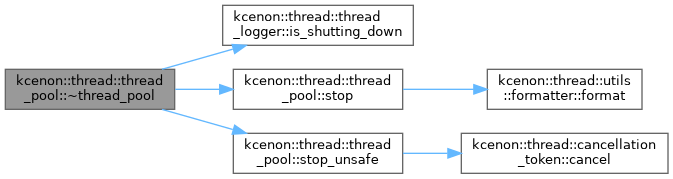
References kcenon::thread::thread_logger::is_shutting_down(), stop(), and stop_unsafe().
Member Function Documentation
◆ add_policy()
| void kcenon::thread::thread_pool::add_policy | ( | std::unique_ptr< pool_policy > | policy | ) |
Add a policy to the pool.
- Parameters
-
policy Unique pointer to the policy to add.
Policies provide a way to extend thread pool behavior without modifying the thread_pool class. Multiple policies can be added and they will be called in order of addition.
- See also
- pool_policy
- circuit_breaker_policy
Example
Definition at line 834 of file thread_pool.cpp.
◆ check_worker_health()
| auto kcenon::thread::thread_pool::check_worker_health | ( | bool | restart_failed = true | ) | -> std::size_t |
Check health of all worker threads and restart failed workers.
This method performs health monitoring on all worker threads:
- Detects workers that have stopped unexpectedly (consecutive failures)
- Removes dead workers from the pool
- Optionally restarts failed workers to maintain pool capacity
Use Cases:
- Periodic health checks (e.g., from a watchdog thread)
- Recovery from worker failures in long-running processes
- Maintaining consistent thread pool capacity
Thread Safety:
- Thread-safe: can be called from any thread
- Acquires workers_mutex_ for safe access to workers vector
- Parameters
-
restart_failed If true, creates new workers to replace failed ones
- Returns
- Number of workers that were detected as failed/unhealthy
Example:
Definition at line 706 of file thread_pool.cpp.
◆ collect_worker_diagnostics()
|
nodiscard |
Collects diagnostics information from all workers.
- Returns
- Vector of thread_info for each worker.
Thread Safety:
- Acquires workers_mutex_ for safe access
- Returns snapshot of current worker states
Definition at line 783 of file thread_pool.cpp.
References kcenon::thread::info.
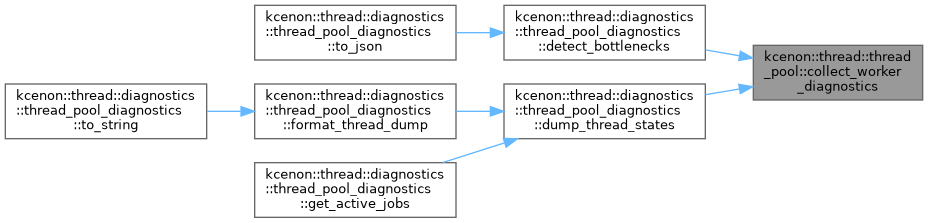
Referenced by kcenon::thread::diagnostics::thread_pool_diagnostics::detect_bottlenecks(), and kcenon::thread::diagnostics::thread_pool_diagnostics::dump_thread_states().
◆ diagnostics() [1/2]
|
nodiscard |
Get the diagnostics interface for this pool.
- Returns
- Reference to the diagnostics object.
The diagnostics interface provides:
- Thread dump capabilities
- Job inspection
- Bottleneck detection
- Health check integration
- Event tracing
Definition at line 768 of file thread_pool.cpp.
◆ diagnostics() [2/2]
|
nodiscard |
Get the diagnostics interface for this pool (const version).
- Returns
- Const reference to the diagnostics object.
Definition at line 775 of file thread_pool.cpp.
◆ enhanced_metrics()
|
nodiscard |
Access enhanced metrics (read-only reference).
- Returns
- Reference to enhanced metrics with histograms and percentiles.
- Exceptions
-
std::runtime_error if enhanced metrics is not enabled.
Definition at line 294 of file thread_pool.cpp.
References metrics_service_.
◆ enhanced_metrics_snapshot()
|
nodiscard |
Get enhanced metrics snapshot.
- Returns
- EnhancedSnapshot with all current metric values.
Returns empty snapshot if enhanced metrics is not enabled.
Definition at line 298 of file thread_pool.cpp.
References metrics_service_.
Referenced by kcenon::thread::autoscaler::collect_metrics().

◆ enqueue() [1/2]
| auto kcenon::thread::thread_pool::enqueue | ( | std::unique_ptr< job > && | job | ) | -> common::VoidResult |
Enqueues a new job into the shared job_queue.
Adds a single job to the thread pool for processing.
- Parameters
-
job A std::unique_ptr<job>representing the work to be done.
- Returns
common::VoidResultcontaining an error on failure, or success value on success.
Implementation details:
- Validates job pointer before submission
- Validates queue availability
- Delegates to adaptive job queue for optimal scheduling
- Job will be processed by next available worker thread
Queue Behavior:
- Adaptive queue automatically selects best strategy (mutex/lock-free)
- Jobs are processed in FIFO order within the selected strategy
- Workers are notified when jobs become available
Thread Safety:
- Safe to call from multiple threads simultaneously
- Adaptive queue handles contention efficiently
- Parameters
-
job Unique pointer to job (ownership transferred)
- Returns
- std::nullopt on success, error message on failure
- Examples
- /home/runner/work/thread_system/thread_system/include/kcenon/thread/core/thread_pool.h, and crash_protection/main.cpp.
Definition at line 323 of file thread_pool.cpp.
References kcenon::thread::invalid_argument, kcenon::thread::latency, kcenon::thread::queue_stopped, and kcenon::thread::resource_allocation_failed.
Referenced by main().

◆ enqueue() [2/2]
| auto kcenon::thread::thread_pool::enqueue | ( | std::unique_ptr< thread_worker > && | worker | ) | -> common::VoidResult |
Adds a thread_worker to the thread pool for specialized or additional processing.
- Parameters
-
worker A std::unique_ptr<thread_worker>object.
- Returns
common::VoidResultcontaining an error on failure, or success value on success.
Definition at line 412 of file thread_pool.cpp.
References kcenon::thread::invalid_argument, and kcenon::thread::resource_allocation_failed.
◆ enqueue_batch() [1/2]
| auto kcenon::thread::thread_pool::enqueue_batch | ( | std::vector< std::unique_ptr< job > > && | jobs | ) | -> common::VoidResult |
Enqueues a batch of jobs into the shared job_queue.
- Parameters
-
jobs A vector of std::unique_ptr<job>objects to be added.
- Returns
common::VoidResultcontaining an error on failure, or success value on success.
- Examples
- /home/runner/work/thread_system/thread_system/include/kcenon/thread/core/thread_pool.h, crash_protection/main.cpp, thread_pool_sample.cpp, typed_thread_pool_sample.cpp, and typed_thread_pool_sample_2.cpp.
Definition at line 368 of file thread_pool.cpp.
References kcenon::thread::invalid_argument, kcenon::thread::latency, kcenon::thread::queue_stopped, and kcenon::thread::resource_allocation_failed.
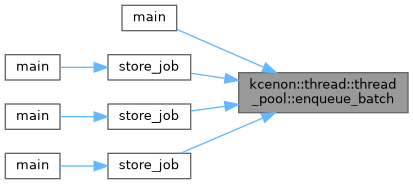
Referenced by main(), store_job(), store_job(), and store_job().
◆ enqueue_batch() [2/2]
| auto kcenon::thread::thread_pool::enqueue_batch | ( | std::vector< std::unique_ptr< thread_worker > > && | workers | ) | -> common::VoidResult |
Adds a batch of thread_worker objects to the thread pool.
- Parameters
-
workers A vector of std::unique_ptr<thread_worker>objects.
- Returns
common::VoidResultcontaining an error on failure, or success value on success.
Definition at line 469 of file thread_pool.cpp.
References kcenon::thread::invalid_argument, and kcenon::thread::resource_allocation_failed.
◆ find_policy()
|
nodiscard |
Find a policy by name.
- Parameters
-
name The policy name to search for.
- Returns
- Pointer to the policy, or nullptr if not found.
Example
Definition at line 118 of file thread_pool_impl.h.
◆ get_active_worker_count()
| auto kcenon::thread::thread_pool::get_active_worker_count | ( | ) | const -> std::size_t |
Get the current number of active (running) workers.
- Returns
- Number of workers currently in running state
This differs from the total worker count as it only counts workers that are actively running, not stopped or stopping.
Definition at line 755 of file thread_pool.cpp.
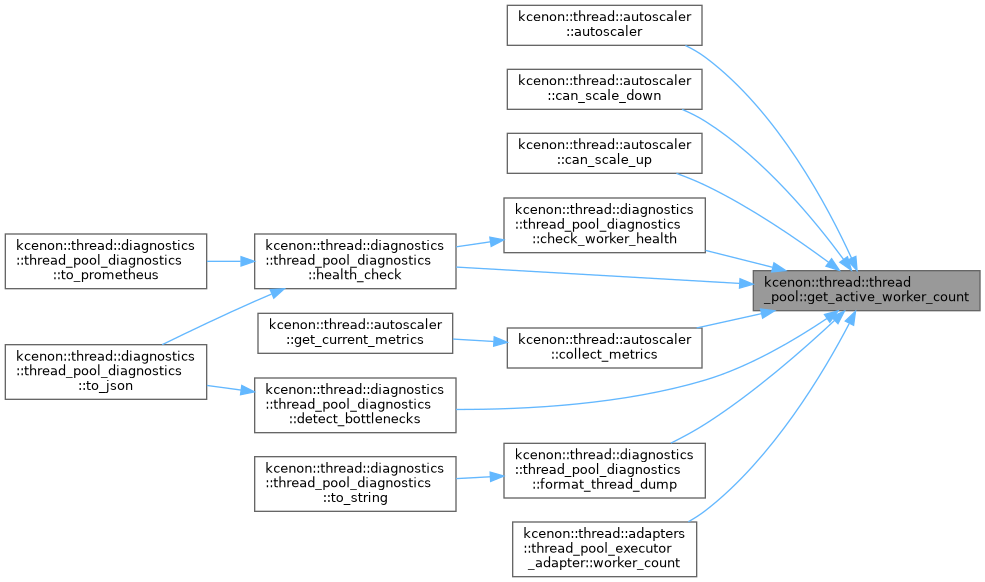
Referenced by kcenon::thread::autoscaler::autoscaler(), kcenon::thread::autoscaler::can_scale_down(), kcenon::thread::autoscaler::can_scale_up(), kcenon::thread::diagnostics::thread_pool_diagnostics::check_worker_health(), kcenon::thread::autoscaler::collect_metrics(), kcenon::thread::diagnostics::thread_pool_diagnostics::detect_bottlenecks(), kcenon::thread::diagnostics::thread_pool_diagnostics::format_thread_dump(), kcenon::thread::diagnostics::thread_pool_diagnostics::health_check(), and kcenon::thread::adapters::thread_pool_executor_adapter::worker_count().
◆ get_context()
|
nodiscard |
Gets the thread context for this pool.
- Returns
- The thread context providing access to logging and monitoring services.
Definition at line 645 of file thread_pool.cpp.
◆ get_idle_worker_count()
|
nodiscard |
Get the number of idle workers.
- Returns
- Number of workers currently not processing jobs.
Definition at line 679 of file thread_pool.cpp.
References workers_, and workers_mutex_.
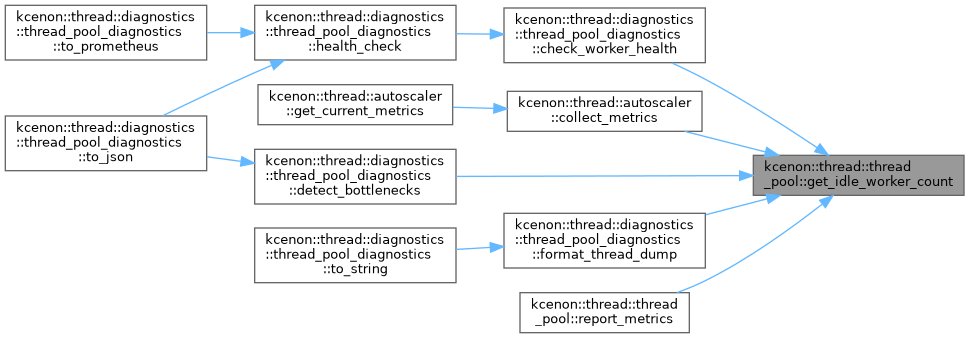
Referenced by kcenon::thread::diagnostics::thread_pool_diagnostics::check_worker_health(), kcenon::thread::autoscaler::collect_metrics(), kcenon::thread::diagnostics::thread_pool_diagnostics::detect_bottlenecks(), kcenon::thread::diagnostics::thread_pool_diagnostics::format_thread_dump(), and report_metrics().
◆ get_job_queue()
|
nodiscard |
Returns the shared job_queue used by this thread pool.
Returns the shared job queue used by all workers.
- Returns
- A
std::shared_ptr<job_queue>that stores the queued jobs.
The returned queue is shared among all worker threads in the pool, which can concurrently dequeue and process jobs.
Implementation details:
- Provides access to the adaptive job queue for external job submission
- Queue is shared among all workers for load balancing
- Adaptive queue automatically optimizes based on contention patterns
- Returns
- Shared pointer to the job queue
Definition at line 269 of file thread_pool.cpp.
Referenced by kcenon::thread::diagnostics::thread_pool_diagnostics::check_queue_health(), kcenon::thread::diagnostics::thread_pool_diagnostics::detect_bottlenecks(), and kcenon::thread::diagnostics::thread_pool_diagnostics::health_check().

◆ get_pending_task_count()
| auto kcenon::thread::thread_pool::get_pending_task_count | ( | ) | const -> std::size_t |
Get the number of pending tasks in the queue.
- Returns
- Number of tasks waiting to be processed
Definition at line 695 of file thread_pool.cpp.
References job_queue_, and queue_adapter_.
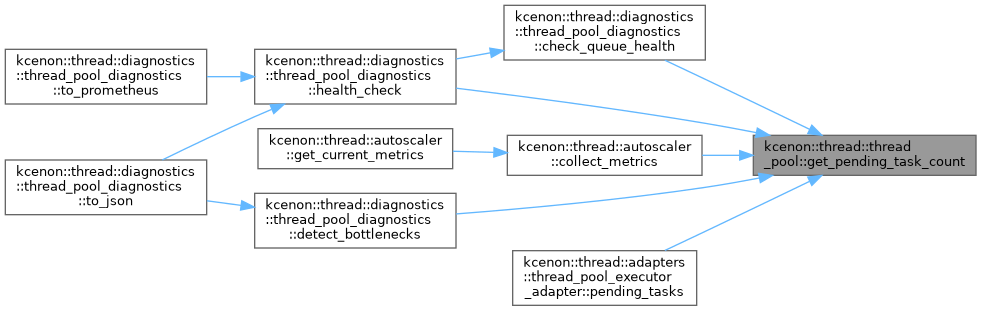
Referenced by kcenon::thread::diagnostics::thread_pool_diagnostics::check_queue_health(), kcenon::thread::autoscaler::collect_metrics(), kcenon::thread::diagnostics::thread_pool_diagnostics::detect_bottlenecks(), kcenon::thread::diagnostics::thread_pool_diagnostics::health_check(), and kcenon::thread::adapters::thread_pool_executor_adapter::pending_tasks().
◆ get_policies()
|
nodiscard |
Get all registered policies.
- Returns
- Const reference to the vector of policies.
Definition at line 843 of file thread_pool.cpp.
◆ get_pool_instance_id()
|
nodiscard |
Get the pool instance id.
- Returns
- Returns the unique instance id for this pool.
Definition at line 649 of file thread_pool.cpp.
References pool_instance_id_.
◆ get_ptr()
|
nodiscard |
Retrieves a std::shared_ptr to this thread_pool instance.
Returns a shared pointer to this thread pool instance.
- Returns
- A shared pointer to the current
thread_poolobject.
By inheriting from std::enable_shared_from_this, you can call get_ptr() within member functions to avoid storing a separate shared pointer.
Implementation details:
- Uses std::enable_shared_from_this for safe shared_ptr creation
- Required for passing pool reference to workers or other components
- Ensures proper lifetime management in multi-threaded environment
- Returns
- Shared pointer to this thread_pool
Definition at line 169 of file thread_pool.cpp.
◆ is_enhanced_metrics_enabled()
|
nodiscard |
Check if enhanced metrics is enabled.
- Returns
- True if enhanced metrics collection is enabled.
Definition at line 290 of file thread_pool.cpp.
References metrics_service_.
Referenced by kcenon::thread::autoscaler::collect_metrics().

◆ is_running()
| auto kcenon::thread::thread_pool::is_running | ( | ) | const -> bool |
Check if the thread pool is currently running.
- Returns
- true if the pool is active, false otherwise
Definition at line 689 of file thread_pool.cpp.
References start_pool_.
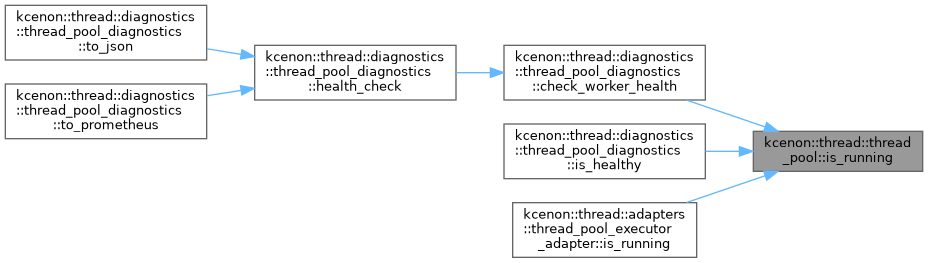
Referenced by kcenon::thread::diagnostics::thread_pool_diagnostics::check_worker_health(), kcenon::thread::diagnostics::thread_pool_diagnostics::is_healthy(), and kcenon::thread::adapters::thread_pool_executor_adapter::is_running().
◆ metrics()
|
nodiscardnoexcept |
Access aggregated runtime metrics (read-only reference).
Definition at line 273 of file thread_pool.cpp.
References metrics_service_.
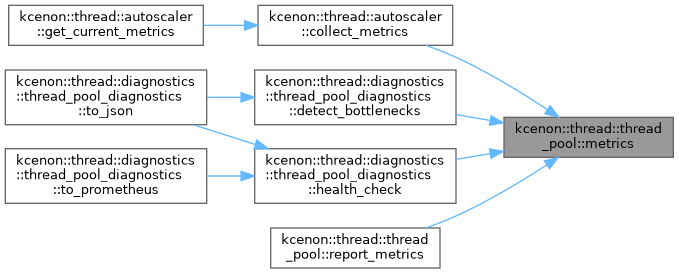
Referenced by kcenon::thread::autoscaler::collect_metrics(), kcenon::thread::diagnostics::thread_pool_diagnostics::detect_bottlenecks(), kcenon::thread::diagnostics::thread_pool_diagnostics::health_check(), and report_metrics().
◆ remove_policy()
| auto kcenon::thread::thread_pool::remove_policy | ( | const std::string & | name | ) | -> bool |
Remove a policy by name.
- Parameters
-
name The policy name to remove.
- Returns
- True if policy was found and removed.
Definition at line 847 of file thread_pool.cpp.
◆ remove_workers_internal()
|
nodiscardprivate |
Internal method to remove workers from the pool.
- Parameters
-
count Number of workers to remove. min_workers Minimum workers to keep.
- Returns
- Error if operation fails.
Used internally by autoscaler for scale-down operations. Gracefully stops and removes idle workers.
Definition at line 867 of file thread_pool.cpp.
References kcenon::thread::utils::formatter::format().

◆ report_metrics()
| void kcenon::thread::thread_pool::report_metrics | ( | ) |
Collect and report current thread pool metrics.
This method gathers current metrics from the pool and reports them through the monitoring interface if available.
Definition at line 653 of file thread_pool.cpp.
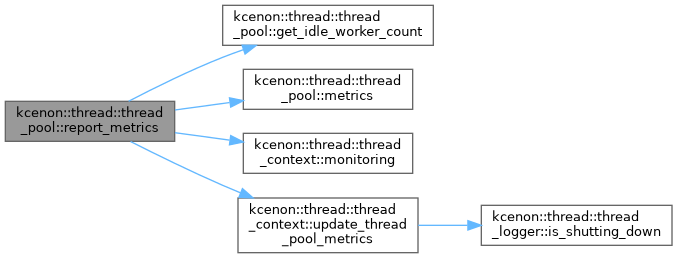
References context_, get_idle_worker_count(), job_queue_, metrics(), kcenon::thread::thread_context::monitoring(), pool_instance_id_, queue_adapter_, thread_title_, kcenon::thread::thread_context::update_thread_pool_metrics(), workers_, and workers_mutex_.
◆ reset_metrics()
| void kcenon::thread::thread_pool::reset_metrics | ( | ) |
Reset accumulated metrics.
Definition at line 277 of file thread_pool.cpp.
References metrics_service_, and kcenon::thread::metrics::ThreadPoolMetrics::reset().

◆ set_enhanced_metrics_enabled()
| void kcenon::thread::thread_pool::set_enhanced_metrics_enabled | ( | bool | enabled | ) |
Enable or disable enhanced metrics collection.
- Parameters
-
enabled True to enable enhanced metrics (histograms, percentiles).
When enabled, additional metrics like latency histograms and throughput counters are collected. This has minimal overhead (< 100ns per operation) but can be disabled for maximum performance.
Definition at line 281 of file thread_pool.cpp.
References metrics_service_, workers_, and workers_mutex_.
◆ start()
| auto kcenon::thread::thread_pool::start | ( | void | ) | -> common::VoidResult |
Starts the thread pool and all associated workers.
Starts all worker threads in the pool.
- Returns
common::VoidResultcontaining an error on failure, or success value on success.
If the pool is already running, a subsequent call to start() may return an error. On success, each thread_worker in workers_ is started, enabling them to process jobs from the job_queue_.
Implementation details:
- Validates that workers have been added to the pool
- Starts each worker thread individually
- If any worker fails to start, stops all workers and returns error
- Sets start_pool_ flag to true on successful startup
- Workers begin processing jobs from the shared queue immediately
Startup Sequence:
- Check that workers exist
- Start each worker sequentially
- On failure: stop all workers and return error message
- On success: mark pool as started
Error Handling:
- All-or-nothing startup (if one fails, all stop)
- Provides detailed error message from failed worker
- Ensures consistent pool state (either all running or all stopped)
- Returns
- std::nullopt on success, error message on failure
- Examples
- /home/runner/work/thread_system/thread_system/include/kcenon/thread/core/thread_pool.h, crash_protection/main.cpp, thread_pool_sample.cpp, typed_thread_pool_sample.cpp, and typed_thread_pool_sample_2.cpp.
Definition at line 196 of file thread_pool.cpp.
References kcenon::thread::cancellation_token::create(), kcenon::thread::invalid_argument, kcenon::thread::queue_stopped, and kcenon::thread::thread_already_running.
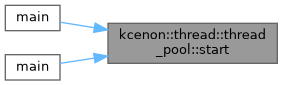
Referenced by main(), and main().

◆ stop()
| auto kcenon::thread::thread_pool::stop | ( | const bool & | immediately_stop = false | ) | -> common::VoidResult |
Stops the thread pool and all worker threads.
- Parameters
-
immediately_stop If true, any ongoing jobs may be interrupted; iffalse(default), each worker attempts to finish its current job before stopping.
- Returns
common::VoidResultcontaining an error on failure, or success value on success.
- Examples
- /home/runner/work/thread_system/thread_system/include/kcenon/thread/core/thread_pool.h, crash_protection/main.cpp, thread_pool_sample.cpp, typed_thread_pool_sample.cpp, and typed_thread_pool_sample_2.cpp.
Definition at line 518 of file thread_pool.cpp.
References kcenon::thread::utils::formatter::format().
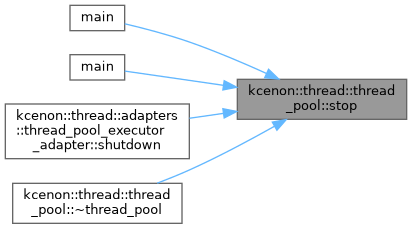
Referenced by main(), main(), kcenon::thread::adapters::thread_pool_executor_adapter::shutdown(), and ~thread_pool().

◆ stop_unsafe()
|
privatenoexcept |
Stops the thread pool without logging (for use during static destruction).
This method performs the same shutdown sequence as stop() but without any logging operations. It is specifically designed to be called from the destructor when static destruction is in progress, preventing Static Destruction Order Fiasco (SDOF) by avoiding access to potentially destroyed logger/monitoring singletons.
- Returns
common::VoidResultcontaining an error on failure, or success value on success.
- Note
- This method should only be called from the destructor during static destruction.
This method performs the same shutdown sequence as stop() but without any logging operations. It is specifically designed to be called from the destructor when static destruction is in progress, preventing Static Destruction Order Fiasco (SDOF) by avoiding access to potentially destroyed logger/monitoring singletons.
Implementation details:
- Same atomic state transition as stop()
- Cancels pool-level token for hierarchical cancellation
- Stops job queue without clearing (graceful shutdown)
- Stops all workers without logging errors
- noexcept guarantee for safe destructor use
- Returns
result_voidcontaining an error on failure, or success value on success.
Definition at line 584 of file thread_pool.cpp.
References kcenon::thread::cancellation_token::cancel(), job_queue_, pool_cancellation_token_, queue_adapter_, start_pool_, workers_, and workers_mutex_.
Referenced by ~thread_pool().


◆ submit() [1/2]
|
nodiscard |
Definition at line 35 of file thread_pool_impl.h.
◆ submit() [2/2]
|
nodiscard |
Definition at line 60 of file thread_pool_impl.h.
References kcenon::thread::detail::batch_apply(), and kcenon::thread::submit_options::name.

◆ submit_wait_all()
|
nodiscard |
Submit a batch and wait for all results.
Convenience overload that blocks until all tasks complete. Equivalent to submit(callables, submit_options::all()).
- Template Parameters
-
F Callable type R Return type (automatically deduced)
- Parameters
-
callables Vector of functions to execute opts Submit options (wait_all is implicitly true)
- Returns
- Vector of results
Definition at line 71 of file thread_pool_impl.h.
References kcenon::thread::detail::collect_all().

◆ submit_wait_any()
|
nodiscard |
Submit a batch and return first completed result.
Convenience overload that returns when any task completes. Equivalent to submit(callables, submit_options::any()).
- Template Parameters
-
F Callable type R Return type (automatically deduced)
- Parameters
-
callables Vector of functions to execute opts Submit options (wait_any is implicitly true)
- Returns
- common::Result<R> containing the first completed result, or an error if callables is empty or execution failed
Definition at line 79 of file thread_pool_impl.h.
References kcenon::thread::completed, kcenon::thread::invalid_argument, kcenon::thread::job_execution_failed, kcenon::thread::make_error_result(), and kcenon::thread::unknown_error.

◆ to_string()
|
nodiscard |
Provides a string representation of this thread_pool.
- Returns
- A string describing the pool, including its title and other optional details.
Derived classes may override this to include more diagnostic or state-related info.
- Examples
- /home/runner/work/thread_system/thread_system/include/kcenon/thread/core/thread_pool.h, thread_pool_sample.cpp, typed_thread_pool_sample.cpp, and typed_thread_pool_sample_2.cpp.
Definition at line 616 of file thread_pool.cpp.
References kcenon::thread::utils::formatter::format_to().
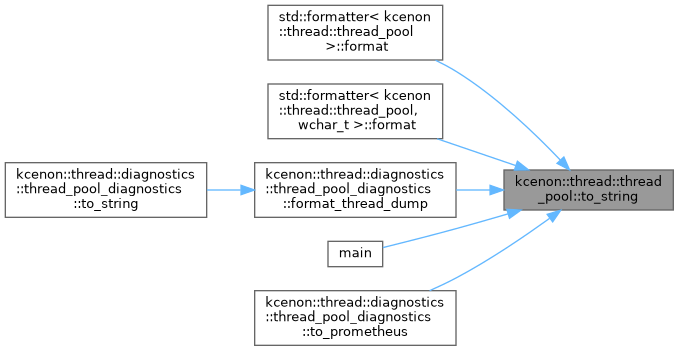
Referenced by std::formatter< kcenon::thread::thread_pool >::format(), std::formatter< kcenon::thread::thread_pool, wchar_t >::format(), kcenon::thread::diagnostics::thread_pool_diagnostics::format_thread_dump(), main(), and kcenon::thread::diagnostics::thread_pool_diagnostics::to_prometheus().

Friends And Related Symbol Documentation
◆ autoscaler
|
friend |
Definition at line 186 of file thread_pool.h.
◆ diagnostics::thread_pool_diagnostics
|
friend |
Definition at line 643 of file thread_pool.h.
◆ numa_thread_pool
|
friend |
Definition at line 184 of file thread_pool.h.
Member Data Documentation
◆ context_
|
private |
The thread context providing access to logging and monitoring services.
This context is shared with all worker threads created by this pool, enabling consistent logging and monitoring throughout the pool.
Definition at line 721 of file thread_pool.h.
Referenced by report_metrics(), thread_pool(), thread_pool(), and thread_pool().
◆ diagnostics_
|
mutableprivate |
Diagnostics interface for this pool.
Lazily initialized on first access to diagnostics().
Definition at line 776 of file thread_pool.h.
◆ diagnostics_init_flag_
|
mutableprivate |
Once flag for thread-safe lazy initialization of diagnostics_.
Definition at line 781 of file thread_pool.h.
◆ job_queue_
|
private |
The shared job queue where jobs (job objects) are enqueued.
Worker threads dequeue jobs from this queue to perform tasks. The queue persists for the lifetime of the pool or until no more references exist.
- Note
- When queue_adapter_ is set, this may be nullptr for policy_queue adapters. Use get_queue_adapter() for unified access.
Definition at line 676 of file thread_pool.h.
Referenced by get_pending_task_count(), report_metrics(), and stop_unsafe().
◆ metrics_service_
|
private |
Centralized metrics service for all pool and worker metrics.
Consolidates metrics management that was previously spread across thread_pool and thread_worker. Provides:
- Basic metrics (ThreadPoolMetrics)
- Enhanced metrics with histograms and percentiles (lazily initialized)
- Unified recording interface
- Clear ownership semantics (pool owns, workers borrow)
- See also
- metrics::metrics_service
Definition at line 768 of file thread_pool.h.
Referenced by enhanced_metrics(), enhanced_metrics_snapshot(), is_enhanced_metrics_enabled(), metrics(), reset_metrics(), and set_enhanced_metrics_enabled().
◆ next_pool_instance_id_
|
staticprivate |
Static counter for generating unique pool instance IDs.
Definition at line 647 of file thread_pool.h.
◆ policies_
|
private |
Registered pool policies for extending thread pool behavior.
Policies are called in order of addition for each lifecycle event. Protected by policies_mutex_ for thread-safe access.
Definition at line 789 of file thread_pool.h.
◆ policies_mutex_
|
mutableprivate |
Mutex protecting concurrent access to the policies_ vector.
Definition at line 794 of file thread_pool.h.
◆ pool_cancellation_token_
|
private |
Pool-level cancellation token.
This token is used to propagate cancellation to all workers and jobs when the pool is stopped. Each worker receives a linked token that combines this pool token with its own worker token, creating a hierarchical cancellation structure.
Cancellation Hierarchy:
- Pool stop() → cancels pool_cancellation_token_
- Pool token cancellation → propagates to all linked worker tokens
- Worker token cancellation → propagates to running jobs
- Note
- This token is reset when the pool is restarted to allow fresh job execution without stale cancellation state.
Definition at line 739 of file thread_pool.h.
Referenced by stop_unsafe().
◆ pool_instance_id_
|
private |
Unique instance ID for this pool (for multi-pool scenarios).
Definition at line 657 of file thread_pool.h.
Referenced by get_pool_instance_id(), and report_metrics().
◆ queue_adapter_
|
private |
Queue adapter for unified access to different queue types.
When set, provides a unified interface for both job_queue and policy_queue. This enables thread_pool to work with the new policy-based queue system while maintaining backward compatibility.
The adapter wraps either:
- job_queue: Legacy queue with full feature support
- policy_queue: New policy-based queue with compile-time configuration
Definition at line 689 of file thread_pool.h.
Referenced by get_pending_task_count(), report_metrics(), and stop_unsafe().
◆ start_pool_
|
private |
Indicates whether the pool is currently running.
Set to true after a successful call to start(), and reset to false after stop(). Used internally to prevent multiple active starts or erroneous state transitions.
Definition at line 665 of file thread_pool.h.
Referenced by is_running(), and stop_unsafe().
◆ thread_title_
|
private |
A title or name for this thread pool, useful for identification and logging.
Definition at line 652 of file thread_pool.h.
Referenced by report_metrics().
◆ workers_
|
private |
A collection of worker threads associated with this pool.
Each thread_worker typically runs in its own thread context, processing jobs from job_queue_ or performing specialized logic. They are started together when thread_pool::start() is called.
Thread Safety:
- Protected by workers_mutex_ to prevent concurrent modification
- Accessed during enqueue_worker() and stop() operations
Definition at line 702 of file thread_pool.h.
Referenced by kcenon::thread::diagnostics::thread_pool_diagnostics::check_worker_health(), kcenon::thread::diagnostics::thread_pool_diagnostics::detect_bottlenecks(), kcenon::thread::diagnostics::thread_pool_diagnostics::format_thread_dump(), get_idle_worker_count(), kcenon::thread::diagnostics::thread_pool_diagnostics::health_check(), kcenon::thread::diagnostics::thread_pool_diagnostics::is_healthy(), report_metrics(), set_enhanced_metrics_enabled(), and stop_unsafe().
◆ workers_mutex_
|
mutableprivate |
Mutex protecting concurrent access to the workers_ vector.
Synchronization Strategy:
- Guards all workers_ modifications (enqueue, stop)
- Prevents iterator invalidation during concurrent operations
- Uses scoped_lock for RAII-based protection
- Held briefly to minimize contention
Definition at line 713 of file thread_pool.h.
Referenced by kcenon::thread::diagnostics::thread_pool_diagnostics::check_worker_health(), kcenon::thread::diagnostics::thread_pool_diagnostics::detect_bottlenecks(), kcenon::thread::diagnostics::thread_pool_diagnostics::format_thread_dump(), get_idle_worker_count(), kcenon::thread::diagnostics::thread_pool_diagnostics::health_check(), kcenon::thread::diagnostics::thread_pool_diagnostics::is_healthy(), report_metrics(), set_enhanced_metrics_enabled(), and stop_unsafe().
The documentation for this class was generated from the following files:
- include/kcenon/thread/core/thread_pool.h
- src/impl/thread_pool/thread_pool.cpp
- include/kcenon/thread/core/thread_pool_impl.h