Represents a unit of work (task) to be executed, typically by a job queue. More...
#include <job.h>
Public Member Functions | |
| auto | get_job_id () const -> std::uint64_t |
| Gets the unique ID of this job. | |
| auto | get_enqueue_time () const -> std::chrono::steady_clock::time_point |
| Gets the time when this job was created (enqueued). | |
| job (const std::string &name="job") | |
Constructs a new job with an optional human-readable name. | |
| job (const std::vector< uint8_t > &data, const std::string &name="data_job") | |
Constructs a new job with associated raw byte data and a name. | |
| virtual | ~job (void) |
Virtual destructor for the job class to allow proper cleanup in derived classes. | |
| auto | get_name (void) const -> std::string |
| Retrieves the name of this job. | |
| virtual auto | do_work (void) -> common::VoidResult |
| The core task execution method to be overridden by derived classes. | |
| virtual auto | set_cancellation_token (const cancellation_token &token) -> void |
| Sets a cancellation token that can be used to cancel the job. | |
| virtual auto | get_cancellation_token () const -> cancellation_token |
| Gets the cancellation token associated with this job. | |
| virtual auto | set_job_queue (const std::shared_ptr< job_queue > &job_queue) -> void |
Associates this job with a specific job_queue. | |
| virtual auto | get_job_queue (void) const -> std::shared_ptr< job_queue > |
Retrieves the job_queue associated with this job, if any. | |
| virtual auto | to_string (void) const -> std::string |
| Provides a string representation of the job for logging or debugging. | |
| auto | with_on_complete (std::function< void(common::VoidResult)> callback) -> job & |
| Attaches a completion callback to this job. | |
| auto | with_on_error (std::function< void(const common::error_info &)> callback) -> job & |
| Attaches an error callback to this job. | |
| auto | with_priority (job_priority priority) -> job & |
| Sets the priority level for this job. | |
| auto | with_cancellation (const cancellation_token &token) -> job & |
| Attaches a cancellation token to this job via composition. | |
| auto | with_retry (const retry_policy &policy) -> job & |
| Attaches a retry policy to this job. | |
| auto | with_timeout (std::chrono::milliseconds timeout) -> job & |
| Sets a timeout for job execution. | |
| auto | get_priority () const -> job_priority |
| Gets the priority level of this job. | |
| auto | get_retry_policy () const -> std::optional< retry_policy > |
| Gets the retry policy of this job. | |
| auto | get_timeout () const -> std::optional< std::chrono::milliseconds > |
| Gets the timeout duration for this job. | |
| auto | has_explicit_cancellation () const -> bool |
| Checks if this job has an explicit cancellation set via composition. | |
| auto | has_components () const -> bool |
| Checks if this job has any composed components. | |
Protected Member Functions | |
| auto | invoke_callbacks (const common::VoidResult &result) -> void |
| Invokes the completion callbacks if they are set. | |
Protected Attributes | |
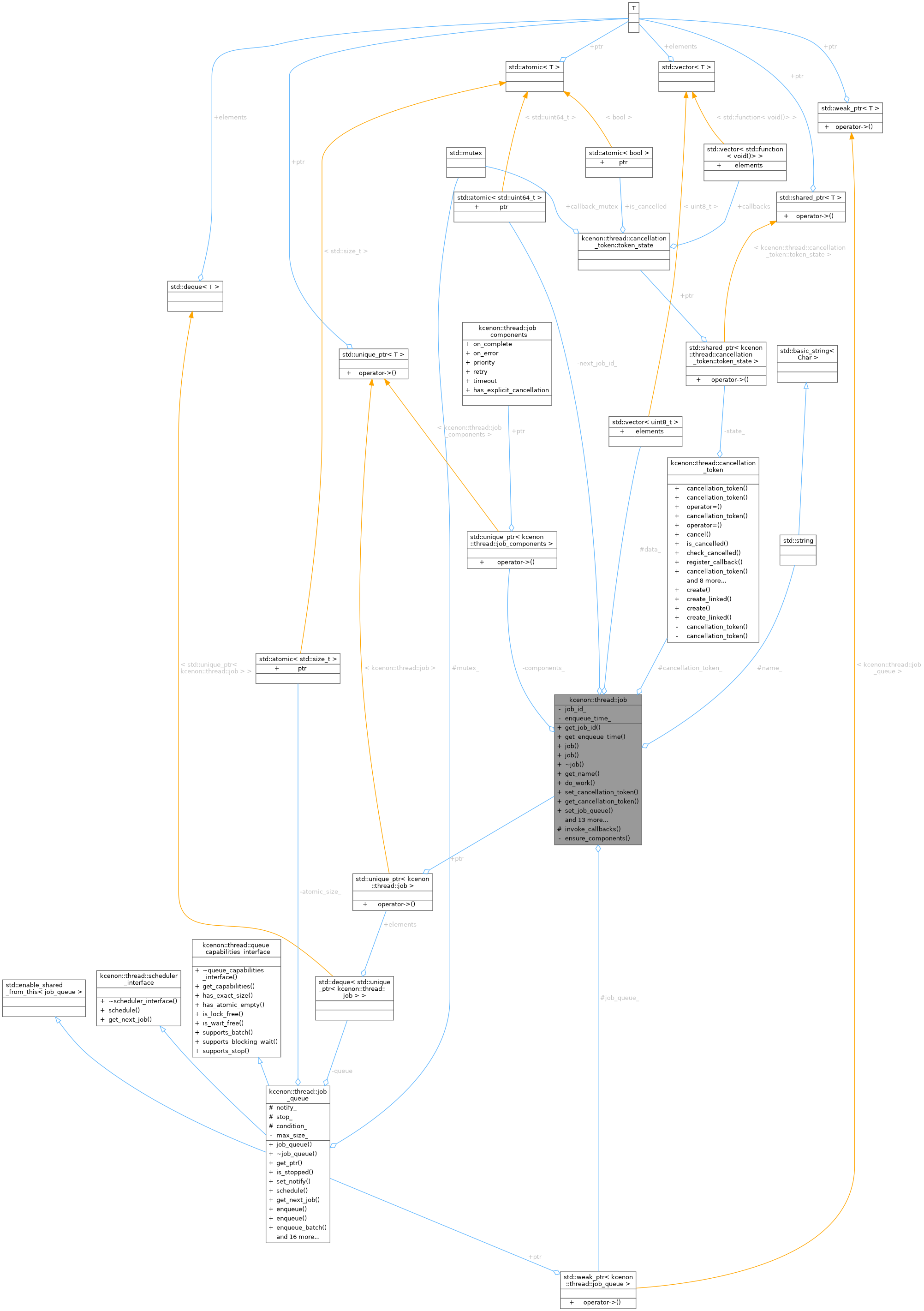
| std::string | name_ |
| The descriptive name of the job, used primarily for identification and logging. | |
| std::vector< uint8_t > | data_ |
| An optional container of raw byte data that may be used by the job. | |
| std::weak_ptr< job_queue > | job_queue_ |
A weak reference to the job_queue that currently manages this job. | |
| cancellation_token | cancellation_token_ |
| The cancellation token associated with this job. | |
Private Member Functions | |
| auto | ensure_components () -> job_components & |
| Ensures components_ is allocated (lazy initialization). | |
Private Attributes | |
| std::uint64_t | job_id_ |
| Unique identifier for this job. | |
| std::chrono::steady_clock::time_point | enqueue_time_ |
| Time when the job was created. | |
| std::unique_ptr< job_components > | components_ |
| Composed components for this job. | |
Static Private Attributes | |
| static std::atomic< std::uint64_t > | next_job_id_ {0} |
| Static counter for generating unique job IDs. | |
Detailed Description
Represents a unit of work (task) to be executed, typically by a job queue.
The job class provides a base interface for scheduling and executing discrete tasks within a multi-threaded environment. Derived classes can override the do_work() method to implement custom logic for their specific tasks.
Thread-Safety
do_work()will generally be called from a worker thread. If your task accesses shared data or interacts with shared resources, you must ensure your implementation is thread-safe.- The job itself is meant to be used via
std::shared_ptr, making it easier to manage lifetimes across multiple threads.
Error Handling
- A job returns a
common::VoidResultfromdo_work().- Returning
common::ok()indicates success. - Returning a
common::error_infoindicates failure with a typed error code and message.
- Returning
- Error information can be used for logging, debugging, or to retry a job if desired.
Usage Example
Constructor & Destructor Documentation
◆ job() [1/2]
| kcenon::thread::job::job | ( | const std::string & | name = "job" | ) |
Constructs a new job with an optional human-readable name.
Constructs a basic job with name only.
Use this constructor when your derived job class does not need to store any initial data beyond what you might manually store in derived class members.
- Parameters
-
name A descriptive name for the job (default is "job").
Example
Implementation details:
- Initializes job with descriptive name for identification
- Creates empty data vector (no binary data associated)
- Cancellation token is default-constructed (not cancelled)
- Job queue is not associated initially (weak_ptr is empty)
Use Cases:
- Simple computational jobs without input data
- Lambda-based callback jobs
- Jobs that generate data rather than process it
- Parameters
-
name Descriptive name for debugging and logging
- Examples
- /home/runner/work/thread_system/thread_system/include/kcenon/thread/core/job_builder.h, and job_cancellation_example.cpp.
Definition at line 53 of file job.cpp.
◆ job() [2/2]
| kcenon::thread::job::job | ( | const std::vector< uint8_t > & | data, |
| const std::string & | name = "data_job" ) |
Constructs a new job with associated raw byte data and a name.
Constructs a data-processing job with binary data.
This constructor is particularly useful if your job needs an inline payload or associated data that should be passed directly to do_work().
- Parameters
-
data A vector of bytes serving as the job's payload. name A descriptive name for the job (default is "data_job").
Example
Implementation details:
- Stores binary data for processing during job execution
- Data is copied into the job (caller retains ownership of original)
- Suitable for file processing, network data handling, etc.
- Memory efficient for moderate data sizes
Data Handling:
- Data is stored as std::vector<uint8_t> for flexibility
- Supports any binary data format (images, documents, network packets)
- Data lifetime matches job lifetime (automatic cleanup)
Performance Considerations:
- Data is copied during construction (consider move semantics for large data)
- Memory usage scales with data size
- Efficient for data sizes up to several MB
- Parameters
-
data Binary data to be processed by this job name Descriptive name for debugging and logging
◆ ~job()
|
virtual |
Virtual destructor for the job class to allow proper cleanup in derived classes.
Destroys the job and cleans up resources.
Implementation details:
- Virtual destructor ensures proper cleanup of derived classes
- Automatically cleans up stored data and job queue reference
- No manual cleanup required due to RAII design
- Safe to destroy even if job is queued (weak_ptr prevents dangling references)
Definition at line 100 of file job.cpp.
Member Function Documentation
◆ do_work()
|
nodiscardvirtual |
The core task execution method to be overridden by derived classes.
Default implementation of work execution (must be overridden).
- Returns
- A
common::VoidResultindicating success or error:- A success result (constructed with common::ok()) if no error occurred.
- An error result (constructed with common::error_info{code, message}) on failure.
Default Behavior
The base class implementation simply returns a success result. Override this method in a derived class to perform meaningful work.
Concurrency
- Typically invoked by worker threads in a
job_queue. - Ensure that any shared data or resources accessed here are protected with appropriate synchronization mechanisms (mutexes, locks, etc.) if needed.
- This method should check the cancellation token if one is set and return an error with code operation_canceled if the token is cancelled.
Implementation details:
- Base implementation always returns "not implemented" error
- Forces derived classes to provide actual work implementation
- Maintains compatibility with result_void error handling
- Should never be called in production (indicates missing override)
Design Pattern:
- Template method pattern: defines interface, requires implementation
- Pure virtual in spirit (returns error instead of being pure virtual)
- Enables compilation while encouraging proper inheritance
Derived Class Requirements:
- Must override this method to provide actual work logic
- Should return common::ok() on success
- Should return common::error_info{...} on failure with descriptive message
- Returns
- Error indicating method needs to be implemented in derived class
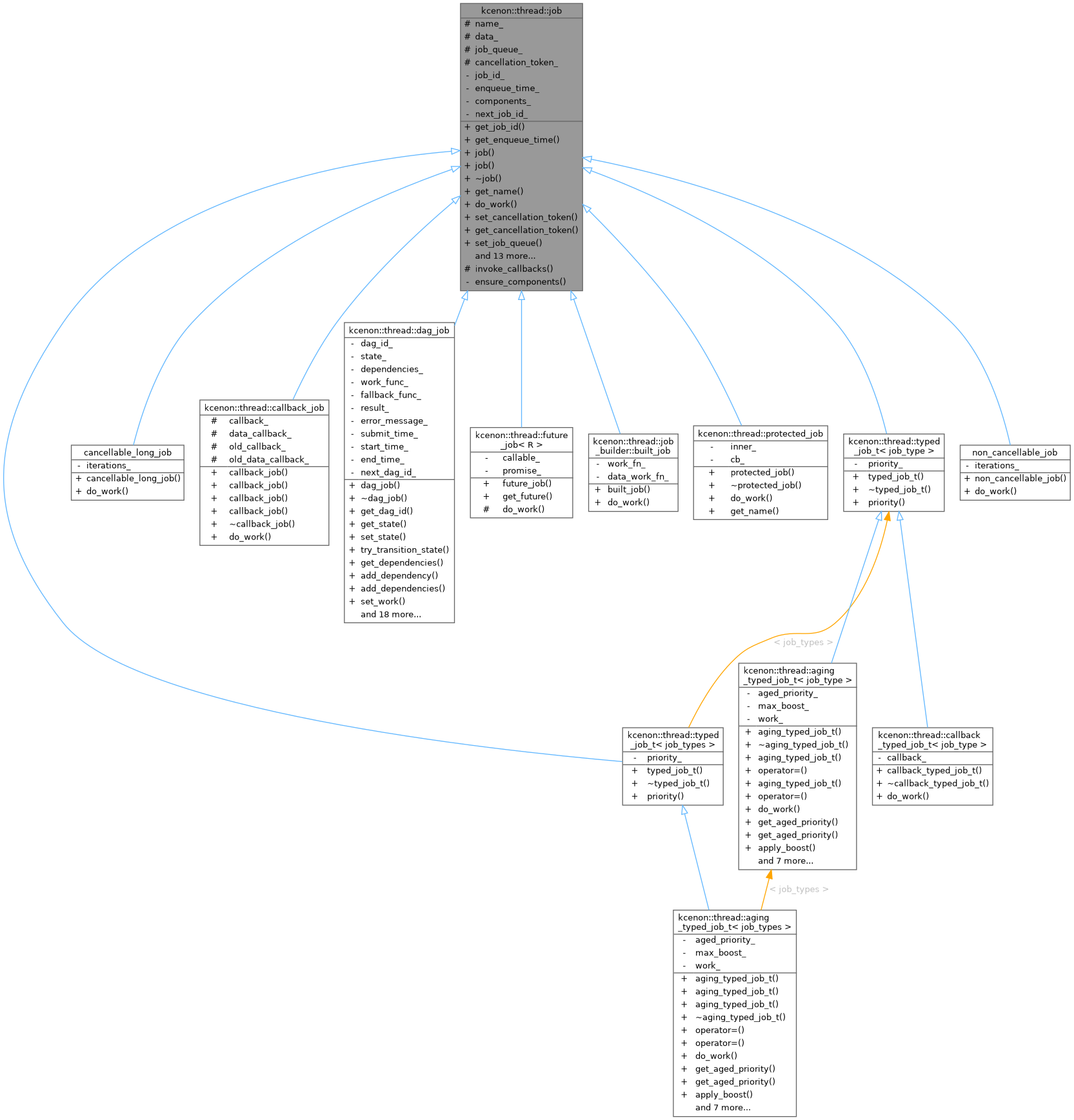
Reimplemented in cancellable_long_job, kcenon::thread::aging_typed_job_t< job_type >, kcenon::thread::aging_typed_job_t< job_types >, kcenon::thread::callback_job, kcenon::thread::callback_typed_job_t< job_type >, kcenon::thread::dag_job, kcenon::thread::future_job< R >, kcenon::thread::job_builder::built_job, kcenon::thread::protected_job, and non_cancellable_job.
Definition at line 135 of file job.cpp.
References kcenon::thread::not_implemented.
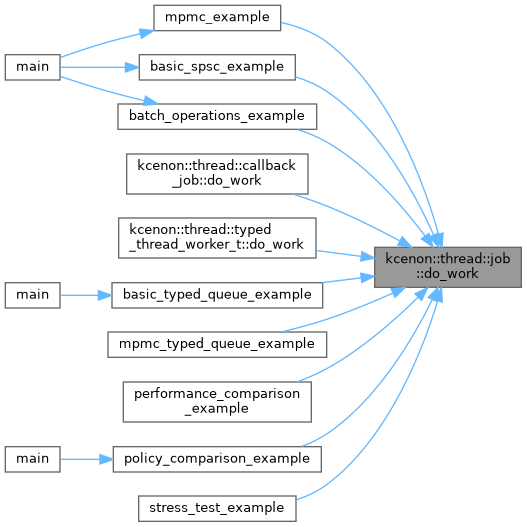
Referenced by basic_spsc_example(), basic_typed_queue_example(), batch_operations_example(), kcenon::thread::callback_job::do_work(), kcenon::thread::typed_thread_worker_t< job_type >::do_work(), mpmc_example(), mpmc_typed_queue_example(), performance_comparison_example(), policy_comparison_example(), and stress_test_example().
◆ ensure_components()
|
private |
Ensures components_ is allocated (lazy initialization).
Ensures the components structure is allocated.
Implementation details:
- Lazy initialization: only allocates memory when first needed
- Returns reference for convenient access after ensuring allocation
- Thread-safety note: this method is not thread-safe, but composition is typically done during job construction before submission to a queue
- Returns
- Reference to the components structure
Definition at line 279 of file job.cpp.
◆ get_cancellation_token()
|
nodiscardvirtual |
Gets the cancellation token associated with this job.
Gets the current cancellation token.
- Returns
- The cancellation token, or a default token if none was set.
Implementation details:
- Returns copy of stored cancellation token
- Thread-safe operation (cancellation_token is thread-safe)
- Used by derived classes to check cancellation status
- Returns default token if none was set (not cancelled)
Typical Usage in Derived Classes:
- Returns
- Current cancellation token
Definition at line 192 of file job.cpp.
References cancellation_token_.
◆ get_enqueue_time()
|
inlinenodiscard |
Gets the time when this job was created (enqueued).
- Returns
- Time point when the job was created.
Definition at line 151 of file job.h.
References enqueue_time_.
◆ get_job_id()
|
inlinenodiscard |
◆ get_job_queue()
|
nodiscardvirtual |
Retrieves the job_queue associated with this job, if any.
Gets the associated job queue if it still exists.
- Returns
- A
std::shared_ptrto the associatedjob_queue. Will be empty if no queue was set or if the queue has already been destroyed.
Usage Example
Implementation details:
- Converts weak_ptr to shared_ptr (may return nullptr)
- Thread-safe operation (weak_ptr::lock is atomic)
- Returns nullptr if queue has been destroyed
- Used for advanced job scheduling scenarios
Return Value Interpretation:
- Valid shared_ptr: Queue is alive and accessible
- nullptr: Queue has been destroyed or was never set
Safety Considerations:
- Always check return value before use
- Queue may be destroyed between check and use
- Designed to fail gracefully if queue is unavailable
- Returns
- Shared pointer to job queue or nullptr if unavailable
Definition at line 244 of file job.cpp.
◆ get_name()
|
nodiscard |
Retrieves the name of this job.
Gets the descriptive name of this job.
- Returns
- A string containing the name assigned to this job.
The name can be useful for logging and diagnostic messages, especially when multiple jobs are running concurrently.
Implementation details:
- Simple accessor for job identification
- Thread-safe (string is immutable after construction)
- Used for debugging, logging, and diagnostics
- Returns
- Job name as provided during construction
- Examples
- job_cancellation_example.cpp.
Definition at line 112 of file job.cpp.
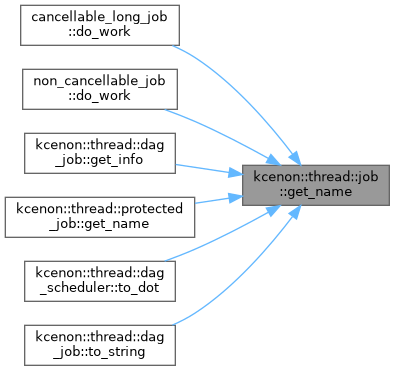
Referenced by cancellable_long_job::do_work(), non_cancellable_job::do_work(), kcenon::thread::dag_job::get_info(), kcenon::thread::protected_job::get_name(), kcenon::thread::dag_scheduler::to_dot(), and kcenon::thread::dag_job::to_string().
◆ get_priority()
|
nodiscard |
Gets the priority level of this job.
- Returns
- The job's priority, or job_priority::normal if not set
Implementation details:
- Returns normal priority if not explicitly set
- Returns the composed priority if set via with_priority()
- Returns
- The job's priority level
Definition at line 400 of file job.cpp.
References components_, and kcenon::thread::normal.
◆ get_retry_policy()
|
nodiscard |
Gets the retry policy of this job.
- Returns
- The job's retry policy, or std::nullopt if not set
Implementation details:
- Returns the retry policy if set via with_retry()
- Returns std::nullopt if no retry policy was configured
- Returns
- The job's retry policy or std::nullopt
Definition at line 418 of file job.cpp.
References components_.
◆ get_timeout()
|
nodiscard |
Gets the timeout duration for this job.
- Returns
- The job's timeout, or std::nullopt if not set
Implementation details:
- Returns the timeout if set via with_timeout()
- Returns std::nullopt if no timeout was configured
- Returns
- The job's timeout or std::nullopt
Definition at line 436 of file job.cpp.
References components_.
◆ has_components()
|
nodiscard |
Checks if this job has any composed components.
- Returns
- true if any with_*() method has been called, false otherwise
Implementation details:
- Simple null check on the components pointer
- Useful for conditional logic based on composition state
- Returns
- true if any with_*() method has been called
Definition at line 468 of file job.cpp.
References components_.
◆ has_explicit_cancellation()
|
nodiscard |
Checks if this job has an explicit cancellation set via composition.
- Returns
- true if with_cancellation() was called
Implementation details:
- Returns true if with_cancellation() was called
- Distinguishes between explicit composition and set_cancellation_token()
- Returns
- true if with_cancellation() was called
Definition at line 454 of file job.cpp.
References components_.
◆ invoke_callbacks()
|
protected |
Invokes the completion callbacks if they are set.
This method should be called by derived classes or the job execution framework after do_work() completes. It handles invoking both the on_complete and on_error callbacks as appropriate.
- Parameters
-
result The result from do_work()
Implementation details:
- Invokes on_complete callback with the full result
- Invokes on_error callback only if result is an error
- Order: on_error is called first (if applicable), then on_complete
- Exceptions from callbacks are not caught (propagate to caller)
- Parameters
-
result The result from do_work()
Definition at line 484 of file job.cpp.
Referenced by kcenon::thread::job_builder::built_job::do_work().

◆ set_cancellation_token()
|
virtual |
Sets a cancellation token that can be used to cancel the job.
Sets the cancellation token for cooperative cancellation.
- Parameters
-
token The cancellation token to associate with this job.
Implementation details:
- Stores cancellation token for use during job execution
- Enables cooperative cancellation (job checks token periodically)
- Thread-safe assignment (cancellation_token is thread-safe)
- Token can be checked during long-running operations
Cancellation Model:
- Cooperative: job must check token voluntarily
- Non-preemptive: job won't be forcibly stopped
- Graceful: allows cleanup before termination
Usage Pattern:
- Create cancellation_token
- Set token on jobs before submission
- Job checks token during execution
- External code can signal cancellation
- Parameters
-
token Cancellation token for cooperative cancellation
◆ set_job_queue()
|
virtual |
Associates this job with a specific job_queue.
Associates this job with a job queue for scheduling.
Once assigned, the job can be aware of the queue that manages it, enabling scenarios like re-enqueuing itself upon partial failure, or querying the queue for state (depending on the queue's interface).
Implementation Detail
- Stored internally as a
std::weak_ptr. If the queue is destroyed, the pointer becomes invalid.
Implementation details:
- Stores weak reference to prevent circular dependencies
- Allows job to interact with its queue if needed
- Automatic cleanup when queue is destroyed
- Used for advanced job management scenarios
Weak Reference Benefits:
- Prevents memory leaks from circular references
- Queue can be destroyed without affecting jobs
- Jobs can check if queue is still alive
- No impact on queue lifetime management
Use Cases:
- Jobs that need to submit additional jobs
- Self-scheduling or recursive jobs
- Jobs that need queue statistics
- Advanced workflow management
- Parameters
-
job_queue Shared pointer to the job queue
◆ to_string()
|
nodiscardvirtual |
Provides a string representation of the job for logging or debugging.
Provides a string representation of this job.
By default, this returns the job's name. Derived classes can override to include extra diagnostic details (e.g., job status, data contents, etc.).
- Returns
- A string describing the job (e.g.,
name_).
Example
Implementation details:
- Formats job name for display purposes
- Used in debugging, logging, and diagnostics
- Consistent format across all job types
- Thread-safe operation (accesses immutable name)
Output Format:
- "job: <name>" where <name> is the job's descriptive name
- Simple, readable format for human consumption
- Suitable for log files and debug output
- Returns
- Formatted string representation of the job
Reimplemented in kcenon::thread::dag_job.
Definition at line 262 of file job.cpp.
References kcenon::thread::utils::formatter::format().

◆ with_cancellation()
| auto kcenon::thread::job::with_cancellation | ( | const cancellation_token & | token | ) | -> job& |
Attaches a cancellation token to this job via composition.
The cancellation token enables cooperative cancellation of the job. The job should periodically check the token and abort if cancelled.
- Parameters
-
token The cancellation token to use
- Returns
- Reference to this job for method chaining
Thread Safety
- The token itself is thread-safe for cancellation requests
- The job must cooperatively check the token during execution
Example
Implementation details:
- Sets the cancellation token on the job
- Marks the job as having explicit cancellation for querying
- Enables fluent method chaining
- Parameters
-
token The cancellation token to use
- Returns
- Reference to this job for chaining
Definition at line 350 of file job.cpp.
◆ with_on_complete()
| auto kcenon::thread::job::with_on_complete | ( | std::function< void(common::VoidResult)> | callback | ) | -> job& |
Attaches a completion callback to this job.
The callback will be invoked after do_work() completes, regardless of success or failure. The callback receives the VoidResult from do_work().
- Parameters
-
callback Function to call with the job's result
- Returns
- Reference to this job for method chaining
Thread Safety
- The callback is invoked on the same thread that executes do_work()
- Ensure callback is thread-safe if it accesses shared resources
Example
Implementation details:
- Uses lazy initialization to avoid memory overhead for simple jobs
- Returns *this to enable fluent method chaining
- Callback is stored and invoked by invoke_callbacks()
- Parameters
-
callback Function to call with the job's result
- Returns
- Reference to this job for chaining
Definition at line 299 of file job.cpp.
References kcenon::thread::callback.
◆ with_on_error()
| auto kcenon::thread::job::with_on_error | ( | std::function< void(const common::error_info &)> | callback | ) | -> job& |
Attaches an error callback to this job.
The callback will be invoked only if do_work() returns an error. This is more specific than with_on_complete() for error-only handling.
- Parameters
-
callback Function to call with the error information
- Returns
- Reference to this job for method chaining
Example
Implementation details:
- Called only when do_work() returns an error
- More specific than with_on_complete() for error-only handling
- Can be used in combination with with_on_complete()
- Parameters
-
callback Function to call with the error information
- Returns
- Reference to this job for chaining
Definition at line 316 of file job.cpp.
References kcenon::thread::callback.
◆ with_priority()
| auto kcenon::thread::job::with_priority | ( | job_priority | priority | ) | -> job& |
Sets the priority level for this job.
Priority can be used by job queues and schedulers to determine execution order. Higher priority jobs are typically executed first.
- Parameters
-
priority The priority level to set
- Returns
- Reference to this job for method chaining
Example
Implementation details:
- Priority is stored in optional to distinguish "not set" from "normal"
- Can be queried by schedulers via get_priority()
- Does not affect execution order in basic job_queue (for typed pools)
- Parameters
-
priority The priority level to set
- Returns
- Reference to this job for chaining
Definition at line 333 of file job.cpp.
References kcenon::thread::priority.
◆ with_retry()
| auto kcenon::thread::job::with_retry | ( | const retry_policy & | policy | ) | -> job& |
Attaches a retry policy to this job.
When the job fails, it can be automatically retried according to the specified retry policy. The executor must support retry behavior.
- Parameters
-
policy The retry policy to use
- Returns
- Reference to this job for method chaining
Supported Policies
- retry_policy::none() - No retry
- retry_policy::fixed() - Fixed delay between retries
- retry_policy::linear() - Linearly increasing delay
- retry_policy::exponential_backoff() - Exponential delay
Example
Implementation details:
- Stores the retry policy in components for executor access
- The executor is responsible for implementing retry logic
- Enables fluent method chaining
- Parameters
-
policy The retry policy to use
- Returns
- Reference to this job for chaining
◆ with_timeout()
| auto kcenon::thread::job::with_timeout | ( | std::chrono::milliseconds | timeout | ) | -> job& |
Sets a timeout for job execution.
If the job does not complete within the specified duration, it may be cancelled (requires executor support for timeout handling).
- Parameters
-
timeout Maximum execution time allowed
- Returns
- Reference to this job for method chaining
Note
- Timeout enforcement requires executor/queue support
- The job should check cancellation token for cooperative timeout
Example
Implementation details:
- Stores timeout duration in components for executor access
- The executor is responsible for implementing timeout logic
- Enables fluent method chaining
- Parameters
-
timeout Maximum execution time allowed
- Returns
- Reference to this job for chaining
Member Data Documentation
◆ cancellation_token_
|
protected |
The cancellation token associated with this job.
This token can be used to cancel the job during execution. The job should periodically check this token and abort if it is cancelled.
- Examples
- /home/runner/work/thread_system/thread_system/include/kcenon/thread/core/job_builder.h, and job_cancellation_example.cpp.
Definition at line 504 of file job.h.
Referenced by cancellable_long_job::do_work(), kcenon::thread::future_job< R >::do_work(), kcenon::thread::job_builder::built_job::do_work(), and get_cancellation_token().
◆ components_
|
private |
Composed components for this job.
Lazily allocated when first with_*() method is called. This enables the composition pattern without memory overhead for jobs that don't use composition.
Definition at line 535 of file job.h.
Referenced by get_priority(), get_retry_policy(), get_timeout(), has_components(), and has_explicit_cancellation().
◆ data_
|
protected |
An optional container of raw byte data that may be used by the job.
If the constructor without the data parameter is used, this vector will remain empty unless manually populated by derived classes or other means.
Definition at line 488 of file job.h.
Referenced by kcenon::thread::job_builder::built_job::do_work().
◆ enqueue_time_
|
private |
Time when the job was created.
Captured during construction, used for wait time calculations in diagnostics.
Definition at line 526 of file job.h.
Referenced by get_enqueue_time().
◆ job_id_
|
private |
Unique identifier for this job.
Generated automatically during construction, unique within the lifetime of the application.
Definition at line 518 of file job.h.
Referenced by get_job_id().
◆ job_queue_
|
protected |
◆ name_
|
protected |
◆ next_job_id_
|
staticprivate |
The documentation for this class was generated from the following files: