A thread-safe job queue for managing and dispatching work items. More...
#include <job_queue.h>
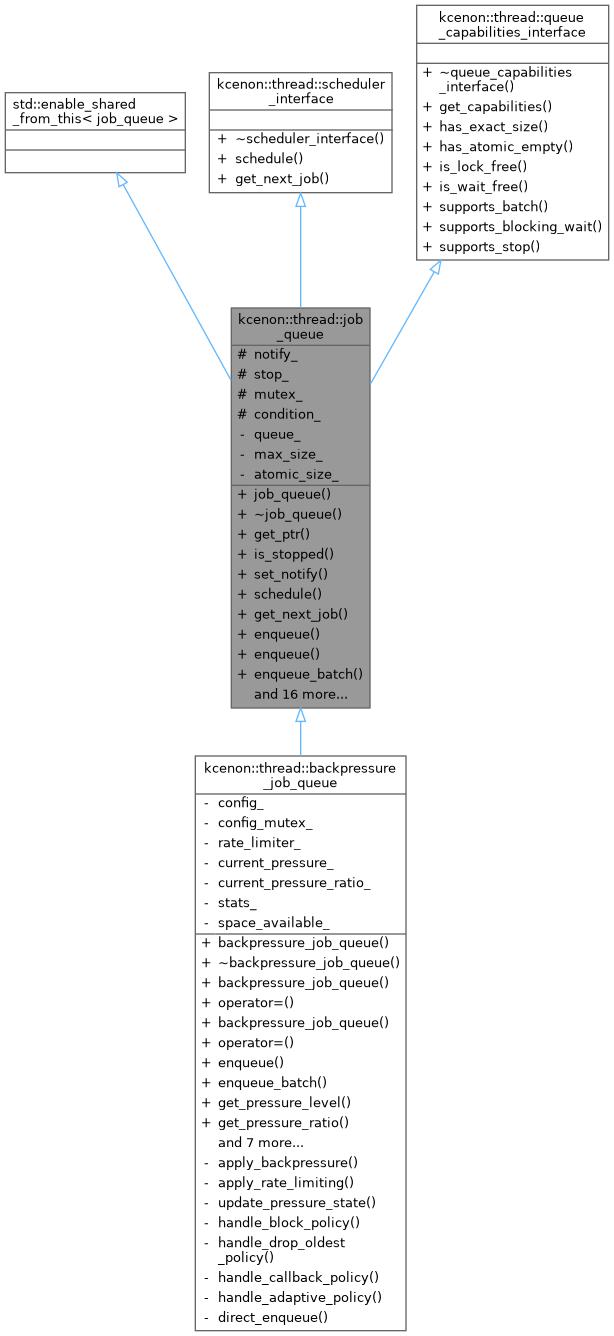
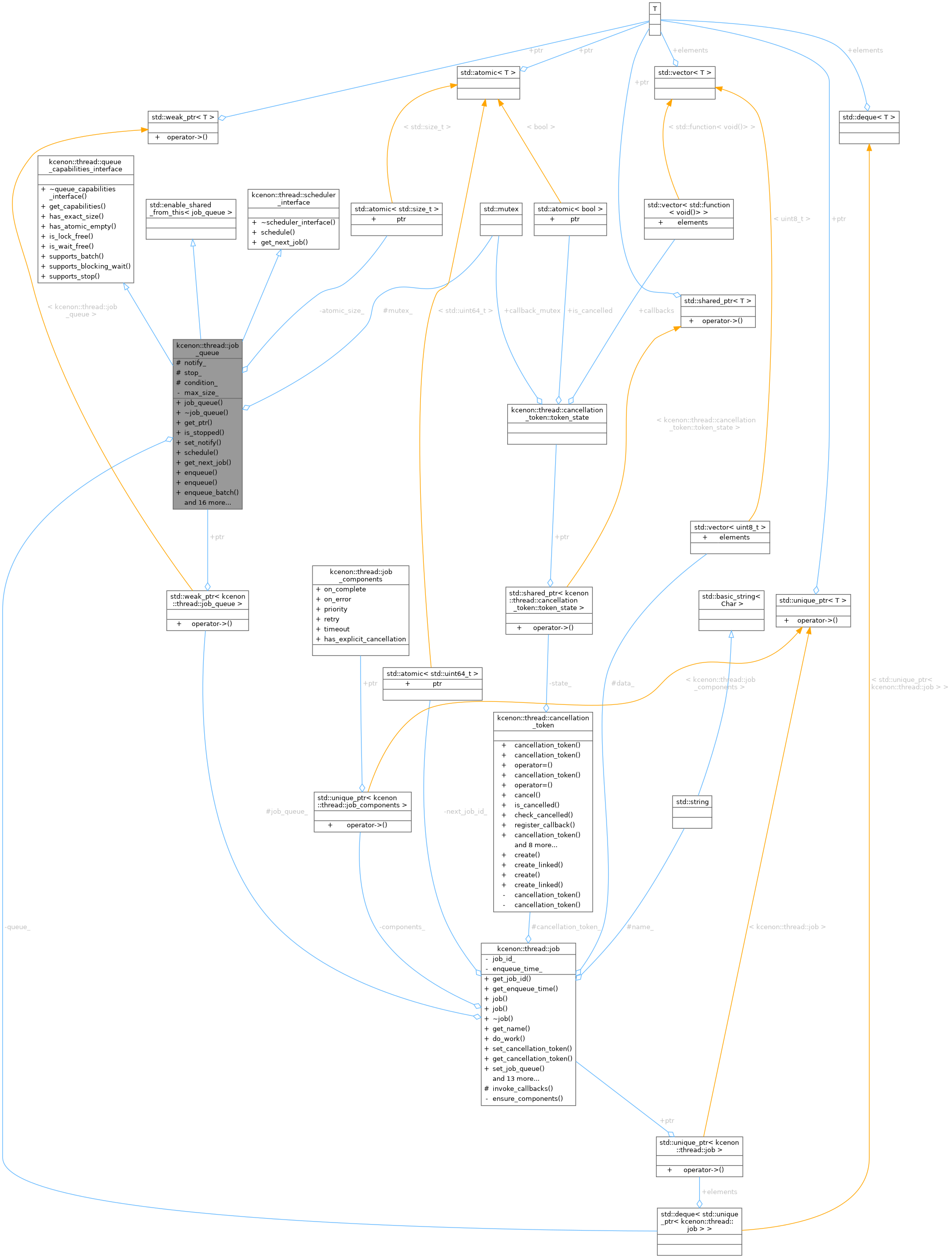
Classes | |
| struct | memory_stats |
| Get memory footprint statistics for the queue. More... | |
Public Member Functions | |
| job_queue (std::optional< std::size_t > max_size=std::nullopt) | |
Constructs a new, empty job_queue. | |
| virtual | ~job_queue (void) |
Virtual destructor. Cleans up resources used by the job_queue. | |
| auto | get_ptr (void) -> std::shared_ptr< job_queue > |
Obtains a std::shared_ptr that points to this queue instance. | |
| auto | is_stopped () const -> bool |
| Checks if the queue is in a "stopped" state. | |
| auto | set_notify (bool notify) -> void |
| Sets the 'notify' flag for this queue. | |
| auto | schedule (std::unique_ptr< job > &&value) -> common::VoidResult override |
| scheduler_interface implementation: schedule a job | |
| auto | get_next_job () -> common::Result< std::unique_ptr< job > > override |
| scheduler_interface implementation: get next job | |
| virtual auto | enqueue (std::unique_ptr< job > &&value) -> common::VoidResult |
| Enqueues a new job into the queue. | |
| template<typename JobType , typename = std::enable_if_t<std::is_base_of_v<job, JobType>>> | |
| auto | enqueue (std::unique_ptr< JobType > &&value) -> common::VoidResult |
| Type-safe enqueue for job subclasses. | |
| virtual auto | enqueue_batch (std::vector< std::unique_ptr< job > > &&jobs) -> common::VoidResult |
| Enqueues a batch of jobs into the queue. | |
| virtual auto | dequeue (void) -> common::Result< std::unique_ptr< job > > |
| Dequeues a job from the queue in FIFO order (blocking operation). | |
| virtual auto | try_dequeue (void) -> common::Result< std::unique_ptr< job > > |
| Attempts to dequeue a job from the queue without blocking. | |
| virtual auto | dequeue_batch (void) -> std::deque< std::unique_ptr< job > > |
| Dequeues all remaining jobs from the queue without processing them. | |
| virtual auto | dequeue_batch_limited (std::size_t max_count) -> std::deque< std::unique_ptr< job > > |
| Dequeues up to N jobs in a single operation (micro-batching). | |
| virtual auto | clear (void) -> void |
| Removes all jobs currently in the queue without processing them. | |
| auto | empty (void) const -> bool |
| Checks if the queue is currently empty. | |
| auto | size (void) const -> std::size_t |
| Returns the current number of jobs in the queue. | |
| auto | get_memory_stats () const -> memory_stats |
| Get memory footprint statistics for debugging and monitoring. | |
| auto | stop (void) -> void |
| Signals the queue to stop waiting for new jobs (e.g., during shutdown). | |
| virtual auto | to_string (void) const -> std::string |
| Returns a string representation of this job_queue. | |
| auto | get_capabilities () const -> queue_capabilities override |
| Returns capabilities of this job_queue implementation. | |
| auto | is_bounded () const -> bool |
| Check if queue has a size limit. | |
| auto | get_max_size () const -> std::optional< std::size_t > |
| Get the maximum queue size. | |
| auto | set_max_size (std::optional< std::size_t > max_size) -> void |
| Set maximum queue size. | |
| auto | is_full () const -> bool |
| Check if queue is at capacity. | |
| virtual auto | inspect_pending_jobs (std::size_t limit=100) const -> std::vector< diagnostics::job_info > |
| Inspects pending jobs in the queue without removing them. | |
 Public Member Functions inherited from kcenon::thread::scheduler_interface Public Member Functions inherited from kcenon::thread::scheduler_interface | |
| virtual | ~scheduler_interface ()=default |
| Public Member Functions inherited from kcenon::thread::queue_capabilities_interface | |
| virtual | ~queue_capabilities_interface ()=default |
| auto | has_exact_size () const -> bool |
| Check if size() returns exact values. | |
| auto | has_atomic_empty () const -> bool |
| Check if empty() check is atomic. | |
| auto | is_lock_free () const -> bool |
| Check if this is a lock-free implementation. | |
| auto | is_wait_free () const -> bool |
| Check if this is a wait-free implementation. | |
| auto | supports_batch () const -> bool |
| Check if batch operations are supported. | |
| auto | supports_blocking_wait () const -> bool |
| Check if blocking wait is supported. | |
| auto | supports_stop () const -> bool |
| Check if stop signaling is supported. | |
Protected Attributes | |
| std::atomic_bool | notify_ |
If true, threads waiting for new jobs are notified when a new job is enqueued. If false, enqueuing does not automatically trigger a notification. | |
| std::atomic_bool | stop_ |
| Indicates whether the queue has been signaled to stop. | |
| std::mutex | mutex_ |
Mutex to protect access to the underlying queue_ container and related state. | |
| std::condition_variable | condition_ |
| Condition variable used to signal worker threads. | |
Private Attributes | |
| std::deque< std::unique_ptr< job > > | queue_ |
| The underlying container storing the jobs in FIFO order. | |
| std::optional< std::size_t > | max_size_ |
| Optional maximum queue size. | |
| std::atomic< std::size_t > | atomic_size_ {0} |
| Atomic size counter for lock-free read-only queries. | |
Detailed Description
A thread-safe job queue for managing and dispatching work items.
The job_queue class provides a synchronized queue for storing and retrieving job objects (or derived classes). Multiple threads can safely enqueue and dequeue jobs, ensuring proper synchronization and preventing data races.
This class inherits from std::enable_shared_from_this, which allows it to create std::shared_ptr instances referring to itself via get_ptr(). This is often useful when passing a job_queue pointer to jobs themselves or other components that need a safe, shared reference to the queue.
Typical Usage
- Create a
job_queueinstance, typically viastd::make_shared. - Enqueue
jobobjects (or derived types) usingenqueue(). - One or more worker threads repeatedly call
dequeue()to retrieve jobs and process them. - Call
stop()and possiblyclear()to shut down the queue gracefully when all jobs are done or when the system is stopping.
- Examples
- queue_capabilities_sample.cpp.
Definition at line 62 of file job_queue.h.
Constructor & Destructor Documentation
◆ job_queue()
|
explicit |
Constructs a new, empty job_queue.
Constructs a new job_queue with optional size limit.
- Parameters
-
max_size Optional maximum queue size. If set, enqueue will fail when the queue reaches this size. Use std::nullopt for unlimited.
Initializes internal synchronization primitives and sets all flags to their default states (e.g., notify_ = false, stop_ = false).
Implementation details:
- notify_ starts as true (enables condition variable notifications)
- stop_ starts as false (queue is active)
- mutex_ and condition_ are default constructed
- queue_ is an empty deque ready for job storage
- max_size_ controls the maximum queue size (std::nullopt = unlimited)
The queue is immediately ready for use after construction.
- Parameters
-
max_size Optional maximum queue size. If set, enqueue will fail when the queue reaches this size. Use std::nullopt for unlimited.
Definition at line 33 of file job_queue.cpp.
◆ ~job_queue()
|
virtual |
Virtual destructor. Cleans up resources used by the job_queue.
Destroys the job_queue.
Implementation details:
- Any remaining jobs in the queue are automatically destroyed
- No explicit cleanup needed due to RAII design
- Any threads waiting on dequeue() will be unblocked by the stop mechanism
Definition at line 44 of file job_queue.cpp.
Member Function Documentation
◆ clear()
|
virtual |
Removes all jobs currently in the queue without processing them.
Removes all jobs from the queue without returning them.
This operation is thread-safe and can be used to discard pending jobs, typically during shutdown or error recovery. It does not affect the stop_ or notify_ flags.
Implementation details:
- Discards all jobs immediately (destructors called automatically)
- Uses deque::clear() for efficient bulk removal
- Notifies all waiting threads since queue is now empty
- More efficient than dequeue_batch() when jobs don't need to be processed
Use Cases:
- Emergency shutdown (discard pending work)
- Queue reset/reinitialization
- Error recovery scenarios
- Note
- Jobs are destroyed immediately, so any cleanup logic in job destructors will run
Definition at line 440 of file job_queue.cpp.
◆ dequeue()
|
nodiscardvirtual |
Dequeues a job from the queue in FIFO order (blocking operation).
Removes and returns the first job from the queue (blocking operation).
- Returns
- A common::Result<std::unique_ptr<job>> containing either a valid job or an error object.
If the queue is empty, the caller will block until a job becomes available or the queue is stopped. Use try_dequeue() for non-blocking operation.
Implementation details:
- Uses unique_lock (required by condition_variable)
- Blocks until a job is available OR queue is stopped
- Returns error if queue is empty after waking up (indicates stop condition)
- Efficiently moves job out of queue (zero-copy transfer)
- Automatically unlocks mutex when function exits
Blocking Behavior:
- Waits indefinitely until job available or stop requested
- Uses condition variable for efficient waiting (no busy polling)
- Multiple threads can wait concurrently (fair wake-up via notify_one)
Stop Coordination:
- Wakes up when stop_.load() becomes true
- Returns error instead of blocking indefinitely during shutdown
Thread Safety:
- Safe for concurrent access with other dequeue/enqueue operations
- Uses proper synchronization primitives
- Handles race with clear() by re-checking queue state
Race Condition Fix:
- Prevents TOCTOU bug between condition.wait() and queue access
- Even if wait() returns with !queue_.empty(), another thread could call clear() before we access queue_.front()
- Solution: Re-check queue_.empty() while still holding the lock
- Returns
- Unique pointer to job on success, error if queue empty/stopped
Definition at line 248 of file job_queue.cpp.
References kcenon::thread::queue_empty.
Referenced by get_next_job().

◆ dequeue_batch()
|
nodiscardvirtual |
Dequeues all remaining jobs from the queue without processing them.
Removes and returns ALL jobs from the queue (non-blocking operation).
- Returns
- A
std::dequeof unique_ptr<job> containing all jobs that were in the queue at the time of the call.
Similar to clear(), but returns the dequeued jobs to the caller for potential inspection or manual processing.
Implementation details:
- Non-blocking: returns immediately regardless of queue state
- Uses efficient swap operation to transfer entire queue contents
- Notifies all waiting threads since queue is now empty
- Returns empty deque if queue was already empty
- Leaves queue in empty state after operation
Performance Characteristics:
- O(1) complexity due to swap operation (very efficient)
- No copying of job objects (moves ownership)
- Single lock acquisition for entire batch
Use Cases:
- Shutdown scenarios (drain all pending work)
- Batch processing of accumulated jobs
- Queue migration between workers
Thread Safety:
- Uses scoped_lock for automatic cleanup
- notify_all() ensures no threads remain blocked on empty queue
- Returns
- Deque containing all jobs that were in the queue
Definition at line 347 of file job_queue.cpp.
◆ dequeue_batch_limited()
|
nodiscardvirtual |
Dequeues up to N jobs in a single operation (micro-batching).
Dequeues up to N jobs in a single lock acquisition (micro-batching).
- Parameters
-
max_count Maximum number of jobs to dequeue (typically 4-8)
- Returns
- A
std::dequeof unique_ptr<job> containing dequeued jobs
This method implements micro-batching to reduce mutex contention:
- Acquires lock once for multiple jobs (vs N separate dequeues)
- Reduces overhead under high contention scenarios
- Provides better cache locality for job processing
- Returns fewer jobs if queue has less than max_count
Recommended batch sizes:
- Light load: 4 jobs (balance latency and throughput)
- Heavy contention: 8 jobs (amortize lock overhead)
Use Cases:
- High-throughput scenarios with many producers/consumers
- Reducing lock contention in multi-threaded workloads
- Improving cache efficiency for batch processing
Implementation details:
- Acquires lock once and extracts up to max_count jobs
- Reduces lock contention compared to N individual dequeue() calls
- Returns immediately with available jobs (non-blocking)
- Returns empty deque if queue is empty
- Does not notify condition variable (jobs remain available)
Performance Characteristics:
- O(N) where N = min(max_count, queue.size())
- Amortizes lock overhead across multiple jobs
- Improves cache locality for batch processing
- Reduces context switching under high contention
Micro-Batching Benefits:
- With 8-job batches and 100 producers:
- Reduces lock acquisitions by ~8x
- Improves throughput by 15-40% under contention
- Minimizes cache line bouncing between threads
- Better CPU pipeline utilization
Thread Safety:
- Uses scoped_lock for exception safety
- Safe to call concurrently with enqueue/dequeue operations
- No spurious wake-ups since jobs still remain
- Parameters
-
max_count Maximum number of jobs to extract (typically 4-8)
- Returns
- Deque containing up to max_count jobs
Definition at line 396 of file job_queue.cpp.
◆ empty()
|
nodiscard |
Checks if the queue is currently empty.
Checks if the queue contains any jobs.
- Returns
trueif the queue has no pending jobs,falseotherwise.
- Note
- This method is thread-safe.
Implementation details:
- Thread-safe read operation using mutex
- Snapshot in time (may change immediately after call)
- Useful for non-blocking queue state checks
- Note
- Result may be stale by the time caller uses it in multi-threaded environment
- Returns
- true if queue has no jobs, false if jobs are present
Definition at line 465 of file job_queue.cpp.
◆ enqueue() [1/2]
|
nodiscardvirtual |
Enqueues a new job into the queue.
Adds a single job to the back of the queue.
- Parameters
-
value A unique pointer to the job being added.
- Returns
- A common::VoidResult indicating success or an error message.
This method is thread-safe. If notify_ is set to true, a waiting thread (if any) will be notified upon successful enqueue.
Implementation details:
- First checks if queue is stopped to fail fast
- Validates that the job pointer is not null
- Uses scoped_lock for automatic mutex management
- Moves the job into the queue (zero-copy transfer)
- Optionally notifies one waiting thread if notifications enabled
Thread Safety:
- Uses mutex to protect queue modification
- Safe to call concurrently from multiple threads
- notify_one() wakes exactly one waiting thread (fair scheduling)
Error Conditions:
- Returns error if queue is stopped
- Returns error if job is null
- Parameters
-
value Unique pointer to job (moved into queue)
- Returns
- Empty result on success, error on failure
Reimplemented in kcenon::thread::backpressure_job_queue.
Definition at line 105 of file job_queue.cpp.
References kcenon::thread::invalid_argument, kcenon::thread::queue_full, and kcenon::thread::queue_stopped.
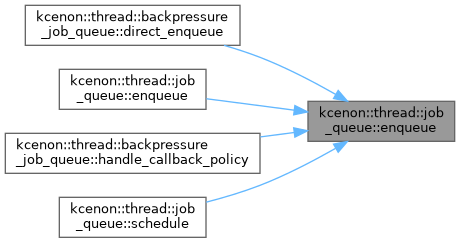
Referenced by kcenon::thread::backpressure_job_queue::direct_enqueue(), enqueue(), kcenon::thread::backpressure_job_queue::handle_callback_policy(), and schedule().
◆ enqueue() [2/2]
|
inlinenodiscard |
Type-safe enqueue for job subclasses.
This template method provides type-safe job submission, allowing callers to enqueue jobs without explicit casting. The JobType must be derived from the base job class.
- Template Parameters
-
JobType A type derived from job
- Parameters
-
value A unique pointer to the job being added.
- Returns
- A common::VoidResult indicating success or an error message.
Definition at line 149 of file job_queue.h.
References enqueue().

◆ enqueue_batch()
|
nodiscardvirtual |
Enqueues a batch of jobs into the queue.
Adds multiple jobs to the queue in a single operation.
- Parameters
-
jobs A vector of unique pointers to the jobs being added.
- Returns
- A common::VoidResult indicating success or an error message.
Implementation details:
- Validates queue state and input before any modifications
- Pre-validates all jobs to ensure atomicity (all or nothing)
- Uses single lock acquisition for entire batch (better performance)
- Moves all jobs efficiently without copying
- Only notifies once after all jobs are added (avoids notification spam)
Performance Benefits:
- Single mutex acquisition vs multiple for individual enqueues
- Single notification vs notification per job
- Reduced contention for high-throughput scenarios
Atomicity:
- Either all jobs are added or none are (on validation failure)
- No partial batches in case of null job detection
- Parameters
-
jobs Vector of unique pointers to jobs (moved into queue)
- Returns
- Empty result on success, error on failure
Reimplemented in kcenon::thread::backpressure_job_queue.
Definition at line 163 of file job_queue.cpp.
References kcenon::thread::invalid_argument, kcenon::thread::queue_full, and kcenon::thread::queue_stopped.
Referenced by kcenon::thread::backpressure_job_queue::enqueue_batch().

◆ get_capabilities()
|
inlinenodiscardoverridevirtual |
Returns capabilities of this job_queue implementation.
- Returns
- Queue capabilities struct describing this implementation.
job_queue provides:
- Exact size: size() returns precise count (mutex-protected)
- Atomic empty check: empty() is consistent (mutex-protected)
- Not lock-free: Uses mutex for synchronization
- Batch operations: Supports enqueue_batch/dequeue_batch
- Blocking wait: Supports blocking dequeue()
- Stop support: Supports stop() for graceful shutdown
Reimplemented from kcenon::thread::queue_capabilities_interface.
Definition at line 287 of file job_queue.h.
◆ get_max_size()
|
nodiscard |
Get the maximum queue size.
Gets the maximum queue size.
- Returns
- The maximum size, or std::nullopt if unlimited
Definition at line 594 of file job_queue.cpp.
References max_size_.
Referenced by kcenon::thread::backpressure_job_queue::get_pressure_ratio().

◆ get_memory_stats()
|
nodiscard |
Get memory footprint statistics for debugging and monitoring.
Implementation details:
- Estimates total memory used by jobs in queue
- Includes deque node overhead (platform-dependent)
- Assumes average job size for pointer storage
- Thread-safe operation using mutex
Memory Estimation:
- Job pointer: sizeof(std::unique_ptr<job>) per job
- Deque node: ~40 bytes overhead per node (typical for std::deque)
- Total = (pointer_size + node_overhead) * job_count
Use Cases:
- Detecting memory leaks (growing queue size)
- Monitoring queue memory pressure
- Setting memory-based thresholds for backpressure
- Returns
- Structure containing memory usage estimates
Definition at line 540 of file job_queue.cpp.
References mutex_, kcenon::thread::job_queue::memory_stats::node_overhead_bytes, kcenon::thread::job_queue::memory_stats::pending_job_count, queue_, and kcenon::thread::job_queue::memory_stats::queue_size_bytes.
◆ get_next_job()
|
inlineoverridevirtual |
scheduler_interface implementation: get next job
Implements kcenon::thread::scheduler_interface.
Definition at line 119 of file job_queue.h.
References dequeue().

◆ get_ptr()
|
nodiscard |
Obtains a std::shared_ptr that points to this queue instance.
Returns a shared pointer to this job_queue instance.
- Returns
- A shared pointer to the current
job_queueobject.
Because job_queue inherits from std::enable_shared_from_this, calling get_ptr() allows retrieving a shared_ptr<job_queue> from within member functions of job_queue.
Implementation details:
- Uses std::enable_shared_from_this to safely create shared_ptr
- Required for passing the queue to multiple threads safely
- Ensures proper lifetime management of the queue object
- Returns
- Shared pointer to this job_queue
Definition at line 56 of file job_queue.cpp.
◆ inspect_pending_jobs()
|
nodiscardvirtual |
Inspects pending jobs in the queue without removing them.
- Parameters
-
limit Maximum number of jobs to inspect (0 = all).
- Returns
- Vector of job_info for pending jobs.
Thread Safety:
- Acquires mutex for safe inspection
- Returns snapshot of current queue state
- No performance impact on normal queue operations
Use Cases:
- Diagnostics and monitoring
- Queue depth analysis
- Job wait time tracking
Implementation details:
- Thread-safe operation using mutex
- Creates job_info snapshots for each pending job
- Does not modify the queue (read-only inspection)
- Returns up to 'limit' jobs, or all if limit is 0
Performance Characteristics:
- O(min(limit, queue_size)) complexity
- Single lock acquisition for entire inspection
- Minimal overhead on normal queue operations
- Parameters
-
limit Maximum number of jobs to inspect (0 = all)
- Returns
- Vector of job_info for pending jobs
Definition at line 648 of file job_queue.cpp.
References kcenon::thread::info, kcenon::thread::diagnostics::job_info::job_id, and kcenon::thread::diagnostics::pending.
◆ is_bounded()
|
nodiscard |
Check if queue has a size limit.
Checks if the queue has a size limit.
- Returns
- true if max_size is set, false otherwise
- true if max_size is set, false if unlimited
Definition at line 584 of file job_queue.cpp.
References max_size_.
◆ is_full()
|
nodiscard |
Check if queue is at capacity.
Checks if the queue is at capacity.
- Returns
- true if queue is at max_size, false otherwise
- true if queue is at max_size (bounded and full), false otherwise
Definition at line 618 of file job_queue.cpp.
References atomic_size_, and max_size_.
◆ is_stopped()
|
nodiscard |
Checks if the queue is in a "stopped" state.
Checks if the queue has been stopped.
- Returns
trueif the queue is stopped,falseotherwise.
When stopped, worker threads are typically notified to cease waiting for new jobs. New jobs may still be enqueued, but it is up to the system design how they are handled in a stopped state.
Implementation details:
- Uses atomic load for thread-safe access
- When stopped, dequeue operations will fail instead of blocking
- Used to coordinate shutdown between producer and consumer threads
- Returns
- true if queue is stopped, false if active
Definition at line 68 of file job_queue.cpp.
References stop_.
◆ schedule()
|
inlineoverridevirtual |
scheduler_interface implementation: schedule a job
Implements kcenon::thread::scheduler_interface.
Definition at line 114 of file job_queue.h.
References enqueue().

◆ set_max_size()
| auto kcenon::thread::job_queue::set_max_size | ( | std::optional< std::size_t > | max_size | ) | -> void |
Set maximum queue size.
Sets the maximum queue size.
- Parameters
-
max_size New maximum size (std::nullopt for unlimited)
Note: This does not remove existing jobs if the queue is currently larger than the new max_size. It only affects future enqueue operations.
- Parameters
-
max_size New maximum size (std::nullopt for unlimited)
Definition at line 607 of file job_queue.cpp.
◆ set_notify()
| auto kcenon::thread::job_queue::set_notify | ( | bool | notify | ) | -> void |
Sets the 'notify' flag for this queue.
Controls whether enqueue operations notify waiting threads.
- Parameters
-
notify If true, signals that enqueue should notify waiting threads. Iffalse, jobs can still be enqueued, but waiting threads won't be automatically notified.
Implementation details:
- Uses atomic store for thread-safe modification
- When false, enqueue won't wake up threads waiting in dequeue()
- Useful for batch operations to avoid excessive notifications
- Default is true (notifications enabled)
- Parameters
-
notify true to enable notifications, false to disable
Definition at line 81 of file job_queue.cpp.
◆ size()
|
nodiscard |
Returns the current number of jobs in the queue.
- Returns
- The number of pending jobs.
- Note
- This method is thread-safe.
Implementation details:
- Thread-safe read operation using mutex
- Snapshot in time (may change immediately after call)
- O(1) operation for std::deque
- Note
- Result may be stale by the time caller uses it in multi-threaded environment
- Returns
- Number of jobs currently in the queue
Definition at line 514 of file job_queue.cpp.
Referenced by kcenon::thread::backpressure_job_queue::get_pressure_ratio(), and kcenon::thread::backpressure_job_queue::to_string().

◆ stop()
| auto kcenon::thread::job_queue::stop | ( | void | ) | -> void |
Signals the queue to stop waiting for new jobs (e.g., during shutdown).
Signals the queue to stop accepting jobs and wake waiting threads.
Sets the stop_ flag to true and notifies any threads that might be blocked in dequeue(). This allows worker threads to exit gracefully rather than remain blocked indefinitely.
This method provides a consistent API with thread_pool and thread_base classes.
Implementation details:
- Sets atomic stop flag to prevent new enqueue operations
- Wakes all threads waiting in dequeue() operations
- Those threads will then return with error instead of blocking
- Used for coordinated shutdown of producer-consumer systems
Shutdown Sequence:
- Set stop flag (prevents new jobs)
- Notify all waiting consumers
- Waiting dequeue() calls return with error
- Threads can then complete their shutdown process
Thread Safety:
- Safe to call from any thread
- Idempotent operation (safe to call multiple times)
Definition at line 489 of file job_queue.cpp.
◆ to_string()
|
nodiscardvirtual |
Returns a string representation of this job_queue.
Provides a string representation of the queue's current state.
- Returns
- A std::string describing the state of the queue (e.g., size, flags).
Primarily used for logging and debugging. Derived classes may override this to include additional diagnostic information.
Implementation details:
- Uses size() method to get current job count
- Formats output using the formatter utility
- Useful for logging and debugging purposes
- Returns
- Formatted string showing current job count
Reimplemented in kcenon::thread::backpressure_job_queue.
Definition at line 570 of file job_queue.cpp.
References utility_module::formatter::format().

◆ try_dequeue()
|
nodiscardvirtual |
Attempts to dequeue a job from the queue without blocking.
Attempts to dequeue a job without blocking (non-blocking operation).
- Returns
- A common::Result<std::unique_ptr<job>> containing either a valid job or an error object.
If the queue is empty, this method returns immediately with an error instead of blocking. This is useful for polling-based consumers.
Implementation details:
- Never blocks, returns immediately regardless of queue state
- Returns error if queue is empty (vs blocking in dequeue())
- Uses scoped_lock for quick queue access and release
- Ideal for polling-based consumers or timeout-based operations
Performance Benefits:
- No condition variable overhead
- No thread blocking/unblocking costs
- Suitable for high-frequency polling scenarios
Use Cases:
- Non-blocking consumer threads
- Timeout-based dequeue operations
- Testing scenarios where blocking is undesirable
- Returns
- Unique pointer to job on success, error if queue empty/stopped
Definition at line 296 of file job_queue.cpp.
References kcenon::thread::queue_empty, and kcenon::thread::queue_stopped.
Member Data Documentation
◆ atomic_size_
|
private |
◆ condition_
|
protected |
Condition variable used to signal worker threads.
Used in combination with mutex_ to block or notify threads waiting for new jobs.
Definition at line 379 of file job_queue.h.
◆ max_size_
|
private |
Optional maximum queue size.
If set, enqueue operations will fail when the queue reaches this size. std::nullopt means unlimited size (default behavior).
Definition at line 397 of file job_queue.h.
Referenced by get_max_size(), is_bounded(), and is_full().
◆ mutex_
|
mutableprotected |
Mutex to protect access to the underlying queue_ container and related state.
Any operation that modifies or reads the queue should lock this mutex to ensure thread safety.
Definition at line 371 of file job_queue.h.
Referenced by get_memory_stats().
◆ notify_
|
protected |
If true, threads waiting for new jobs are notified when a new job is enqueued. If false, enqueuing does not automatically trigger a notification.
Definition at line 355 of file job_queue.h.
◆ queue_
|
private |
The underlying container storing the jobs in FIFO order.
- Note
- This container is guarded by
mutex_and should only be modified while holding the lock. The size of this container should be the only source of truth for the queue size to prevent inconsistencies.
Definition at line 389 of file job_queue.h.
Referenced by get_memory_stats().
◆ stop_
|
protected |
Indicates whether the queue has been signaled to stop.
Setting stop_ to true typically causes waiting threads to unblock and exit their waiting loop.
Definition at line 363 of file job_queue.h.
Referenced by is_stopped().
The documentation for this class was generated from the following files:
- include/kcenon/thread/core/job_queue.h
- src/core/job_queue.cpp