Namespaces | |
| namespace | compression |
| namespace | simd |
Classes | |
| struct | character_set_info |
| Information about a DICOM character set. More... | |
| class | explicit_vr_big_endian_codec |
| Encoder/decoder for Explicit VR Big Endian transfer syntax. More... | |
| class | explicit_vr_codec |
| Encoder/decoder for Explicit VR Little Endian transfer syntax. More... | |
| class | implicit_vr_codec |
| Encoder/decoder for Implicit VR Little Endian transfer syntax. More... | |
| struct | specific_character_set |
| Parsed representation of a multi-valued Specific Character Set. More... | |
| struct | text_segment |
| A text segment with its associated character set. More... | |
| class | transfer_syntax |
| Represents a DICOM Transfer Syntax. More... | |
| struct | vr_info |
| Metadata structure containing comprehensive VR properties. More... | |
Enumerations | |
| enum class | byte_order { little_endian , big_endian } |
| Byte ordering for DICOM data encoding. More... | |
| enum class | vr_encoding { implicit , explicit_vr } |
| Value Representation encoding mode. More... | |
| enum class | vr_type : uint16_t { AE = 0x4145 , AS = 0x4153 , CS = 0x4353 , DA = 0x4441 , DS = 0x4453 , DT = 0x4454 , IS = 0x4953 , LO = 0x4C4F , LT = 0x4C54 , PN = 0x504E , SH = 0x5348 , ST = 0x5354 , TM = 0x544D , UC = 0x5543 , UI = 0x5549 , UR = 0x5552 , UT = 0x5554 , FL = 0x464C , FD = 0x4644 , SL = 0x534C , SS = 0x5353 , UL = 0x554C , US = 0x5553 , OB = 0x4F42 , OD = 0x4F44 , OF = 0x4F46 , OL = 0x4F4C , OV = 0x4F56 , OW = 0x4F57 , UN = 0x554E , AT = 0x4154 , SQ = 0x5351 , SV = 0x5356 , UV = 0x5556 } |
| DICOM Value Representation (VR) types. More... | |
Functions | |
| std::string | get_decoded_string (const core::dicom_dataset &ds, core::dicom_tag tag, std::string_view default_value="") |
| Get a string value from dataset, decoded to UTF-8. | |
| void | set_encoded_string (core::dicom_dataset &ds, core::dicom_tag tag, vr_type vr, std::string_view utf8_value) |
| Set a string value in dataset, encoding from UTF-8. | |
Single Value Byte Swapping | |
| constexpr uint16_t | byte_swap16 (uint16_t value) noexcept |
| Swaps bytes in a 16-bit value. | |
| constexpr uint32_t | byte_swap32 (uint32_t value) noexcept |
| Swaps bytes in a 32-bit value. | |
| constexpr uint64_t | byte_swap64 (uint64_t value) noexcept |
| Swaps bytes in a 64-bit value. | |
Big Endian Read/Write Functions | |
| constexpr uint16_t | read_be16 (const uint8_t *data) noexcept |
| Reads a 16-bit value from big-endian bytes. | |
| constexpr uint32_t | read_be32 (const uint8_t *data) noexcept |
| Reads a 32-bit value from big-endian bytes. | |
| constexpr uint64_t | read_be64 (const uint8_t *data) noexcept |
| Reads a 64-bit value from big-endian bytes. | |
| void | write_be16 (std::vector< uint8_t > &buffer, uint16_t value) |
| Writes a 16-bit value in big-endian byte order. | |
| void | write_be32 (std::vector< uint8_t > &buffer, uint32_t value) |
| Writes a 32-bit value in big-endian byte order. | |
| void | write_be64 (std::vector< uint8_t > &buffer, uint64_t value) |
| Writes a 64-bit value in big-endian byte order. | |
Bulk Byte Swapping for VR Types | |
| std::vector< uint8_t > | swap_ow_bytes (std::span< const uint8_t > data) |
| Swaps bytes in-place for OW (Other Word) data. | |
| std::vector< uint8_t > | swap_ol_bytes (std::span< const uint8_t > data) |
| Swaps bytes in-place for OL (Other Long) data. | |
| std::vector< uint8_t > | swap_of_bytes (std::span< const uint8_t > data) |
| Swaps bytes in-place for OF (Other Float) data. | |
| std::vector< uint8_t > | swap_od_bytes (std::span< const uint8_t > data) |
| Swaps bytes in-place for OD (Other Double) data. | |
| std::vector< uint8_t > | swap_at_bytes (std::span< const uint8_t > data) |
| Swaps bytes for AT (Attribute Tag) data. | |
Numeric Value Byte Swapping | |
| std::vector< uint8_t > | swap_us_bytes (std::span< const uint8_t > data) |
| Swaps bytes for US (Unsigned Short) value in raw data. | |
| std::vector< uint8_t > | swap_ss_bytes (std::span< const uint8_t > data) |
| Swaps bytes for SS (Signed Short) value in raw data. | |
| std::vector< uint8_t > | swap_ul_bytes (std::span< const uint8_t > data) |
| Swaps bytes for UL (Unsigned Long) value in raw data. | |
| std::vector< uint8_t > | swap_sl_bytes (std::span< const uint8_t > data) |
| Swaps bytes for SL (Signed Long) value in raw data. | |
| std::vector< uint8_t > | swap_fl_bytes (std::span< const uint8_t > data) |
| Swaps bytes for FL (Float) value in raw data. | |
| std::vector< uint8_t > | swap_fd_bytes (std::span< const uint8_t > data) |
| Swaps bytes for FD (Double) value in raw data. | |
Character Set Registry | |
| const character_set_info * | find_character_set (std::string_view defined_term) noexcept |
| Look up character set info by DICOM Defined Term. | |
| const character_set_info * | find_character_set_by_ir (int iso_ir_number) noexcept |
| Look up character set info by ISO-IR number. | |
| const character_set_info & | default_character_set () noexcept |
| Get the default character set (ISO-IR 6, ASCII). | |
| std::vector< const character_set_info * > | all_character_sets () noexcept |
| Get all registered character sets. | |
Specific Character Set Parsing | |
| specific_character_set | parse_specific_character_set (std::string_view value) |
| Parse a Specific Character Set (0008,0005) value. | |
ISO 2022 Escape Sequence Detection | |
| std::vector< text_segment > | split_by_escape_sequences (std::string_view text, const specific_character_set &scs) |
| Split a string into segments by ISO 2022 escape sequences. | |
String Decoding | |
| std::string | decode_to_utf8 (std::string_view text, const specific_character_set &scs) |
| Decode a DICOM string to UTF-8 using the given character set. | |
| std::string | convert_to_utf8 (std::string_view text, const character_set_info &charset) |
| Decode a single segment from a specific encoding to UTF-8. | |
| std::string | decode_person_name (std::string_view pn_value, const specific_character_set &scs) |
| Decode a Person Name (PN) value to UTF-8. | |
| std::string | encode_from_utf8 (std::string_view utf8_text, const specific_character_set &scs) |
| Encode a UTF-8 string to the target character set encoding. | |
| std::string | convert_from_utf8 (std::string_view utf8_text, const character_set_info &charset) |
| Encode a single UTF-8 segment to a specific character set. | |
Registry Functions | |
| std::optional< transfer_syntax > | find_transfer_syntax (std::string_view uid) |
| Looks up a Transfer Syntax by its UID. | |
| std::vector< transfer_syntax > | supported_transfer_syntaxes () |
| Returns a list of all supported Transfer Syntaxes. | |
| std::vector< transfer_syntax > | all_transfer_syntaxes () |
| Returns a list of all known Transfer Syntaxes. | |
VR Information Lookup | |
| const vr_info & | get_vr_info (vr_type vr) |
| Retrieves comprehensive metadata for a VR type. | |
Value Validation Functions | |
| bool | validate_value (vr_type vr, std::span< const uint8_t > data) |
| Validates binary data against VR encoding rules. | |
| bool | validate_string (vr_type vr, std::string_view value) |
| Validates a string value against VR encoding rules. | |
Padding Utilities | |
| std::vector< uint8_t > | pad_to_even (vr_type vr, std::span< const uint8_t > data) |
| Pads data to even length as required by DICOM. | |
| std::string | trim_padding (vr_type vr, std::string_view value) |
| Removes trailing padding characters from a string value. | |
Character Set Validation | |
| bool | is_valid_charset (vr_type vr, std::string_view value) |
| Validates that a string uses only allowed characters for its VR. | |
String Conversion Functions | |
| constexpr std::string_view | to_string (vr_type vr) noexcept |
| Converts a vr_type to its two-character string representation. | |
| constexpr std::optional< vr_type > | from_string (std::string_view str) noexcept |
| Parses a two-character string to a vr_type. | |
VR Category Classification Functions | |
| constexpr bool | is_string_vr (vr_type vr) noexcept |
| Checks if a VR is a string type. | |
| constexpr bool | is_binary_vr (vr_type vr) noexcept |
| Checks if a VR is a binary/raw byte type. | |
| constexpr bool | is_numeric_vr (vr_type vr) noexcept |
| Checks if a VR is a numeric type. | |
| constexpr bool | has_explicit_32bit_length (vr_type vr) noexcept |
| Checks if a VR requires 32-bit length field in Explicit VR encoding. | |
Additional VR Utility Functions | |
| constexpr std::size_t | fixed_length (vr_type vr) noexcept |
| Gets the fixed size of a VR if applicable. | |
| constexpr bool | is_fixed_length (vr_type vr) noexcept |
| Checks if a VR has a fixed length. | |
| constexpr char | padding_char (vr_type vr) noexcept |
| Gets the padding character for a VR. | |
Enumeration Type Documentation
◆ byte_order
|
strong |
Byte ordering for DICOM data encoding.
DICOM supports both little-endian and big-endian byte ordering. Little-endian is the most common and is used by default in DICOM.
| Enumerator | |
|---|---|
| little_endian | Least significant byte first (most common) |
| big_endian | Most significant byte first (legacy, rarely used) |
Definition at line 22 of file byte_order.h.
◆ vr_encoding
|
strong |
Value Representation encoding mode.
Determines whether VR (Value Representation) is explicitly encoded in the data stream or implicitly determined from the tag.
| Enumerator | |
|---|---|
| implicit | VR determined from data dictionary lookup. |
| explicit_vr | VR explicitly encoded in the data stream. |
Definition at line 33 of file byte_order.h.
◆ vr_type
|
strong |
DICOM Value Representation (VR) types.
Value Representation specifies the data type and format of the data element value. Each VR is encoded as two ASCII characters (e.g., "PN" for Person Name). The enum values are the uint16_t representation of these two ASCII characters.
- See also
- DICOM PS3.5 Section 6.2 - Value Representation (VR)
Definition at line 29 of file vr_type.h.
Function Documentation
◆ all_character_sets()
|
nodiscardnoexcept |
Get all registered character sets.
- Returns
- Vector of pointers to all registered character_set_info entries
Definition at line 436 of file character_set.cpp.
◆ all_transfer_syntaxes()
|
nodiscard |
Returns a list of all known Transfer Syntaxes.
- Returns
- Vector of all registered transfer_syntax instances
Definition at line 394 of file transfer_syntax.cpp.
◆ byte_swap16()
|
nodiscardconstexprnoexcept |
Swaps bytes in a 16-bit value.
- Parameters
-
value The value to swap
- Returns
- The byte-swapped value
Example: 0x1234 -> 0x3412
Definition at line 40 of file byte_swap.h.
◆ byte_swap32()
|
nodiscardconstexprnoexcept |
Swaps bytes in a 32-bit value.
- Parameters
-
value The value to swap
- Returns
- The byte-swapped value
Example: 0x12345678 -> 0x78563412
Definition at line 51 of file byte_swap.h.
◆ byte_swap64()
|
nodiscardconstexprnoexcept |
Swaps bytes in a 64-bit value.
- Parameters
-
value The value to swap
- Returns
- The byte-swapped value
Example: 0x123456789ABCDEF0 -> 0xF0DEBC9A78563412
Definition at line 65 of file byte_swap.h.
◆ convert_from_utf8()
|
nodiscard |
Encode a single UTF-8 segment to a specific character set.
- Parameters
-
utf8_text The UTF-8 encoded source string charset The target character set
- Returns
- Encoded string in the target encoding
Definition at line 684 of file character_set.cpp.
References kcenon::pacs::encoding::character_set_info::encoding_name.
Referenced by encode_from_utf8().

◆ convert_to_utf8()
|
nodiscard |
Decode a single segment from a specific encoding to UTF-8.
- Parameters
-
text The raw bytes in the source encoding charset The character set of the source bytes
- Returns
- UTF-8 encoded string
Uses ICU (ucnv_convert) for encoding conversion. Falls back to raw bytes if conversion fails.
Definition at line 589 of file character_set.cpp.
References kcenon::pacs::encoding::character_set_info::encoding_name.
Referenced by decode_to_utf8().

◆ decode_person_name()
|
nodiscard |
Decode a Person Name (PN) value to UTF-8.
- Parameters
-
pn_value The raw PN value (may contain '=' component group separators) scs The Specific Character Set configuration
- Returns
- UTF-8 encoded Person Name string
PN values have up to three component groups separated by '=':
- Alphabetic (single-byte)
- Ideographic (multi-byte, e.g., kanji/hangul)
- Phonetic (single-byte, e.g., romaji/jamo)
Each component group is decoded independently.
Definition at line 641 of file character_set.cpp.
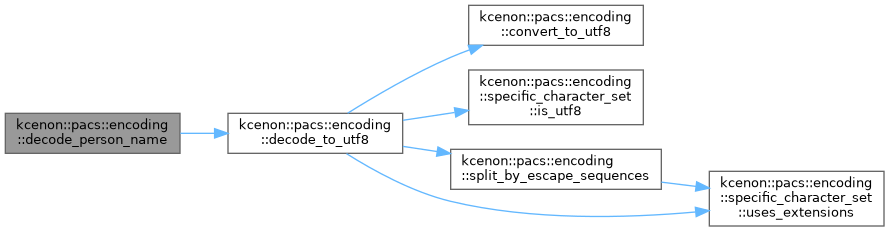
References decode_to_utf8().
◆ decode_to_utf8()
|
nodiscard |
Decode a DICOM string to UTF-8 using the given character set.
- Parameters
-
text The raw DICOM string bytes scs The Specific Character Set configuration
- Returns
- UTF-8 encoded string
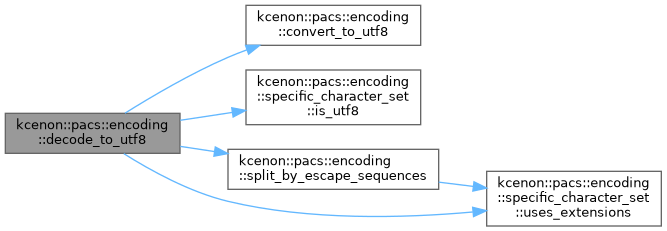
This is the main entry point for character set conversion. It:
- Checks if conversion is needed (UTF-8 passthrough)
- Splits text by escape sequences (if ISO 2022)
- Converts each segment to UTF-8
- Concatenates the results
If conversion fails for any segment, the raw bytes are passed through.
Definition at line 606 of file character_set.cpp.
References convert_to_utf8(), kcenon::pacs::encoding::specific_character_set::default_set, kcenon::pacs::encoding::specific_character_set::is_utf8(), split_by_escape_sequences(), and kcenon::pacs::encoding::specific_character_set::uses_extensions().
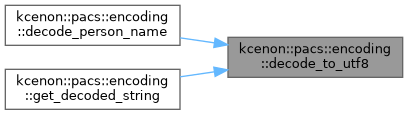
Referenced by decode_person_name(), and get_decoded_string().
◆ default_character_set()
|
nodiscardnoexcept |
Get the default character set (ISO-IR 6, ASCII).
- Returns
- Reference to the ASCII character set info
Definition at line 431 of file character_set.cpp.
Referenced by parse_specific_character_set().

◆ encode_from_utf8()
|
nodiscard |
Encode a UTF-8 string to the target character set encoding.
- Parameters
-
utf8_text The UTF-8 encoded source string scs The Specific Character Set configuration
- Returns
- Encoded string with ISO 2022 escape sequences if needed
This is the reverse of decode_to_utf8(). It converts a UTF-8 string to the encoding specified by the Specific Character Set, inserting ISO 2022 escape sequences as appropriate for CJK text.
If the charset is UTF-8, the input is returned unchanged. If conversion fails, the raw UTF-8 bytes are returned as-is.
Definition at line 700 of file character_set.cpp.
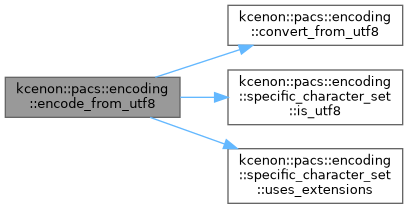
References convert_from_utf8(), kcenon::pacs::encoding::specific_character_set::default_set, kcenon::pacs::encoding::character_set_info::escape_sequence, kcenon::pacs::encoding::specific_character_set::extension_sets, kcenon::pacs::encoding::specific_character_set::is_utf8(), and kcenon::pacs::encoding::specific_character_set::uses_extensions().
Referenced by set_encoded_string().

◆ find_character_set()
|
nodiscardnoexcept |
Look up character set info by DICOM Defined Term.
- Parameters
-
defined_term The DICOM Defined Term (e.g., "ISO 2022 IR 149", "ISO_IR 100")
- Returns
- Pointer to character_set_info, or nullptr if not found
Supports both forms: "ISO_IR 100" (without code extensions) and "ISO 2022 IR 149" (with code extensions).
Definition at line 421 of file character_set.cpp.
◆ find_character_set_by_ir()
|
nodiscardnoexcept |
Look up character set info by ISO-IR number.
- Parameters
-
iso_ir_number The ISO-IR number (e.g., 149, 87, 100)
- Returns
- Pointer to character_set_info, or nullptr if not found
Definition at line 426 of file character_set.cpp.
◆ find_transfer_syntax()
|
nodiscard |
Looks up a Transfer Syntax by its UID.
Allow registry functions to use private constructor.
- Parameters
-
uid The Transfer Syntax UID to search for
- Returns
- The transfer_syntax if found, std::nullopt otherwise
Definition at line 371 of file transfer_syntax.cpp.
◆ fixed_length()
|
nodiscardconstexprnoexcept |
Gets the fixed size of a VR if applicable.
- Parameters
-
vr The VR type to check
- Returns
- The fixed size in bytes, or 0 if the VR has variable length
Fixed-length VRs have a predetermined size regardless of value.
Definition at line 260 of file vr_type.h.
References AT, FD, FL, SL, SS, SV, UL, US, UV, and vr.
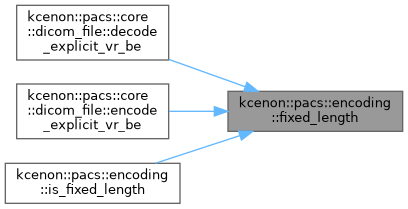
Referenced by kcenon::pacs::core::dicom_file::decode_explicit_vr_be(), kcenon::pacs::core::dicom_file::encode_explicit_vr_be(), and is_fixed_length().
◆ from_string()
|
nodiscardconstexprnoexcept |
Parses a two-character string to a vr_type.
- Parameters
-
str The string to parse (must be exactly 2 characters)
- Returns
- The corresponding vr_type, or std::nullopt if not recognized
Definition at line 132 of file vr_type.h.
References AE, AS, AT, code, CS, DA, DS, DT, FD, FL, IS, LO, LT, OB, OD, OF, OL, OV, OW, PN, SH, SL, SQ, SS, ST, SV, TM, UC, UI, UL, UN, UR, US, UT, and UV.
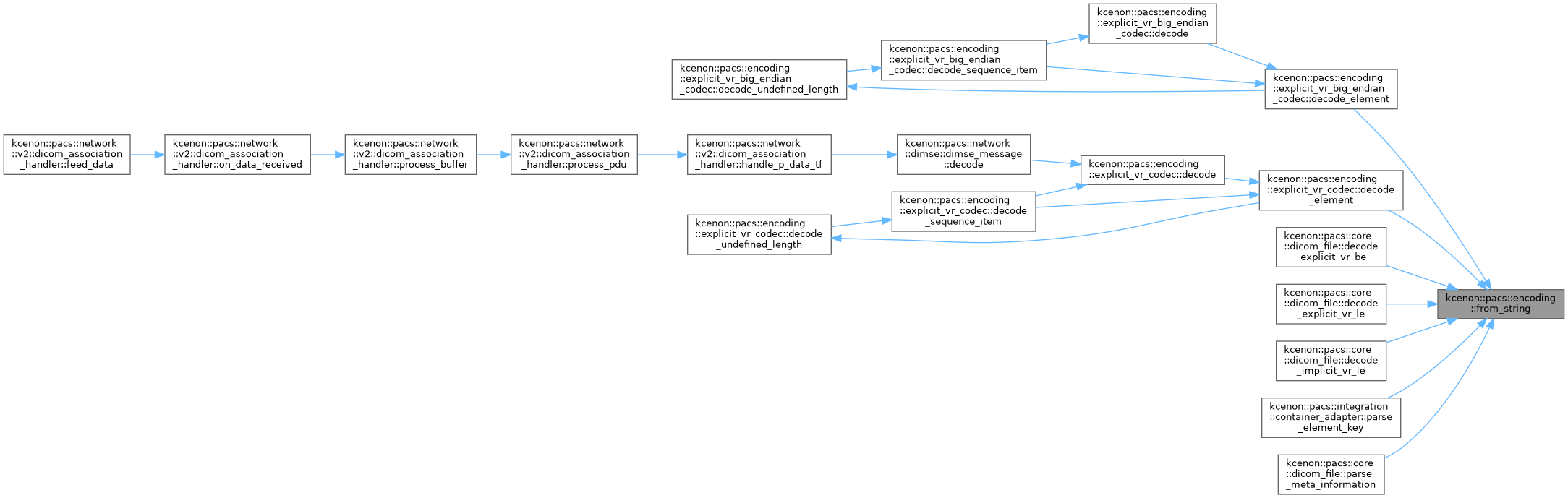
Referenced by kcenon::pacs::encoding::explicit_vr_big_endian_codec::decode_element(), kcenon::pacs::encoding::explicit_vr_codec::decode_element(), kcenon::pacs::core::dicom_file::decode_explicit_vr_be(), kcenon::pacs::core::dicom_file::decode_explicit_vr_le(), kcenon::pacs::core::dicom_file::decode_implicit_vr_le(), kcenon::pacs::integration::container_adapter::parse_element_key(), and kcenon::pacs::core::dicom_file::parse_meta_information().
◆ get_decoded_string()
|
nodiscard |
Get a string value from dataset, decoded to UTF-8.
- Parameters
-
ds The DICOM dataset to read from tag The DICOM tag to look up default_value Value to return if element not found
- Returns
- UTF-8 decoded string value, or default_value if not found
Looks up Specific Character Set (0008,0005) in the dataset and uses it to decode the raw string bytes to UTF-8. If no Specific Character Set is present, ASCII decoding is assumed (raw passthrough).
Definition at line 16 of file dataset_charset.cpp.
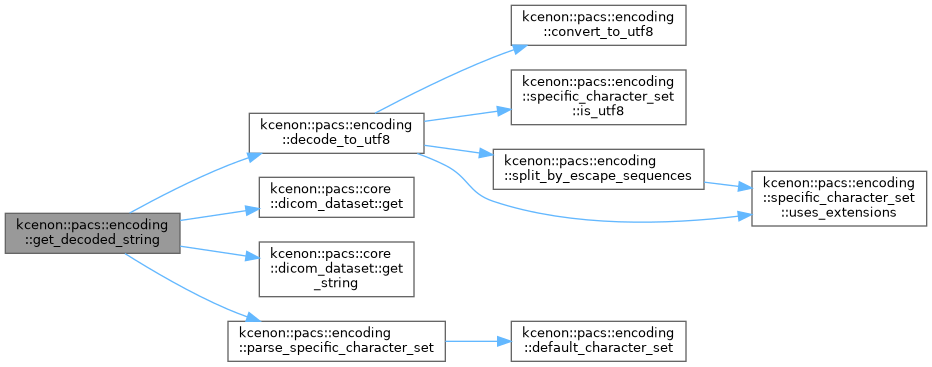
References decode_to_utf8(), kcenon::pacs::core::dicom_dataset::get(), kcenon::pacs::core::dicom_dataset::get_string(), parse_specific_character_set(), and kcenon::pacs::core::tags::specific_character_set.
◆ get_vr_info()
Retrieves comprehensive metadata for a VR type.
- Parameters
-
vr The VR type to look up
- Returns
- Reference to vr_info structure containing VR properties
This function provides all properties needed for encoding/decoding operations, including name, maximum length, padding requirements, and fixed/variable length information.
- Note
- Returns info for vr_type::UN if an unknown VR is provided.
Definition at line 131 of file vr_info.cpp.
References vr.
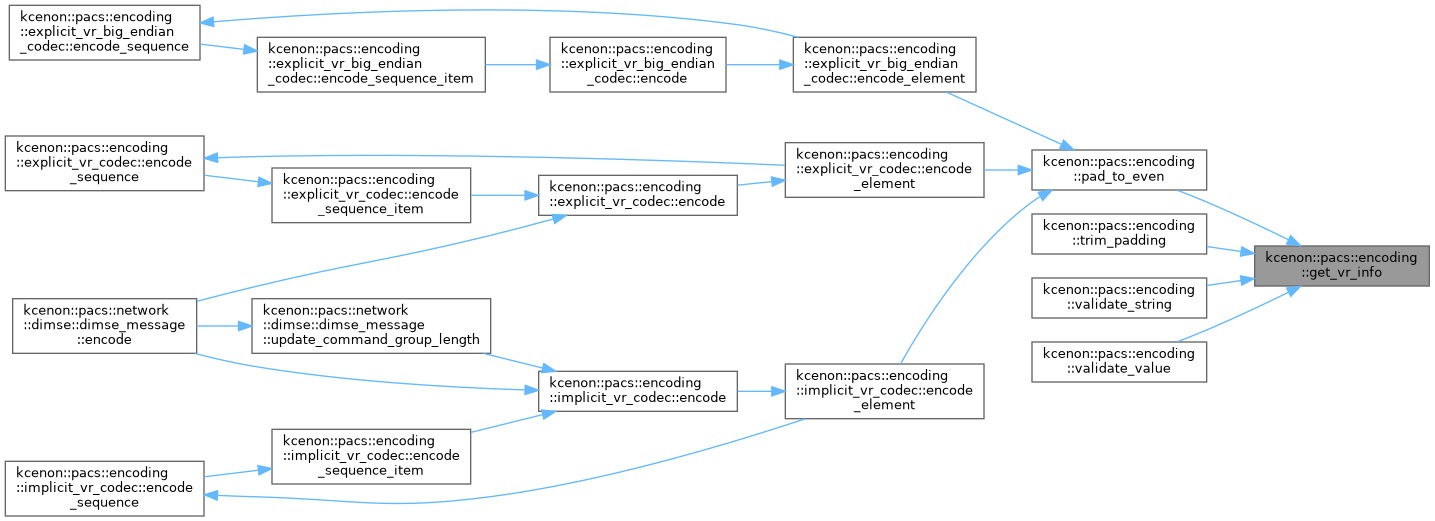
Referenced by pad_to_even(), trim_padding(), validate_string(), and validate_value().
◆ has_explicit_32bit_length()
|
nodiscardconstexprnoexcept |
Checks if a VR requires 32-bit length field in Explicit VR encoding.
- Parameters
-
vr The VR type to check
- Returns
- true if the VR requires extended 32-bit length encoding
In Explicit VR encoding, these VRs have a 2-byte reserved field followed by a 4-byte length field, instead of a 2-byte length field.
- See also
- DICOM PS3.5 Section 7.1.2 - Data Element Structure with Explicit VR
Definition at line 235 of file vr_type.h.
References OB, OD, OF, OL, OV, OW, SQ, SV, UC, UN, UR, UT, UV, and vr.
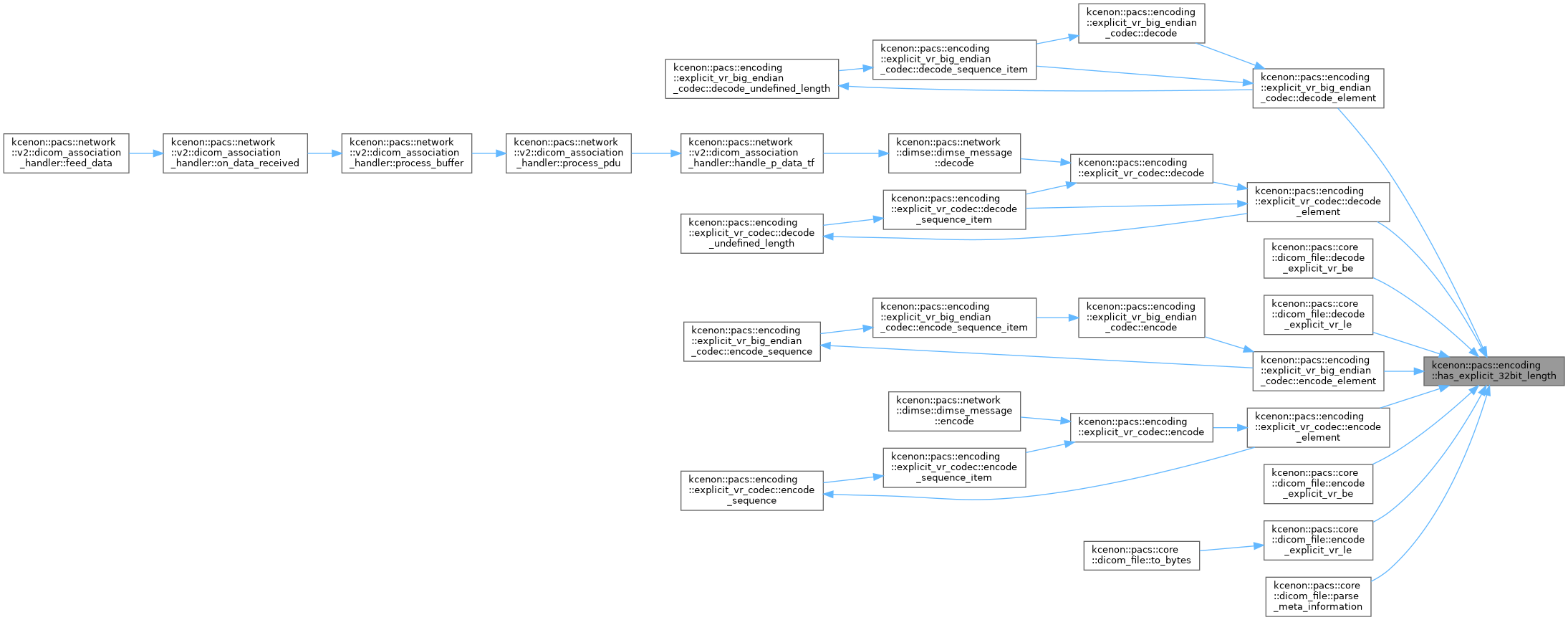
Referenced by kcenon::pacs::encoding::explicit_vr_big_endian_codec::decode_element(), kcenon::pacs::encoding::explicit_vr_codec::decode_element(), kcenon::pacs::core::dicom_file::decode_explicit_vr_be(), kcenon::pacs::core::dicom_file::decode_explicit_vr_le(), kcenon::pacs::encoding::explicit_vr_big_endian_codec::encode_element(), kcenon::pacs::encoding::explicit_vr_codec::encode_element(), kcenon::pacs::core::dicom_file::encode_explicit_vr_be(), kcenon::pacs::core::dicom_file::encode_explicit_vr_le(), and kcenon::pacs::core::dicom_file::parse_meta_information().
◆ is_binary_vr()
|
nodiscardconstexprnoexcept |
Checks if a VR is a binary/raw byte type.
- Parameters
-
vr The VR type to check
- Returns
- true if the VR represents raw binary data
Binary VRs include OB, OD, OF, OL, OV, OW, and UN.
Definition at line 196 of file vr_type.h.
References OB, OD, OF, OL, OV, OW, UN, and vr.
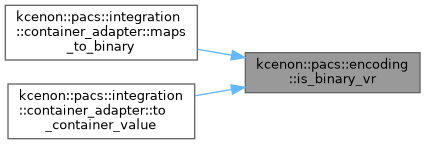
Referenced by kcenon::pacs::integration::container_adapter::maps_to_binary(), and kcenon::pacs::integration::container_adapter::to_container_value().
◆ is_fixed_length()
|
nodiscardconstexprnoexcept |
Checks if a VR has a fixed length.
- Parameters
-
vr The VR type to check
- Returns
- true if the VR has a fixed length
Definition at line 280 of file vr_type.h.
References fixed_length(), and vr.

◆ is_numeric_vr()
|
nodiscardconstexprnoexcept |
Checks if a VR is a numeric type.
- Parameters
-
vr The VR type to check
- Returns
- true if the VR represents numeric data (binary encoded)
Numeric VRs include FL, FD, SL, SS, SV, UL, US, UV.
Definition at line 214 of file vr_type.h.
References FD, FL, SL, SS, SV, UL, US, UV, and vr.
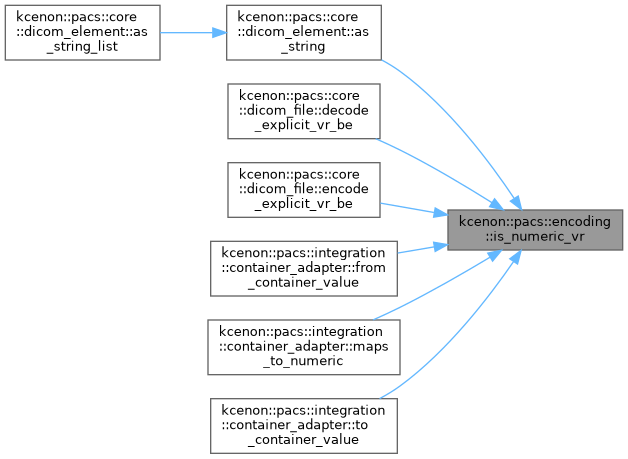
Referenced by kcenon::pacs::core::dicom_element::as_string(), kcenon::pacs::core::dicom_file::decode_explicit_vr_be(), kcenon::pacs::core::dicom_file::encode_explicit_vr_be(), kcenon::pacs::integration::container_adapter::from_container_value(), kcenon::pacs::integration::container_adapter::maps_to_numeric(), and kcenon::pacs::integration::container_adapter::to_container_value().
◆ is_string_vr()
|
nodiscardconstexprnoexcept |
Checks if a VR is a string type.
- Parameters
-
vr The VR type to check
- Returns
- true if the VR represents string/text data
String VRs contain character data that may need padding with spaces.
Definition at line 175 of file vr_type.h.
References AE, AS, CS, DA, DS, DT, IS, LO, LT, PN, SH, ST, TM, UC, UI, UR, UT, and vr.
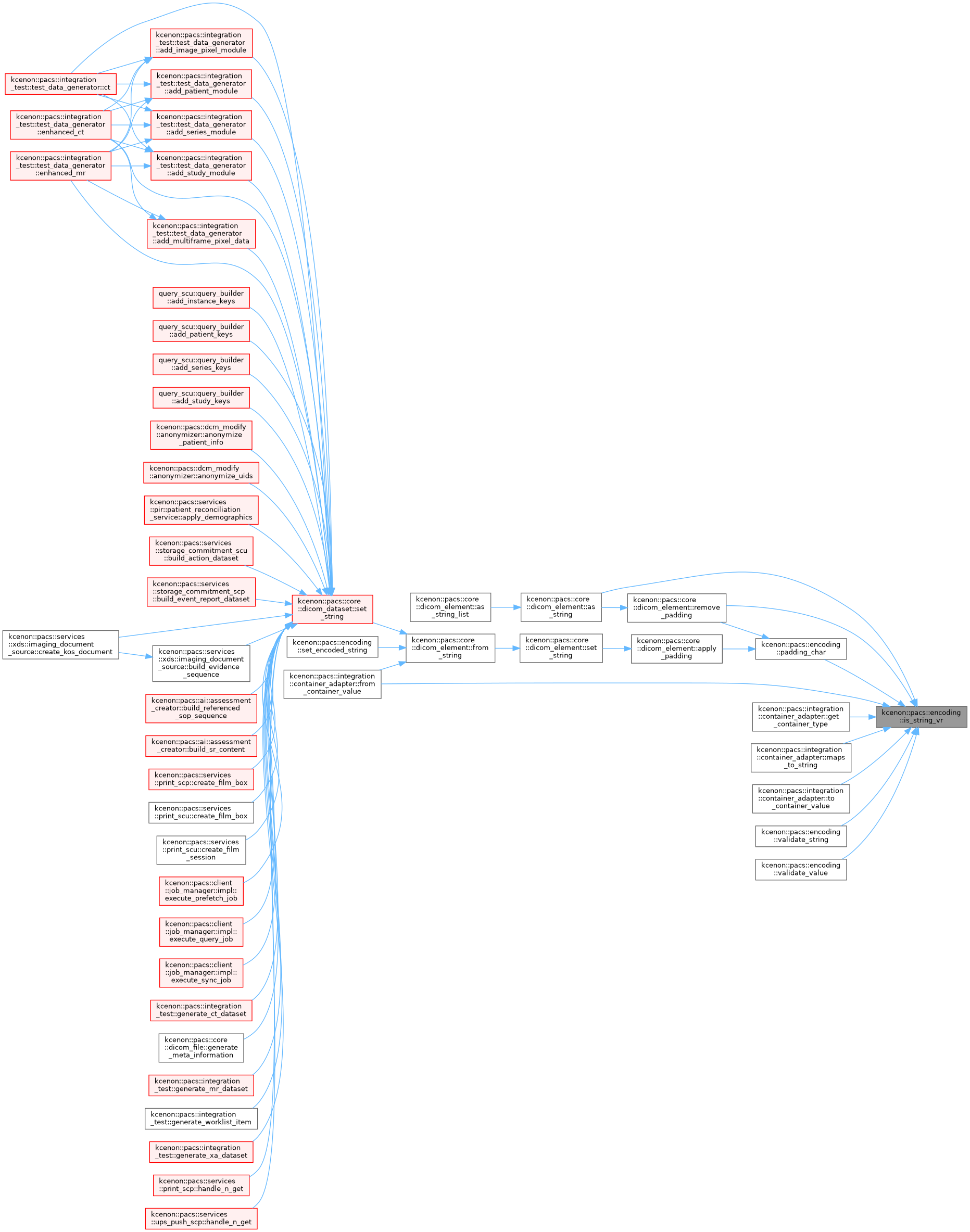
Referenced by kcenon::pacs::core::dicom_element::as_string(), kcenon::pacs::integration::container_adapter::from_container_value(), kcenon::pacs::integration::container_adapter::get_container_type(), kcenon::pacs::integration::container_adapter::maps_to_string(), padding_char(), kcenon::pacs::core::dicom_element::remove_padding(), kcenon::pacs::integration::container_adapter::to_container_value(), validate_string(), and validate_value().
◆ is_valid_charset()
|
nodiscard |
Validates that a string uses only allowed characters for its VR.
- Parameters
-
vr The VR type value The string to validate
- Returns
- true if all characters are valid for the VR
Character restrictions by VR type:
- CS: A-Z, 0-9, space, underscore
- DA: 0-9 only (YYYYMMDD format)
- TM: 0-9, period, colon
- UI: 0-9, period
- DS: 0-9, +, -, ., E, e, space
- IS: 0-9, +, -
- AS: 0-9, D, W, M, Y
- Other string VRs: All printable characters
Definition at line 225 of file vr_info.cpp.
References AE, AS, CS, DA, DS, DT, IS, LO, LT, PN, SH, ST, TM, UC, UI, UR, UT, and vr.
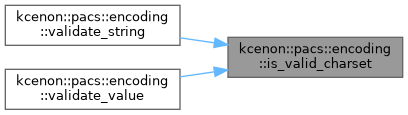
Referenced by validate_string(), and validate_value().
◆ pad_to_even()
|
nodiscard |
Pads data to even length as required by DICOM.
- Parameters
-
vr The VR type (determines padding character) data The data to pad
- Returns
- A new vector with even-length data
DICOM requires all data element values to have even length. This function adds the appropriate padding character if needed:
- Space (' ') for most string VRs
- Null ('\0') for UI and binary VRs
- See also
- DICOM PS3.5 Section 7.1.1 - DICOM Data Element Structure
Definition at line 196 of file vr_info.cpp.
References get_vr_info(), and vr.
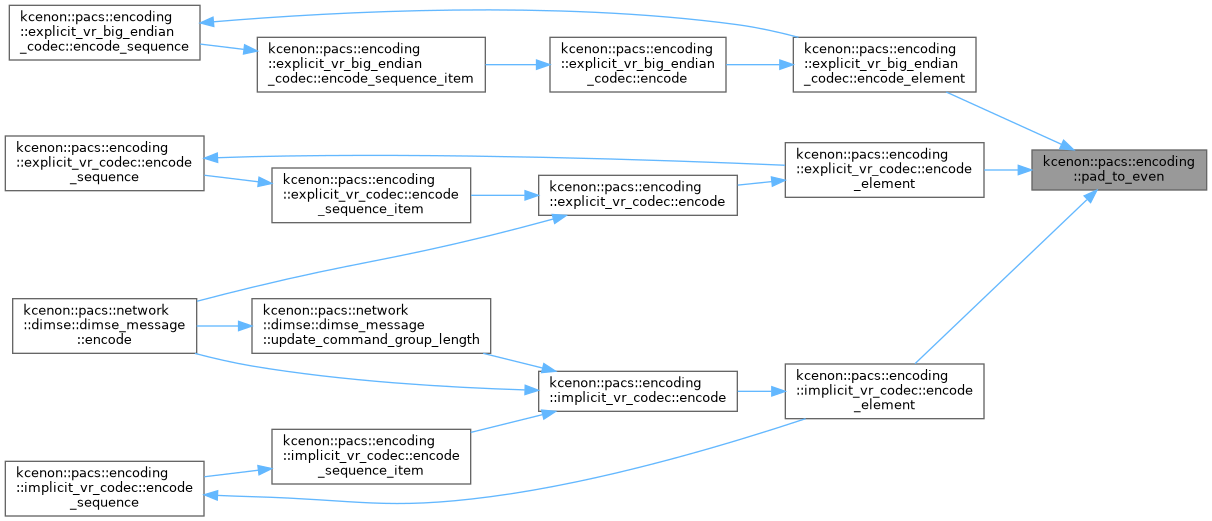
Referenced by kcenon::pacs::encoding::explicit_vr_big_endian_codec::encode_element(), kcenon::pacs::encoding::explicit_vr_codec::encode_element(), and kcenon::pacs::encoding::implicit_vr_codec::encode_element().

◆ padding_char()
|
nodiscardconstexprnoexcept |
Gets the padding character for a VR.
- Parameters
-
vr The VR type to check
- Returns
- The padding character (' ' for most strings, '\0' for UI, 0 for binary)
DICOM requires data elements to have even length. String VRs are padded with space (' ') except for UI which is padded with null ('\0').
Definition at line 292 of file vr_type.h.
References is_string_vr(), UI, and vr.
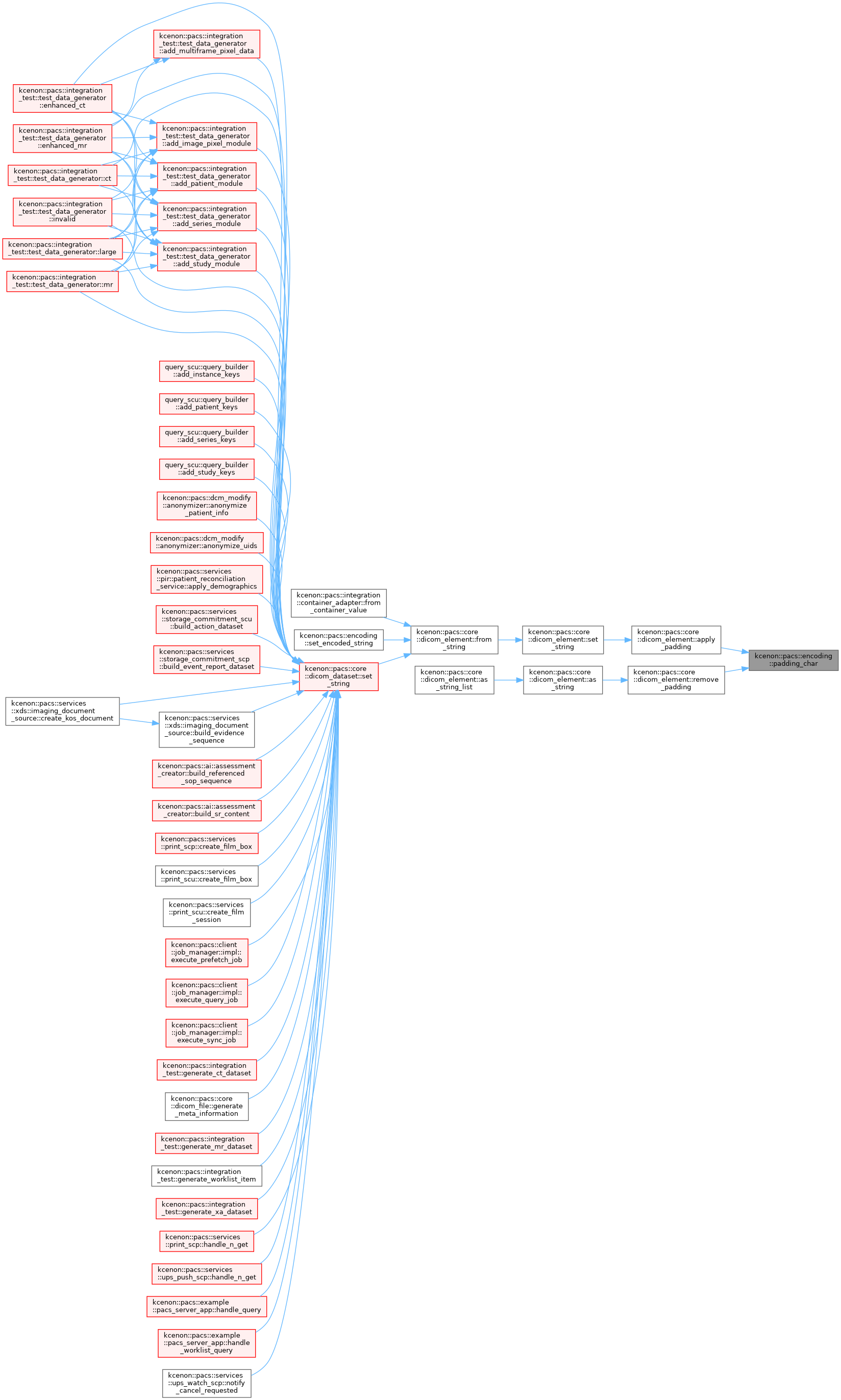
Referenced by kcenon::pacs::core::dicom_element::apply_padding(), and kcenon::pacs::core::dicom_element::remove_padding().

◆ parse_specific_character_set()
|
nodiscard |
Parse a Specific Character Set (0008,0005) value.
- Parameters
-
value The raw attribute value (e.g., "\\ISO 2022 IR 149")
- Returns
- Parsed specific_character_set with resolved character set pointers
Handles multi-valued strings separated by backslash ('\'). Empty first component defaults to ISO-IR 6 (ASCII). Unknown Defined Terms are skipped with a warning.
Definition at line 471 of file character_set.cpp.
References default_character_set(), kcenon::pacs::encoding::specific_character_set::default_set, and kcenon::pacs::encoding::specific_character_set::extension_sets.
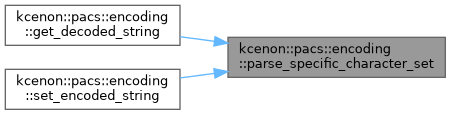
Referenced by get_decoded_string(), and set_encoded_string().

◆ read_be16()
|
nodiscardconstexprnoexcept |
Reads a 16-bit value from big-endian bytes.
- Parameters
-
data Pointer to at least 2 bytes
- Returns
- The value in native byte order
Definition at line 86 of file byte_swap.h.
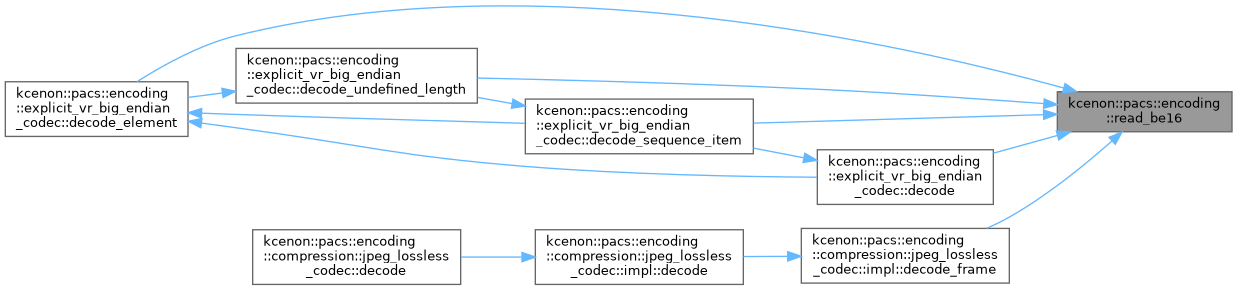
Referenced by kcenon::pacs::encoding::explicit_vr_big_endian_codec::decode(), kcenon::pacs::encoding::explicit_vr_big_endian_codec::decode_element(), kcenon::pacs::encoding::compression::jpeg_lossless_codec::impl::decode_frame(), kcenon::pacs::encoding::explicit_vr_big_endian_codec::decode_sequence_item(), and kcenon::pacs::encoding::explicit_vr_big_endian_codec::decode_undefined_length().
◆ read_be32()
|
nodiscardconstexprnoexcept |
Reads a 32-bit value from big-endian bytes.
- Parameters
-
data Pointer to at least 4 bytes
- Returns
- The value in native byte order
Definition at line 96 of file byte_swap.h.
Referenced by kcenon::pacs::encoding::explicit_vr_big_endian_codec::decode_element(), kcenon::pacs::encoding::explicit_vr_big_endian_codec::decode_sequence_item(), and kcenon::pacs::encoding::explicit_vr_big_endian_codec::decode_undefined_length().

◆ read_be64()
|
nodiscardconstexprnoexcept |
Reads a 64-bit value from big-endian bytes.
- Parameters
-
data Pointer to at least 8 bytes
- Returns
- The value in native byte order
Definition at line 108 of file byte_swap.h.
◆ set_encoded_string()
| void kcenon::pacs::encoding::set_encoded_string | ( | core::dicom_dataset & | ds, |
| core::dicom_tag | tag, | ||
| vr_type | vr, | ||
| std::string_view | utf8_value ) |
Set a string value in dataset, encoding from UTF-8.
- Parameters
-
ds The DICOM dataset to write to tag The DICOM tag vr The value representation utf8_value The UTF-8 encoded string value
Encodes the UTF-8 input to the encoding specified by Specific Character Set (0008,0005) in the dataset, then stores the result. If no Specific Character Set is present, the value is stored as-is (ASCII assumption).
Definition at line 38 of file dataset_charset.cpp.
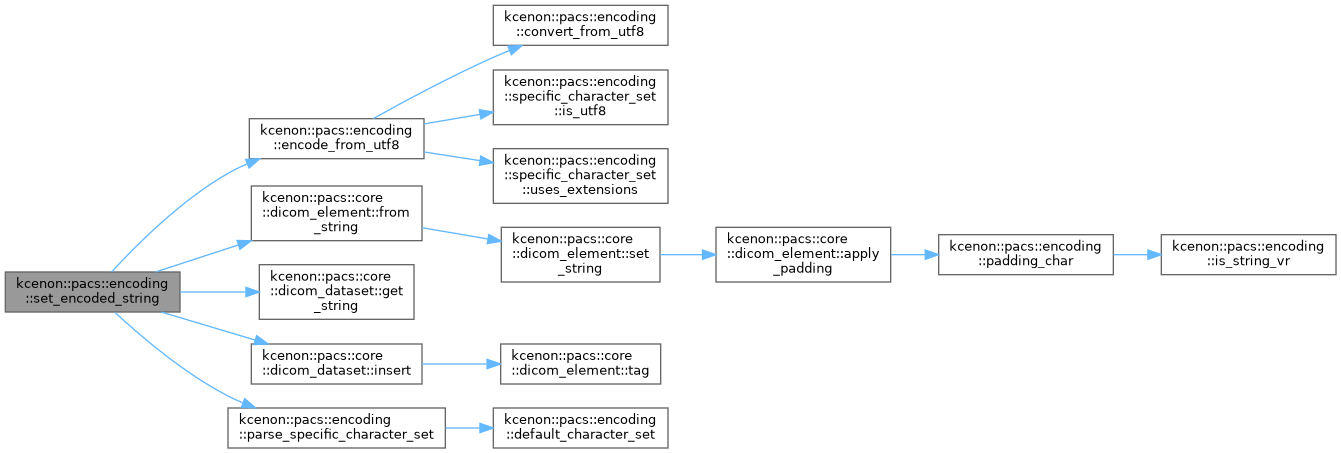
References encode_from_utf8(), kcenon::pacs::core::dicom_element::from_string(), kcenon::pacs::core::dicom_dataset::get_string(), kcenon::pacs::core::dicom_dataset::insert(), parse_specific_character_set(), kcenon::pacs::core::tags::specific_character_set, and vr.
◆ split_by_escape_sequences()
|
nodiscard |
Split a string into segments by ISO 2022 escape sequences.
- Parameters
-
text The raw DICOM string bytes scs The parsed Specific Character Set configuration
- Returns
- Vector of text segments, each with its character set
Scans for ESC (0x1B) bytes, matches escape sequences against the configured character sets, and splits the text into segments. Segments between escape sequences inherit the previous character set.
Definition at line 531 of file character_set.cpp.
References kcenon::pacs::encoding::specific_character_set::default_set, and kcenon::pacs::encoding::specific_character_set::uses_extensions().
Referenced by decode_to_utf8().


◆ supported_transfer_syntaxes()
|
nodiscard |
Returns a list of all supported Transfer Syntaxes.
- Returns
- Vector of supported transfer_syntax instances
Definition at line 380 of file transfer_syntax.cpp.
◆ swap_at_bytes()
|
inlinenodiscard |
Swaps bytes for AT (Attribute Tag) data.
- Parameters
-
data Span of bytes (must be multiple of 4)
- Returns
- Byte-swapped copy of the data
AT consists of two 16-bit values (group, element), each needing byte swap.
Definition at line 226 of file byte_swap.h.
References swap_ow_bytes().

◆ swap_fd_bytes()
|
inlinenodiscard |
Swaps bytes for FD (Double) value in raw data.
- Parameters
-
data Span of 8 bytes
- Returns
- Byte-swapped copy
Definition at line 291 of file byte_swap.h.
References swap_od_bytes().

◆ swap_fl_bytes()
|
inlinenodiscard |
Swaps bytes for FL (Float) value in raw data.
- Parameters
-
data Span of 4 bytes
- Returns
- Byte-swapped copy
Definition at line 281 of file byte_swap.h.
References swap_ol_bytes().

◆ swap_od_bytes()
|
inlinenodiscard |
Swaps bytes in-place for OD (Other Double) data.
- Parameters
-
data Span of bytes (must be multiple of 8)
- Returns
- Byte-swapped copy of the data
OD data consists of 64-bit doubles that need individual byte swapping. Uses SIMD optimization (SSE/AVX/NEON) when available.
Definition at line 212 of file byte_swap.h.
References kcenon::pacs::encoding::simd::swap_bytes_64_simd().
Referenced by swap_fd_bytes(), and kcenon::pacs::encoding::explicit_vr_big_endian_codec::to_big_endian().


◆ swap_of_bytes()
|
inlinenodiscard |
Swaps bytes in-place for OF (Other Float) data.
- Parameters
-
data Span of bytes (must be multiple of 4)
- Returns
- Byte-swapped copy of the data
OF data consists of 32-bit floats that need individual byte swapping.
Definition at line 199 of file byte_swap.h.
References swap_ol_bytes().

◆ swap_ol_bytes()
|
inlinenodiscard |
Swaps bytes in-place for OL (Other Long) data.
- Parameters
-
data Span of bytes (must be multiple of 4)
- Returns
- Byte-swapped copy of the data
OL data consists of 32-bit values that need individual byte swapping. Uses SIMD optimization (SSE/AVX/NEON) when available.
Definition at line 185 of file byte_swap.h.
References kcenon::pacs::encoding::simd::swap_bytes_32_simd().
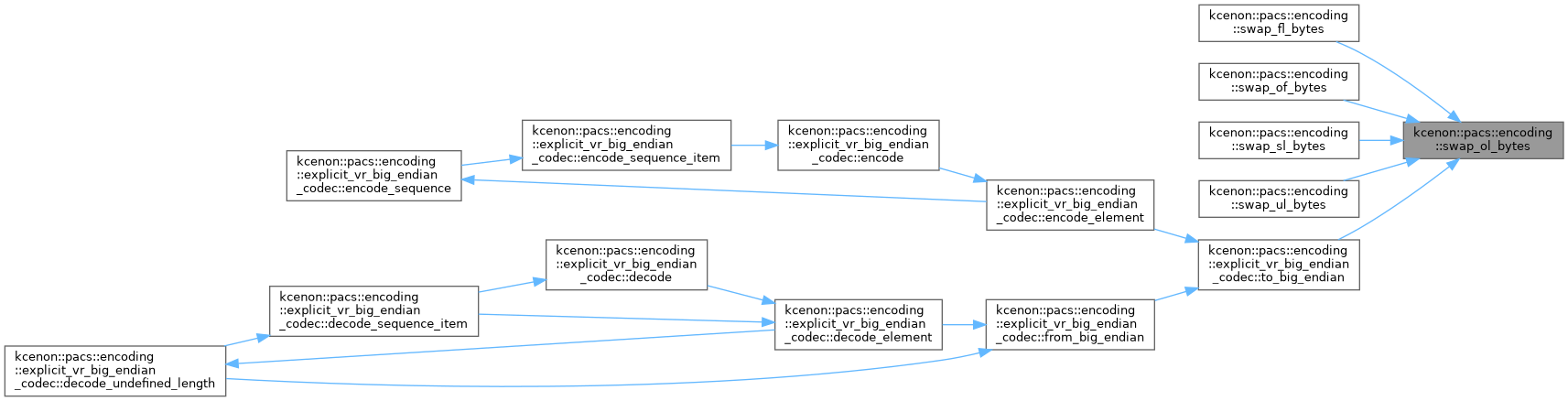
Referenced by swap_fl_bytes(), swap_of_bytes(), swap_sl_bytes(), swap_ul_bytes(), and kcenon::pacs::encoding::explicit_vr_big_endian_codec::to_big_endian().

◆ swap_ow_bytes()
|
inlinenodiscard |
Swaps bytes in-place for OW (Other Word) data.
- Parameters
-
data Span of bytes (must be even length)
- Returns
- Byte-swapped copy of the data
OW data consists of 16-bit words that need individual byte swapping. Uses SIMD optimization (SSE/AVX/NEON) when available.
Definition at line 170 of file byte_swap.h.
References kcenon::pacs::encoding::simd::swap_bytes_16_simd().
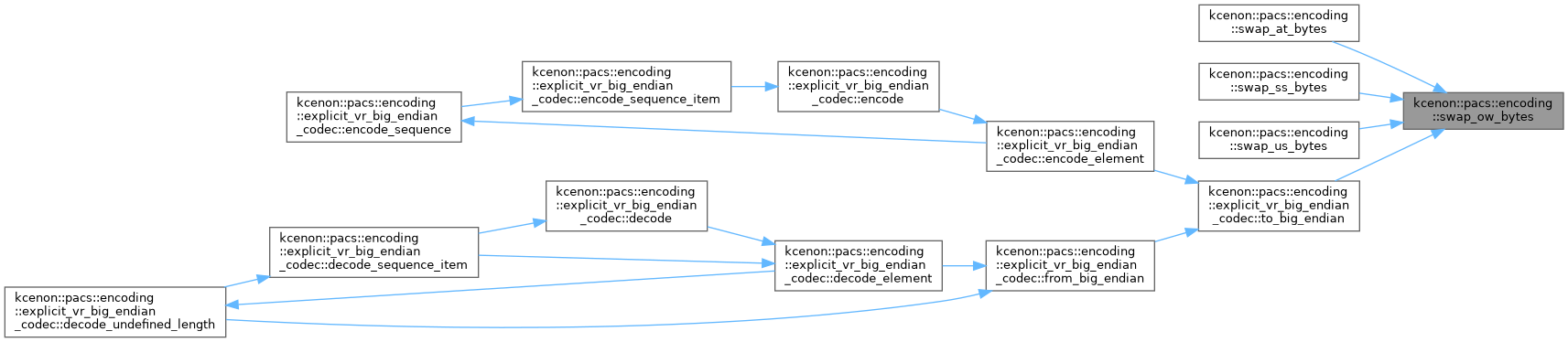
Referenced by swap_at_bytes(), swap_ss_bytes(), swap_us_bytes(), and kcenon::pacs::encoding::explicit_vr_big_endian_codec::to_big_endian().

◆ swap_sl_bytes()
|
inlinenodiscard |
Swaps bytes for SL (Signed Long) value in raw data.
- Parameters
-
data Span of 4 bytes
- Returns
- Byte-swapped copy
Definition at line 271 of file byte_swap.h.
References swap_ol_bytes().

◆ swap_ss_bytes()
|
inlinenodiscard |
Swaps bytes for SS (Signed Short) value in raw data.
- Parameters
-
data Span of 2 bytes
- Returns
- Byte-swapped copy
Definition at line 251 of file byte_swap.h.
References swap_ow_bytes().

◆ swap_ul_bytes()
|
inlinenodiscard |
Swaps bytes for UL (Unsigned Long) value in raw data.
- Parameters
-
data Span of 4 bytes
- Returns
- Byte-swapped copy
Definition at line 261 of file byte_swap.h.
References swap_ol_bytes().

◆ swap_us_bytes()
|
inlinenodiscard |
Swaps bytes for US (Unsigned Short) value in raw data.
- Parameters
-
data Span of 2 bytes
- Returns
- Byte-swapped copy
Definition at line 241 of file byte_swap.h.
References swap_ow_bytes().

◆ to_string()
|
nodiscardconstexprnoexcept |
Converts a vr_type to its two-character string representation.
- Parameters
-
vr The VR type to convert
- Returns
- A string_view containing the VR code (e.g., "PN", "US")
Returns "??" for unknown or invalid VR types.
Definition at line 83 of file vr_type.h.
References AE, AS, AT, CS, DA, DS, DT, FD, FL, IS, LO, LT, OB, OD, OF, OL, OV, OW, PN, SH, SL, SQ, SS, ST, SV, TM, UC, UI, UL, UN, UR, US, UT, UV, and vr.
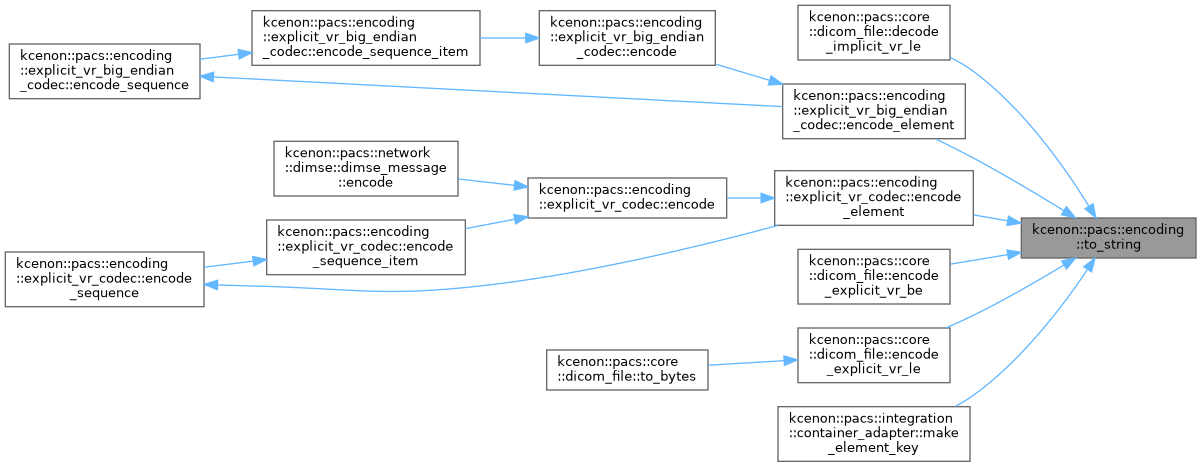
Referenced by kcenon::pacs::core::dicom_file::decode_implicit_vr_le(), kcenon::pacs::encoding::explicit_vr_big_endian_codec::encode_element(), kcenon::pacs::encoding::explicit_vr_codec::encode_element(), kcenon::pacs::core::dicom_file::encode_explicit_vr_be(), kcenon::pacs::core::dicom_file::encode_explicit_vr_le(), main(), kcenon::pacs::integration::container_adapter::make_element_key(), and kcenon::pacs::samples::print_dataset_elements().
◆ trim_padding()
|
nodiscard |
Removes trailing padding characters from a string value.
- Parameters
-
vr The VR type (determines padding character to remove) value The value to trim
- Returns
- A string with trailing padding removed
Removes:
- Trailing spaces for most string VRs
- Trailing nulls for UI VR
Definition at line 207 of file vr_info.cpp.
References get_vr_info(), and vr.

◆ validate_string()
|
nodiscard |
Validates a string value against VR encoding rules.
- Parameters
-
vr The VR type for validation value The string value to validate
- Returns
- true if the string conforms to VR requirements
Validates string VRs for:
- Maximum length
- Allowed character sets
- Format patterns (dates, times, UIDs, etc.)
Definition at line 170 of file vr_info.cpp.
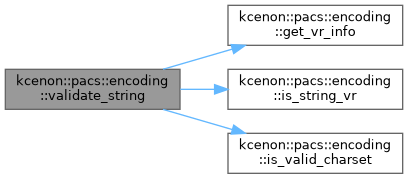
References get_vr_info(), is_string_vr(), is_valid_charset(), and vr.
◆ validate_value()
|
nodiscard |
Validates binary data against VR encoding rules.
- Parameters
-
vr The VR type for validation data The binary data to validate
- Returns
- true if the data conforms to VR requirements
Performs VR-specific validation including:
- Length constraints
- Character set restrictions
- Format requirements (for structured VRs like DA, TM)
Definition at line 141 of file vr_info.cpp.
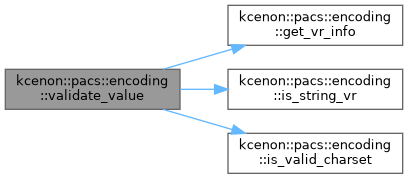
References get_vr_info(), is_string_vr(), is_valid_charset(), and vr.
◆ write_be16()
|
inline |
Writes a 16-bit value in big-endian byte order.
- Parameters
-
buffer Buffer to append to value The value to write
Definition at line 124 of file byte_swap.h.
References buffer.
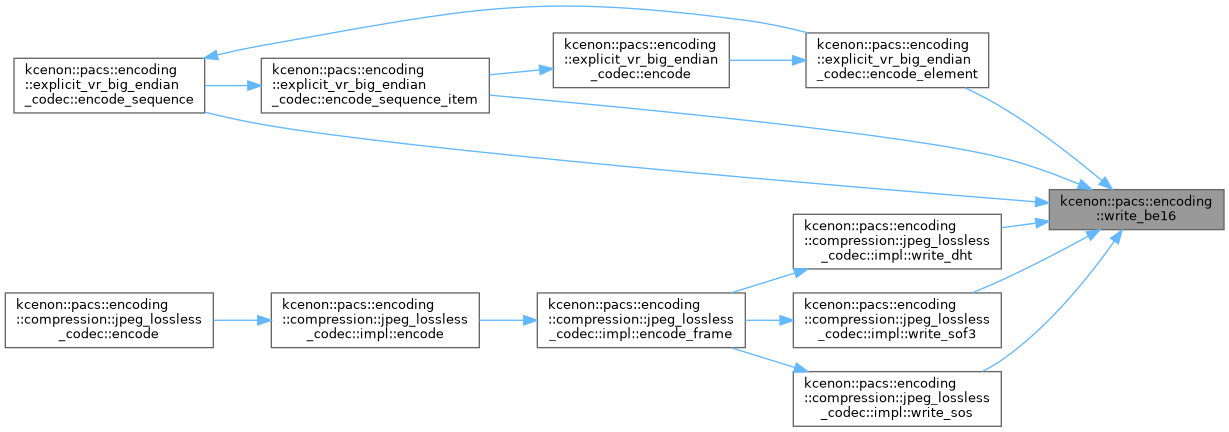
Referenced by kcenon::pacs::encoding::explicit_vr_big_endian_codec::encode_element(), kcenon::pacs::encoding::explicit_vr_big_endian_codec::encode_sequence(), kcenon::pacs::encoding::explicit_vr_big_endian_codec::encode_sequence_item(), kcenon::pacs::encoding::compression::jpeg_lossless_codec::impl::write_dht(), kcenon::pacs::encoding::compression::jpeg_lossless_codec::impl::write_sof3(), and kcenon::pacs::encoding::compression::jpeg_lossless_codec::impl::write_sos().
◆ write_be32()
|
inline |
Writes a 32-bit value in big-endian byte order.
- Parameters
-
buffer Buffer to append to value The value to write
Definition at line 134 of file byte_swap.h.
References buffer.
Referenced by kcenon::pacs::encoding::explicit_vr_big_endian_codec::encode_element(), kcenon::pacs::encoding::explicit_vr_big_endian_codec::encode_sequence(), and kcenon::pacs::encoding::explicit_vr_big_endian_codec::encode_sequence_item().

◆ write_be64()
|
inline |
Writes a 64-bit value in big-endian byte order.
- Parameters
-
buffer Buffer to append to value The value to write
Definition at line 146 of file byte_swap.h.
References buffer.