Factory for creating queue instances. More...
#include <queue_factory.h>
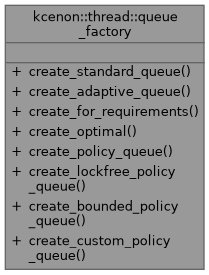
Classes | |
| struct | requirements |
| Queue selection requirements. More... | |
Static Public Member Functions | |
| static auto | create_standard_queue () -> std::shared_ptr< job_queue > |
| Create standard job_queue. | |
| static auto | create_adaptive_queue (adaptive_job_queue::policy policy=adaptive_job_queue::policy::balanced) -> std::unique_ptr< adaptive_job_queue > |
| Create adaptive queue (RECOMMENDED for most use cases) | |
| static auto | create_for_requirements (const requirements &reqs) -> std::unique_ptr< scheduler_interface > |
| Create queue based on requirements. | |
| static auto | create_optimal () -> std::unique_ptr< scheduler_interface > |
| Create optimal queue for current environment. | |
| static auto | create_policy_queue () -> std::unique_ptr< standard_queue > |
| Create a standard policy_queue (mutex-based, unbounded) | |
| static auto | create_lockfree_policy_queue () -> std::unique_ptr< policy_lockfree_queue > |
| Create a lock-free policy_queue. | |
| static auto | create_bounded_policy_queue (std::size_t max_size) -> std::unique_ptr< policy_queue< policies::mutex_sync_policy, policies::bounded_policy, policies::overflow_reject_policy > > |
| Create a bounded policy_queue with specified size. | |
| template<typename SyncPolicy , typename BoundPolicy , typename OverflowPolicy > | |
| static auto | create_custom_policy_queue (SyncPolicy sync_policy, BoundPolicy bound_policy, OverflowPolicy overflow_policy) -> std::unique_ptr< policy_queue< SyncPolicy, BoundPolicy, OverflowPolicy > > |
| Create a policy_queue with custom policies. | |
Detailed Description
Factory for creating queue instances.
Provides convenient methods for queue creation based on requirements. Following Kent Beck's Simple Design principle, we now offer only 2 public queue types:
Queue Selection Guide (Simplified)
| Queue Type | Use Case | Key Feature |
|---|---|---|
| adaptive_job_queue (Recommended) | Most use cases | Auto-optimizing, best of both worlds |
| job_queue | Blocking wait required | Mutex-based, exact size tracking |
Recommended Usage
- Note
- Internal implementations (lockfree_job_queue, concurrent_queue) are now in the detail:: namespace and should not be used directly.
Definition at line 64 of file queue_factory.h.
Member Function Documentation
◆ create_adaptive_queue()
|
inlinestaticnodiscard |
Create adaptive queue (RECOMMENDED for most use cases)
- Parameters
-
policy Adaptation policy (default: balanced)
- Returns
- Unique pointer to new adaptive_job_queue
This is the recommended default choice for most applications.
Use this when you:
- Want automatic optimization between mutex and lock-free modes
- Need high throughput with variable workloads
- Are unsure which implementation to choose
- Want the best of both worlds (safety + performance)
- Note
- Internally uses lock-free queue for high-contention scenarios and mutex-based queue for low-contention scenarios.
Definition at line 120 of file queue_factory.h.
Referenced by practical_use_cases(), and simple_factory_usage().

◆ create_bounded_policy_queue()
|
staticnodiscard |
Create a bounded policy_queue with specified size.
- Parameters
-
max_size Maximum number of jobs the queue can hold
- Returns
- Unique pointer to bounded queue
This creates a policy_queue with:
- mutex_sync_policy: Thread-safe with blocking support
- bounded_policy: Limited to max_size items
- overflow_reject_policy: Returns error when full
Definition at line 67 of file queue_factory.cpp.
◆ create_custom_policy_queue()
|
inlinestaticnodiscard |
Create a policy_queue with custom policies.
- Template Parameters
-
SyncPolicy Synchronization policy type BoundPolicy Bounding policy type OverflowPolicy Overflow handling policy type
- Parameters
-
sync_policy Sync policy instance bound_policy Bound policy instance overflow_policy Overflow policy instance
- Returns
- Unique pointer to the configured policy_queue
This factory method allows full customization of queue behavior.
Definition at line 249 of file queue_factory.h.
References kcenon::thread::is_bound_policy_v, kcenon::thread::is_overflow_policy_v, and kcenon::thread::is_sync_policy_v.
◆ create_for_requirements()
|
staticnodiscard |
Create queue based on requirements.
- Parameters
-
reqs Requirements specification
- Returns
- Scheduler interface pointer to appropriate queue type
Selection logic:
- If need_exact_size or need_atomic_empty or need_batch_operations or need_blocking_wait: returns job_queue
- If prefer_lock_free and no accuracy needs: returns lockfree_job_queue
- Otherwise: returns adaptive_job_queue
Definition at line 12 of file queue_factory.cpp.
References kcenon::thread::adaptive_job_queue::performance_first.
Referenced by requirements_based_selection().

◆ create_lockfree_policy_queue()
|
staticnodiscard |
Create a lock-free policy_queue.
- Returns
- Unique pointer to policy_lockfree_queue
This creates a policy_queue with:
- lockfree_sync_policy: High-throughput, non-blocking
- unbounded_policy: No size limits
- overflow_reject_policy: Rejects on overflow (not applicable for unbounded)
Use this for high-contention scenarios.
- Note
- size() returns approximate values, empty() is non-atomic
Definition at line 62 of file queue_factory.cpp.
◆ create_optimal()
|
staticnodiscard |
Create optimal queue for current environment.
- Returns
- Scheduler interface pointer to queue
Considers:
- CPU architecture (x86 vs ARM memory model)
- Number of CPU cores
- Default: adaptive_job_queue for flexibility
Selection:
- ARM/weak memory model: job_queue (safety)
- Low core count (<=2): job_queue (mutex efficient enough)
- Otherwise: adaptive_job_queue (best of both worlds)
Definition at line 32 of file queue_factory.cpp.
Referenced by optimal_selection().

◆ create_policy_queue()
|
staticnodiscard |
Create a standard policy_queue (mutex-based, unbounded)
- Returns
- Unique pointer to standard_queue
This creates a policy_queue with:
- mutex_sync_policy: Thread-safe with blocking support
- unbounded_policy: No size limits
- overflow_reject_policy: Rejects on overflow (not applicable for unbounded)
Use this as the modern replacement for legacy job_queue.
Definition at line 57 of file queue_factory.cpp.
◆ create_standard_queue()
|
inlinestaticnodiscard |
Create standard job_queue.
- Returns
- Shared pointer to new job_queue (same as std::make_shared<job_queue>())
Use this when you need:
- Exact size() and empty() checks
- Batch operations
- Blocking dequeue with condition variable wait
- Note
- For bounded queue functionality, use: auto bounded = std::make_shared<job_queue>(1000); // max_size = 1000
- See also
- create_adaptive_queue() for the recommended default choice
Definition at line 100 of file queue_factory.h.
Referenced by practical_use_cases(), and simple_factory_usage().

The documentation for this class was generated from the following files:
- include/kcenon/thread/queue/queue_factory.h
- src/queue/queue_factory.cpp