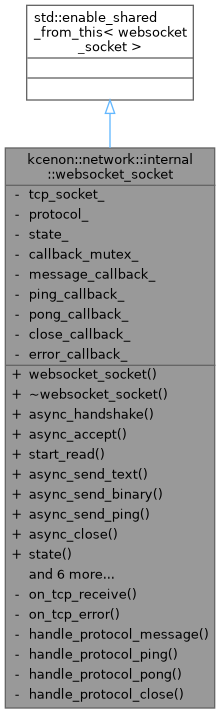
WebSocket framing layer built on top of tcp_socket. More...
#include <websocket_socket.h>
Public Member Functions | |
| websocket_socket (std::shared_ptr< tcp_socket > socket, bool is_client) | |
| Constructs a websocket_socket wrapping an existing tcp_socket. | |
| ~websocket_socket () | |
| Destructor. | |
| auto | async_handshake (const std::string &host, const std::string &path, uint16_t port, std::function< void(std::error_code)> handler) -> void |
| Performs WebSocket client handshake (RFC 6455 Section 4.1). | |
| auto | async_accept (std::function< void(std::error_code)> handler) -> void |
| Accepts WebSocket server handshake (RFC 6455 Section 4.2). | |
| auto | start_read () -> void |
| Starts reading WebSocket frames from the underlying socket. | |
| auto | async_send_text (std::string &&message, std::function< void(std::error_code, std::size_t)> handler) -> VoidResult |
| Sends a text message (UTF-8 encoded). | |
| auto | async_send_binary (std::vector< uint8_t > &&data, std::function< void(std::error_code, std::size_t)> handler) -> VoidResult |
| Sends a binary message. | |
| auto | async_send_ping (std::vector< uint8_t > payload, std::function< void(std::error_code)> handler) -> void |
| Sends a ping control frame. | |
| auto | async_close (ws_close_code code, const std::string &reason, std::function< void(std::error_code)> handler) -> void |
| Initiates the WebSocket closing handshake. | |
| auto | state () const -> ws_state |
| Gets the current connection state. | |
| auto | is_open () const -> bool |
| Checks if the connection is open and ready. | |
| auto | set_message_callback (std::function< void(const ws_message &)> callback) -> void |
| Sets the callback for received messages. | |
| auto | set_ping_callback (std::function< void(const std::vector< uint8_t > &)> callback) -> void |
| Sets the callback for received ping frames. | |
| auto | set_pong_callback (std::function< void(const std::vector< uint8_t > &)> callback) -> void |
| Sets the callback for received pong frames. | |
| auto | set_close_callback (std::function< void(ws_close_code, const std::string &)> callback) -> void |
| Sets the callback for received close frames. | |
| auto | set_error_callback (std::function< void(std::error_code)> callback) -> void |
| Sets the callback for errors. | |
Private Member Functions | |
| auto | on_tcp_receive (std::span< const uint8_t > data) -> void |
| Called by tcp_socket when data is received. | |
| auto | on_tcp_error (std::error_code ec) -> void |
| Called by tcp_socket when an error occurs. | |
| auto | handle_protocol_message (const ws_message &msg) -> void |
| Handles a decoded message from the protocol layer. | |
| auto | handle_protocol_ping (const std::vector< uint8_t > &payload) -> void |
| Handles a ping frame from the protocol layer. | |
| auto | handle_protocol_pong (const std::vector< uint8_t > &payload) -> void |
| Handles a pong frame from the protocol layer. | |
| auto | handle_protocol_close (ws_close_code code, const std::string &reason) -> void |
| Handles a close frame from the protocol layer. | |
Private Attributes | |
| std::shared_ptr< tcp_socket > | tcp_socket_ |
| websocket_protocol | protocol_ |
| std::atomic< ws_state > | state_ {ws_state::connecting} |
| std::mutex | callback_mutex_ |
| std::function< void(const ws_message &)> | message_callback_ |
| std::function< void(const std::vector< uint8_t > &)> | ping_callback_ |
| std::function< void(const std::vector< uint8_t > &)> | pong_callback_ |
| std::function< void(ws_close_code, const std::string &)> | close_callback_ |
| std::function< void(std::error_code)> | error_callback_ |
Detailed Description
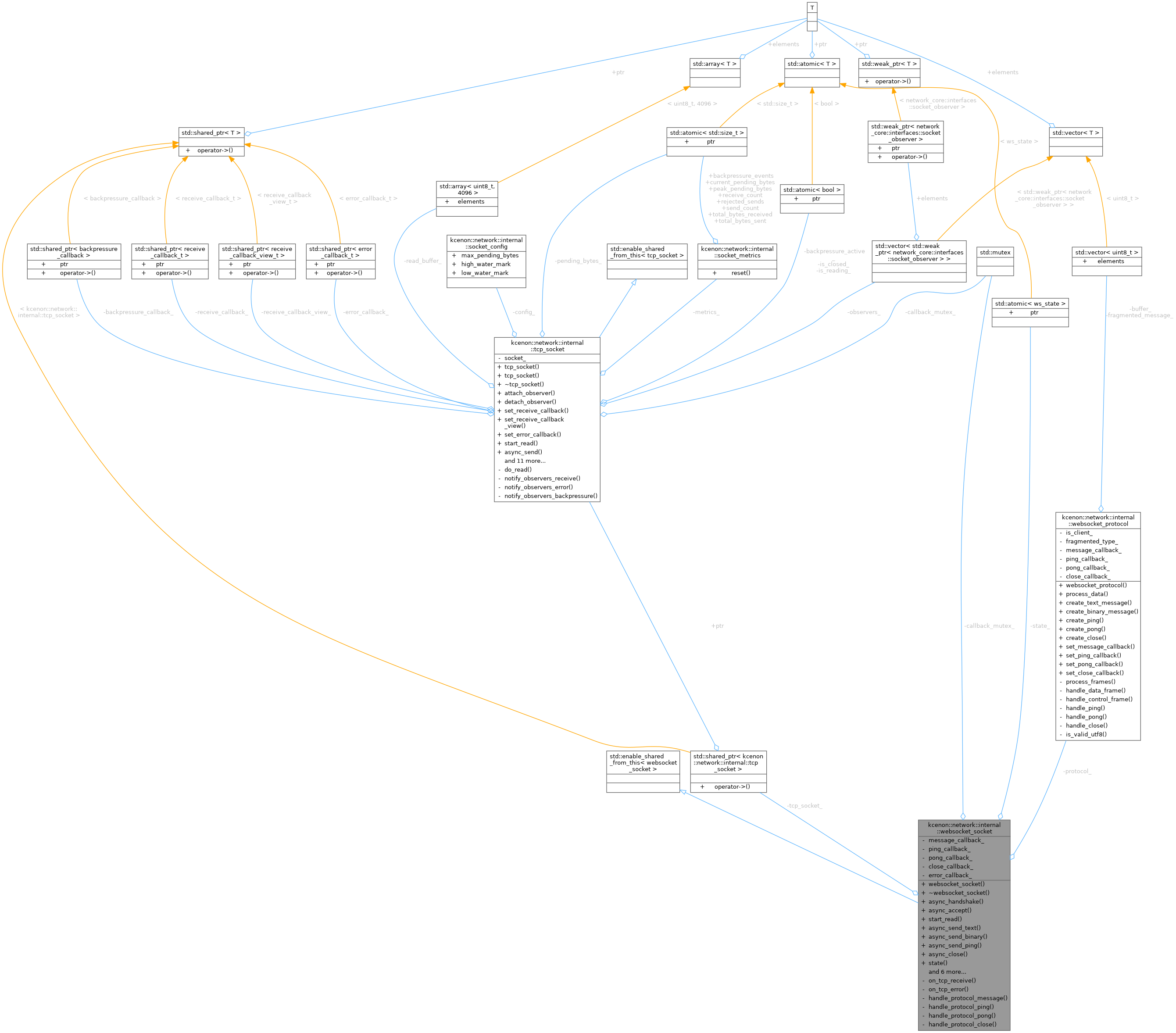
WebSocket framing layer built on top of tcp_socket.
This class wraps an existing tcp_socket and provides WebSocket protocol framing. The underlying tcp_socket handles all transport I/O operations, while websocket_socket handles:
- WebSocket handshake (client and server)
- Frame encoding/decoding via websocket_protocol
- Message fragmentation and reassembly
- Connection state management
- Ping/pong keepalive
- Close handshake
Design rationale:
- Reuses tcp_socket infrastructure (no I/O duplication)
- Maintains consistency with existing network_system patterns
- Separates concerns: tcp_socket = transport, websocket_socket = framing
Definition at line 59 of file websocket_socket.h.
Constructor & Destructor Documentation
◆ websocket_socket()
| kcenon::network::internal::websocket_socket::websocket_socket | ( | std::shared_ptr< tcp_socket > | socket, |
| bool | is_client ) |
Constructs a websocket_socket wrapping an existing tcp_socket.
- Parameters
-
socket The underlying TCP socket (must be connected) is_client True if this is a client endpoint (applies masking)
Definition at line 16 of file websocket_socket.cpp.
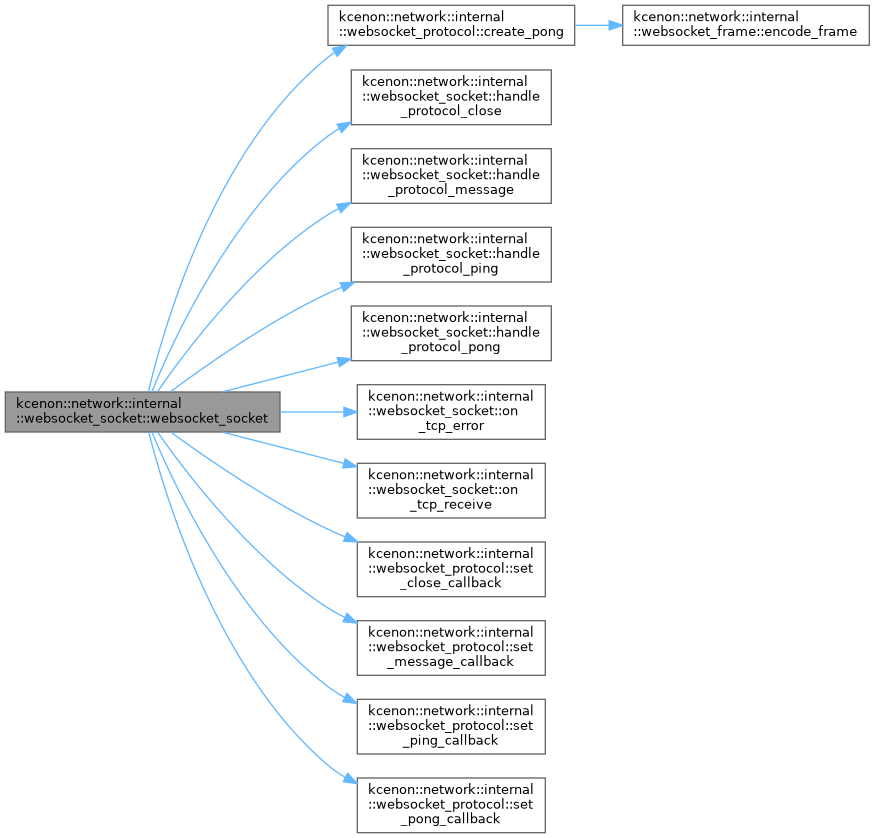
References code, kcenon::network::internal::websocket_protocol::create_pong(), handle_protocol_close(), handle_protocol_message(), handle_protocol_ping(), handle_protocol_pong(), on_tcp_error(), on_tcp_receive(), protocol_, kcenon::network::internal::websocket_protocol::set_close_callback(), kcenon::network::internal::websocket_protocol::set_message_callback(), kcenon::network::internal::websocket_protocol::set_ping_callback(), kcenon::network::internal::websocket_protocol::set_pong_callback(), and tcp_socket_.
◆ ~websocket_socket()
| kcenon::network::internal::websocket_socket::~websocket_socket | ( | ) |
Destructor.
Stops reading and cleans up resources.
Definition at line 52 of file websocket_socket.cpp.
Member Function Documentation
◆ async_accept()
| auto kcenon::network::internal::websocket_socket::async_accept | ( | std::function< void(std::error_code)> | handler | ) | -> void |
Accepts WebSocket server handshake (RFC 6455 Section 4.2).
Reads the client's HTTP/1.1 Upgrade request and sends the acceptance response. The handler is called with success/failure status.
- Parameters
-
handler Callback invoked with handshake result
Definition at line 124 of file websocket_socket.cpp.
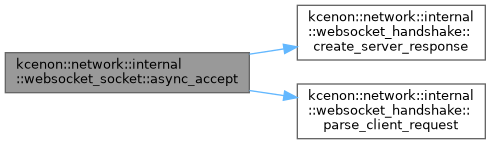
References kcenon::network::internal::websocket_handshake::create_server_response(), kcenon::network::internal::open, and kcenon::network::internal::websocket_handshake::parse_client_request().
◆ async_close()
| auto kcenon::network::internal::websocket_socket::async_close | ( | ws_close_code | code, |
| const std::string & | reason, | ||
| std::function< void(std::error_code)> | handler ) -> void |
Initiates the WebSocket closing handshake.
Sends a close frame with the specified status code and reason. The connection state transitions to closing.
- Parameters
-
code The close status code (RFC 6455 Section 7.4) reason Optional human-readable reason (UTF-8, max ~123 bytes) handler Callback invoked when close frame is sent
Definition at line 249 of file websocket_socket.cpp.
References kcenon::network::internal::closed, kcenon::network::internal::closing, and code.
◆ async_handshake()
| auto kcenon::network::internal::websocket_socket::async_handshake | ( | const std::string & | host, |
| const std::string & | path, | ||
| uint16_t | port, | ||
| std::function< void(std::error_code)> | handler ) -> void |
Performs WebSocket client handshake (RFC 6455 Section 4.1).
Sends an HTTP/1.1 Upgrade request and validates the server response. The handler is called with success/failure status.
- Parameters
-
host The server hostname (for Host header) path The request path (e.g., "/chat") port The server port (for Host header) handler Callback invoked with handshake result
Definition at line 57 of file websocket_socket.cpp.
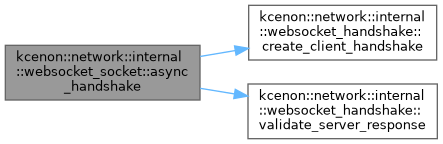
References kcenon::network::internal::websocket_handshake::create_client_handshake(), kcenon::network::internal::open, and kcenon::network::internal::websocket_handshake::validate_server_response().
◆ async_send_binary()
| auto kcenon::network::internal::websocket_socket::async_send_binary | ( | std::vector< uint8_t > && | data, |
| std::function< void(std::error_code, std::size_t)> | handler ) -> VoidResult |
Sends a binary message.
Uses move semantics for zero-copy operation. The data is encoded as a WebSocket binary frame.
- Parameters
-
data The binary data to send handler Callback invoked with send result
- Returns
- VoidResult indicating success
Definition at line 212 of file websocket_socket.cpp.
References kcenon::network::error_codes::network_system::connection_closed, kcenon::network::error_void(), kcenon::network::ok(), and kcenon::network::internal::open.

◆ async_send_ping()
| auto kcenon::network::internal::websocket_socket::async_send_ping | ( | std::vector< uint8_t > | payload, |
| std::function< void(std::error_code)> | handler ) -> void |
Sends a ping control frame.
Ping frames are used to check connection liveness. The peer should respond with a pong frame.
- Parameters
-
payload Optional payload data (max 125 bytes) handler Callback invoked with send result
Definition at line 231 of file websocket_socket.cpp.
◆ async_send_text()
| auto kcenon::network::internal::websocket_socket::async_send_text | ( | std::string && | message, |
| std::function< void(std::error_code, std::size_t)> | handler ) -> VoidResult |
Sends a text message (UTF-8 encoded).
Uses move semantics for zero-copy operation. The message is validated for UTF-8 encoding and encoded as a WebSocket text frame.
- Parameters
-
message The text message to send handler Callback invoked with send result
- Returns
- VoidResult indicating validation success
Definition at line 187 of file websocket_socket.cpp.
References kcenon::network::error_codes::network_system::connection_closed, kcenon::network::error_void(), kcenon::network::error_codes::common_errors::invalid_argument, kcenon::network::message, kcenon::network::ok(), and kcenon::network::internal::open.

◆ handle_protocol_close()
|
private |
Handles a close frame from the protocol layer.
Updates connection state and invokes the close callback.
- Parameters
-
code The close status code reason The close reason string
Definition at line 371 of file websocket_socket.cpp.
References kcenon::network::internal::closed, code, and kcenon::network::internal::open.
Referenced by websocket_socket().

◆ handle_protocol_message()
|
private |
Handles a decoded message from the protocol layer.
Invokes the message callback.
- Parameters
-
msg The decoded message
Definition at line 342 of file websocket_socket.cpp.
Referenced by websocket_socket().

◆ handle_protocol_ping()
|
private |
Handles a ping frame from the protocol layer.
Invokes the ping callback (application may send pong).
- Parameters
-
payload The ping payload
Definition at line 351 of file websocket_socket.cpp.
Referenced by websocket_socket().

◆ handle_protocol_pong()
|
private |
Handles a pong frame from the protocol layer.
Invokes the pong callback.
- Parameters
-
payload The pong payload
Definition at line 361 of file websocket_socket.cpp.
Referenced by websocket_socket().

◆ is_open()
| auto kcenon::network::internal::websocket_socket::is_open | ( | ) | const -> bool |
Checks if the connection is open and ready.
- Returns
- True if state is ws_state::open
Definition at line 283 of file websocket_socket.cpp.
References kcenon::network::internal::open, and state_.
◆ on_tcp_error()
|
private |
Called by tcp_socket when an error occurs.
Propagates the error to the application.
- Parameters
-
ec The error code
Definition at line 329 of file websocket_socket.cpp.
References kcenon::network::internal::closed.
Referenced by websocket_socket().

◆ on_tcp_receive()
|
private |
Called by tcp_socket when data is received.
Feeds the data into the WebSocket protocol decoder. Uses zero-copy span view from tcp_socket's read buffer.
- Parameters
-
data The received raw bytes as a view
Definition at line 323 of file websocket_socket.cpp.
Referenced by websocket_socket().

◆ set_close_callback()
| auto kcenon::network::internal::websocket_socket::set_close_callback | ( | std::function< void(ws_close_code, const std::string &)> | callback | ) | -> void |
Sets the callback for received close frames.
This callback is invoked when a close frame is received. The application should respond with a close frame if it hasn't already.
- Parameters
-
callback The callback function
Definition at line 309 of file websocket_socket.cpp.
◆ set_error_callback()
| auto kcenon::network::internal::websocket_socket::set_error_callback | ( | std::function< void(std::error_code)> | callback | ) | -> void |
Sets the callback for errors.
This callback is invoked when an error occurs on the underlying socket.
- Parameters
-
callback The callback function
Definition at line 316 of file websocket_socket.cpp.
◆ set_message_callback()
| auto kcenon::network::internal::websocket_socket::set_message_callback | ( | std::function< void(const ws_message &)> | callback | ) | -> void |
Sets the callback for received messages.
This callback is invoked when a complete text or binary message has been received and reassembled.
- Parameters
-
callback The callback function
Definition at line 288 of file websocket_socket.cpp.
◆ set_ping_callback()
| auto kcenon::network::internal::websocket_socket::set_ping_callback | ( | std::function< void(const std::vector< uint8_t > &)> | callback | ) | -> void |
Sets the callback for received ping frames.
This callback is invoked when a ping frame is received. The application may choose to send a pong response.
- Parameters
-
callback The callback function
Definition at line 295 of file websocket_socket.cpp.
◆ set_pong_callback()
| auto kcenon::network::internal::websocket_socket::set_pong_callback | ( | std::function< void(const std::vector< uint8_t > &)> | callback | ) | -> void |
Sets the callback for received pong frames.
This callback is invoked when a pong frame is received (typically in response to a ping).
- Parameters
-
callback The callback function
Definition at line 302 of file websocket_socket.cpp.
◆ start_read()
| auto kcenon::network::internal::websocket_socket::start_read | ( | ) | -> void |
Starts reading WebSocket frames from the underlying socket.
Must be called after successful handshake to begin receiving messages.
Definition at line 185 of file websocket_socket.cpp.
◆ state()
| auto kcenon::network::internal::websocket_socket::state | ( | ) | const -> ws_state |
Gets the current connection state.
- Returns
- The current ws_state
Definition at line 281 of file websocket_socket.cpp.
References state_.
Member Data Documentation
◆ callback_mutex_
|
private |
Definition at line 238 of file websocket_socket.h.
◆ close_callback_
|
private |
Definition at line 242 of file websocket_socket.h.
◆ error_callback_
|
private |
Definition at line 243 of file websocket_socket.h.
◆ message_callback_
|
private |
Definition at line 239 of file websocket_socket.h.
◆ ping_callback_
|
private |
Definition at line 240 of file websocket_socket.h.
◆ pong_callback_
|
private |
Definition at line 241 of file websocket_socket.h.
◆ protocol_
|
private |
Definition at line 234 of file websocket_socket.h.
Referenced by websocket_socket().
◆ state_
|
private |
Definition at line 235 of file websocket_socket.h.
◆ tcp_socket_
|
private |
Definition at line 231 of file websocket_socket.h.
Referenced by websocket_socket().
The documentation for this class was generated from the following files:
- src/internal/websocket/websocket_socket.h
- src/internal/websocket_socket.cpp