WebSocket protocol handler for message processing. More...
#include <websocket_protocol.h>
Public Member Functions | |
| websocket_protocol (bool is_client) | |
| Constructs a WebSocket protocol handler. | |
| auto | process_data (std::span< const uint8_t > data) -> void |
| Processes incoming WebSocket data. | |
| auto | create_text_message (std::string &&text) -> std::vector< uint8_t > |
| Creates a text message frame. | |
| auto | create_binary_message (std::vector< uint8_t > &&data) -> std::vector< uint8_t > |
| Creates a binary message frame. | |
| auto | create_ping (std::vector< uint8_t > &&payload={}) -> std::vector< uint8_t > |
| Creates a ping control frame. | |
| auto | create_pong (std::vector< uint8_t > &&payload={}) -> std::vector< uint8_t > |
| Creates a pong control frame. | |
| auto | create_close (ws_close_code code, std::string &&reason="") -> std::vector< uint8_t > |
| Creates a close control frame. | |
| auto | set_message_callback (std::function< void(const ws_message &)> callback) -> void |
| Sets the callback for data messages. | |
| auto | set_ping_callback (std::function< void(const std::vector< uint8_t > &)> callback) -> void |
| Sets the callback for ping frames. | |
| auto | set_pong_callback (std::function< void(const std::vector< uint8_t > &)> callback) -> void |
| Sets the callback for pong frames. | |
| auto | set_close_callback (std::function< void(ws_close_code, const std::string &)> callback) -> void |
| Sets the callback for close frames. | |
Private Member Functions | |
| auto | process_frames () -> void |
| Processes incoming frames from the buffer. | |
| auto | handle_data_frame (const ws_frame_header &header, const std::vector< uint8_t > &payload) -> void |
| Handles a data frame (text or binary). | |
| auto | handle_control_frame (const ws_frame_header &header, const std::vector< uint8_t > &payload) -> void |
| Handles a control frame (ping, pong, close). | |
| auto | handle_ping (const std::vector< uint8_t > &payload) -> void |
| Handles a ping frame. | |
| auto | handle_pong (const std::vector< uint8_t > &payload) -> void |
| Handles a pong frame. | |
| auto | handle_close (const std::vector< uint8_t > &payload) -> void |
| Handles a close frame. | |
Static Private Member Functions | |
| static auto | is_valid_utf8 (const std::vector< uint8_t > &data) -> bool |
| Validates UTF-8 encoding. | |
Private Attributes | |
| bool | is_client_ |
| True if client (applies masking) | |
| std::vector< uint8_t > | buffer_ |
| Incoming data buffer. | |
| std::vector< uint8_t > | fragmented_message_ |
| Reassembly buffer for fragmented messages. | |
| ws_opcode | fragmented_type_ |
| Type of fragmented message in progress. | |
| std::function< void(const ws_message &)> | message_callback_ |
| std::function< void(const std::vector< uint8_t > &)> | ping_callback_ |
| std::function< void(const std::vector< uint8_t > &)> | pong_callback_ |
| std::function< void(ws_close_code, const std::string &)> | close_callback_ |
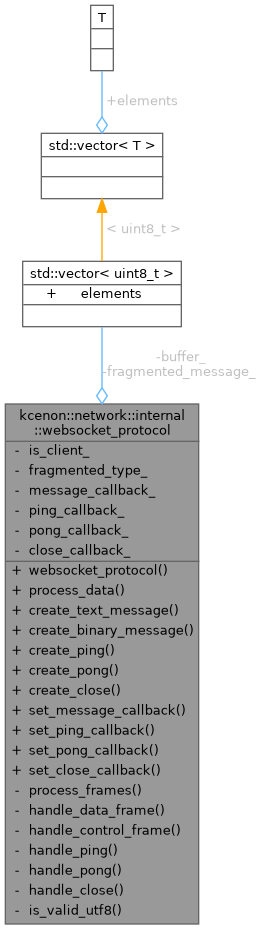
Detailed Description
WebSocket protocol handler for message processing.
This class handles the WebSocket protocol state machine including:
- Frame processing and message reassembly
- Fragmentation handling
- Control frame processing (ping/pong/close)
- Message callbacks
Definition at line 82 of file websocket_protocol.h.
Constructor & Destructor Documentation
◆ websocket_protocol()
|
explicit |
Constructs a WebSocket protocol handler.
- Parameters
-
is_client True if this is a client endpoint (applies masking)
Definition at line 30 of file websocket_protocol.cpp.
Member Function Documentation
◆ create_binary_message()
| auto kcenon::network::internal::websocket_protocol::create_binary_message | ( | std::vector< uint8_t > && | data | ) | -> std::vector<uint8_t> |
Creates a binary message frame.
Encodes the binary data as a WebSocket binary frame. Uses move semantics for zero-copy operation.
- Parameters
-
data The binary data to send
- Returns
- Encoded WebSocket frame ready for transmission
Definition at line 269 of file websocket_protocol.cpp.
References kcenon::network::internal::binary, and kcenon::network::internal::websocket_frame::encode_frame().

◆ create_close()
| auto kcenon::network::internal::websocket_protocol::create_close | ( | ws_close_code | code, |
| std::string && | reason = "" ) -> std::vector<uint8_t> |
Creates a close control frame.
Initiates the WebSocket closing handshake.
- Parameters
-
code The close status code reason Optional human-readable reason (UTF-8)
- Returns
- Encoded close frame
Definition at line 302 of file websocket_protocol.cpp.
References kcenon::network::internal::close, code, and kcenon::network::internal::websocket_frame::encode_frame().

◆ create_ping()
| auto kcenon::network::internal::websocket_protocol::create_ping | ( | std::vector< uint8_t > && | payload = {} | ) | -> std::vector<uint8_t> |
Creates a ping control frame.
Ping frames are used to check connection liveness. The peer should respond with a pong frame.
- Parameters
-
payload Optional payload data (typically empty)
- Returns
- Encoded ping frame
Definition at line 276 of file websocket_protocol.cpp.
References kcenon::network::internal::websocket_frame::encode_frame(), and kcenon::network::internal::ping.

◆ create_pong()
| auto kcenon::network::internal::websocket_protocol::create_pong | ( | std::vector< uint8_t > && | payload = {} | ) | -> std::vector<uint8_t> |
Creates a pong control frame.
Pong frames are sent in response to ping frames.
- Parameters
-
payload Payload data (should match the ping payload)
- Returns
- Encoded pong frame
Definition at line 289 of file websocket_protocol.cpp.
References kcenon::network::internal::websocket_frame::encode_frame(), and kcenon::network::internal::pong.
Referenced by kcenon::network::internal::websocket_socket::websocket_socket().


◆ create_text_message()
| auto kcenon::network::internal::websocket_protocol::create_text_message | ( | std::string && | text | ) | -> std::vector<uint8_t> |
Creates a text message frame.
Encodes the text as a WebSocket text frame with UTF-8 validation. Uses move semantics for zero-copy operation.
- Parameters
-
text The text message to send
- Returns
- Encoded WebSocket frame ready for transmission
Definition at line 251 of file websocket_protocol.cpp.
References kcenon::network::internal::websocket_frame::encode_frame(), and kcenon::network::internal::text.

◆ handle_close()
|
private |
Handles a close frame.
Parses the close code and reason, then invokes the close callback.
- Parameters
-
payload The close frame payload
Definition at line 219 of file websocket_protocol.cpp.
References code, kcenon::network::internal::normal, and kcenon::network::internal::protocol_error.
◆ handle_control_frame()
|
private |
Handles a control frame (ping, pong, close).
Control frames must not be fragmented.
- Parameters
-
header The frame header payload The frame payload
Definition at line 168 of file websocket_protocol.cpp.
References kcenon::network::internal::close, kcenon::network::internal::ping, and kcenon::network::internal::pong.
◆ handle_data_frame()
|
private |
Handles a data frame (text or binary).
Manages fragmentation and reassembly.
- Parameters
-
header The frame header payload The frame payload
Definition at line 90 of file websocket_protocol.cpp.
References kcenon::network::internal::binary, kcenon::network::internal::continuation, kcenon::network::internal::ws_message::data, kcenon::network::internal::text, and kcenon::network::internal::ws_message::type.
◆ handle_ping()
|
private |
Handles a ping frame.
Invokes the ping callback if set.
- Parameters
-
payload The ping payload
Definition at line 203 of file websocket_protocol.cpp.
◆ handle_pong()
|
private |
Handles a pong frame.
Invokes the pong callback if set.
- Parameters
-
payload The pong payload
Definition at line 211 of file websocket_protocol.cpp.
◆ is_valid_utf8()
|
staticprivate |
Validates UTF-8 encoding.
Checks if the data is valid UTF-8 (required for text messages).
- Parameters
-
data The data to validate
- Returns
- True if valid UTF-8, false otherwise
Definition at line 356 of file websocket_protocol.cpp.
◆ process_data()
| auto kcenon::network::internal::websocket_protocol::process_data | ( | std::span< const uint8_t > | data | ) | -> void |
Processes incoming WebSocket data.
Parses frames, handles fragmentation, and invokes appropriate callbacks. This method should be called when data is received from the network.
Zero-Copy Performance
Accepts data as a non-owning span view, avoiding unnecessary copies. The data is copied once into the internal buffer for frame processing.
Lifetime Contract
- The span must remain valid for the duration of this call.
- After the call returns, the span may be invalidated.
- Parameters
-
data The incoming data buffer as a view
Definition at line 36 of file websocket_protocol.cpp.
◆ process_frames()
|
private |
Processes incoming frames from the buffer.
Attempts to parse and handle frames from the accumulated buffer. May invoke callbacks for complete messages.
Definition at line 45 of file websocket_protocol.cpp.
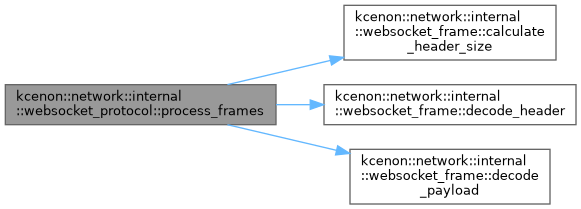
References kcenon::network::internal::binary, kcenon::network::internal::websocket_frame::calculate_header_size(), kcenon::network::internal::continuation, kcenon::network::internal::websocket_frame::decode_header(), kcenon::network::internal::websocket_frame::decode_payload(), and kcenon::network::internal::text.
◆ set_close_callback()
| auto kcenon::network::internal::websocket_protocol::set_close_callback | ( | std::function< void(ws_close_code, const std::string &)> | callback | ) | -> void |
Sets the callback for close frames.
This callback is invoked when a close frame is received. The application should respond with a close frame if it hasn't already.
- Parameters
-
callback The callback function
Definition at line 350 of file websocket_protocol.cpp.
Referenced by kcenon::network::internal::websocket_socket::websocket_socket().

◆ set_message_callback()
| auto kcenon::network::internal::websocket_protocol::set_message_callback | ( | std::function< void(const ws_message &)> | callback | ) | -> void |
Sets the callback for data messages.
This callback is invoked when a complete text or binary message has been received and reassembled.
- Parameters
-
callback The callback function
Definition at line 332 of file websocket_protocol.cpp.
Referenced by kcenon::network::internal::websocket_socket::websocket_socket().

◆ set_ping_callback()
| auto kcenon::network::internal::websocket_protocol::set_ping_callback | ( | std::function< void(const std::vector< uint8_t > &)> | callback | ) | -> void |
Sets the callback for ping frames.
This callback is invoked when a ping frame is received. The application may choose to send a pong response.
- Parameters
-
callback The callback function
Definition at line 338 of file websocket_protocol.cpp.
Referenced by kcenon::network::internal::websocket_socket::websocket_socket().

◆ set_pong_callback()
| auto kcenon::network::internal::websocket_protocol::set_pong_callback | ( | std::function< void(const std::vector< uint8_t > &)> | callback | ) | -> void |
Sets the callback for pong frames.
This callback is invoked when a pong frame is received (typically in response to a ping).
- Parameters
-
callback The callback function
Definition at line 344 of file websocket_protocol.cpp.
Referenced by kcenon::network::internal::websocket_socket::websocket_socket().

Member Data Documentation
◆ buffer_
|
private |
Incoming data buffer.
Definition at line 214 of file websocket_protocol.h.
◆ close_callback_
|
private |
Definition at line 222 of file websocket_protocol.h.
◆ fragmented_message_
|
private |
Reassembly buffer for fragmented messages.
Definition at line 215 of file websocket_protocol.h.
◆ fragmented_type_
|
private |
Type of fragmented message in progress.
Definition at line 216 of file websocket_protocol.h.
◆ is_client_
|
private |
True if client (applies masking)
Definition at line 213 of file websocket_protocol.h.
◆ message_callback_
|
private |
Definition at line 219 of file websocket_protocol.h.
◆ ping_callback_
|
private |
Definition at line 220 of file websocket_protocol.h.
◆ pong_callback_
|
private |
Definition at line 221 of file websocket_protocol.h.
The documentation for this class was generated from the following files:
- src/internal/websocket/websocket_protocol.h
- src/internal/websocket_protocol.cpp