Thread System 0.3.1
High-performance C++20 thread pool with work stealing and DAG scheduling
Loading...
Searching...
No Matches
queue_capabilities_sample.cpp File Reference

Runtime queue capability introspection and adaptive queue selection. More...

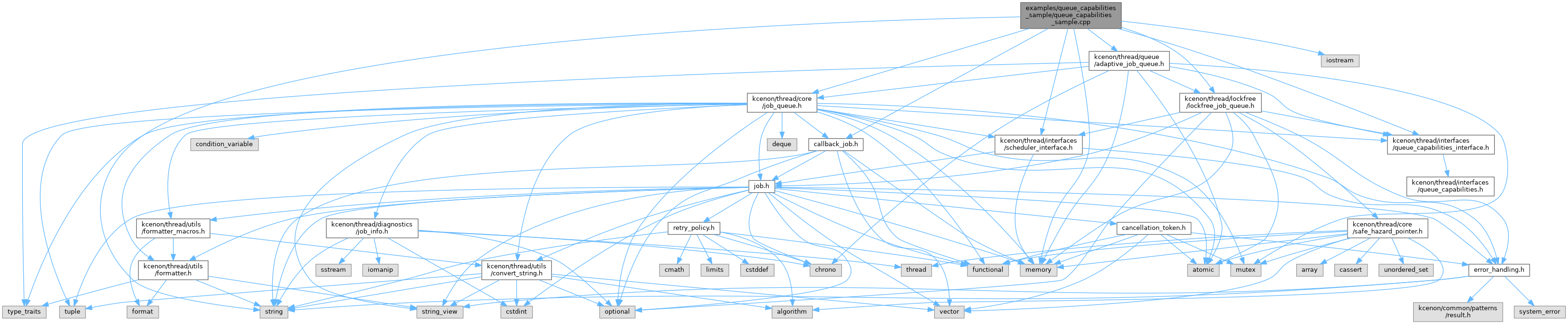
Include dependency graph for queue_capabilities_sample.cpp:

Go to the source code of this file.

Classes

class  SmartJobProcessor
 Smart job processor that adapts to queue capabilities. More...
 

Functions

void basic_capability_query ()
 Example 1: Basic capability query.
 
void convenience_methods ()
 Example 2: Convenience methods.
 
void dynamic_capability_check (scheduler_interface *scheduler)
 Example 3: Dynamic capability check (polymorphic)
 
void capability_driven_selection ()
 Example 4: Capability-driven queue selection.
 
void capability_comparison ()
 Example 5: Capability comparison table.
 
int main ()
 

Detailed Description

Runtime queue capability introspection and adaptive queue selection.

Definition in file queue_capabilities_sample.cpp.

Function Documentation

◆ basic_capability_query()

void basic_capability_query ( )

Example 1: Basic capability query.

Demonstrates how to directly query capabilities from different queue types.

Examples
queue_capabilities_sample.cpp.

Definition at line 36 of file queue_capabilities_sample.cpp.

37{
38 std::cout << "=== Example 1: Basic Capability Query ===" << std::endl;
39
40 auto mutex_queue = std::make_shared<job_queue>();
41 auto lockfree_queue = std::make_unique<detail::lockfree_job_queue>();
42
43 // Query capabilities using get_capabilities()
44 auto mutex_caps = mutex_queue->get_capabilities();
45 auto lockfree_caps = lockfree_queue->get_capabilities();
46
47 std::cout << "\njob_queue capabilities:" << std::endl;
48 std::cout << " exact_size: " << std::boolalpha << mutex_caps.exact_size << std::endl;
49 std::cout << " atomic_empty_check: " << mutex_caps.atomic_empty_check << std::endl;
50 std::cout << " lock_free: " << mutex_caps.lock_free << std::endl;
51 std::cout << " wait_free: " << mutex_caps.wait_free << std::endl;
52 std::cout << " supports_batch: " << mutex_caps.supports_batch << std::endl;
53 std::cout << " supports_blocking_wait: " << mutex_caps.supports_blocking_wait << std::endl;
54 std::cout << " supports_stop: " << mutex_caps.supports_stop << std::endl;
55
56 std::cout << "\ndetail::lockfree_job_queue capabilities:" << std::endl;
57 std::cout << " exact_size: " << lockfree_caps.exact_size << std::endl;
58 std::cout << " atomic_empty_check: " << lockfree_caps.atomic_empty_check << std::endl;
59 std::cout << " lock_free: " << lockfree_caps.lock_free << std::endl;
60 std::cout << " wait_free: " << lockfree_caps.wait_free << std::endl;
61 std::cout << " supports_batch: " << lockfree_caps.supports_batch << std::endl;
62 std::cout << " supports_blocking_wait: " << lockfree_caps.supports_blocking_wait << std::endl;
63 std::cout << " supports_stop: " << lockfree_caps.supports_stop << std::endl;
64
65 std::cout << std::endl;
66}

Referenced by main().

Here is the caller graph for this function:

◆ capability_comparison()

void capability_comparison ( )

Example 5: Capability comparison table.

Displays a comparison table of all queue implementations.

Examples
queue_capabilities_sample.cpp.

Definition at line 237 of file queue_capabilities_sample.cpp.

238{
239 std::cout << "=== Example 5: Capability Comparison Table ===" << std::endl;
240
241 auto mutex_q = std::make_shared<job_queue>();
242 auto lockfree_q = std::make_unique<detail::lockfree_job_queue>();
243 auto adaptive_q = std::make_unique<adaptive_job_queue>();
244
245 auto print_caps = [](const char* name, const queue_capabilities& caps) {
246 std::cout << "\n" << name << ":" << std::endl;
247 std::cout << " exact_size = " << std::boolalpha << caps.exact_size << std::endl;
248 std::cout << " atomic_empty_check = " << caps.atomic_empty_check << std::endl;
249 std::cout << " lock_free = " << caps.lock_free << std::endl;
250 std::cout << " wait_free = " << caps.wait_free << std::endl;
251 std::cout << " supports_batch = " << caps.supports_batch << std::endl;
252 std::cout << " supports_blocking = " << caps.supports_blocking_wait << std::endl;
253 std::cout << " supports_stop = " << caps.supports_stop << std::endl;
254 };
255
256 print_caps("job_queue (mutex-based)", mutex_q->get_capabilities());
257 print_caps("detail::lockfree_job_queue", lockfree_q->get_capabilities());
258 print_caps("adaptive_job_queue (default mode)", adaptive_q->get_capabilities());
259
260 // Summary table
261 std::cout << "\n--- Summary Table ---" << std::endl;
262 std::cout << "Queue Type | exact | atomic | lock-free | batch | blocking" << std::endl;
263 std::cout << "----------------------|-------|--------|-----------|-------|----------" << std::endl;
264
265 auto caps = mutex_q->get_capabilities();
266 std::cout << "job_queue | "
267 << (caps.exact_size ? "Y" : "N") << " | "
268 << (caps.atomic_empty_check ? "Y" : "N") << " | "
269 << (caps.lock_free ? "Y" : "N") << " | "
270 << (caps.supports_batch ? "Y" : "N") << " | "
271 << (caps.supports_blocking_wait ? "Y" : "N") << std::endl;
272
273 caps = lockfree_q->get_capabilities();
274 std::cout << "detail::lockfree_job_queue | "
275 << (caps.exact_size ? "Y" : "N") << " | "
276 << (caps.atomic_empty_check ? "Y" : "N") << " | "
277 << (caps.lock_free ? "Y" : "N") << " | "
278 << (caps.supports_batch ? "Y" : "N") << " | "
279 << (caps.supports_blocking_wait ? "Y" : "N") << std::endl;
280
281 caps = adaptive_q->get_capabilities();
282 std::cout << "adaptive_job_queue | "
283 << (caps.exact_size ? "Y" : "N") << " | "
284 << (caps.atomic_empty_check ? "Y" : "N") << " | "
285 << (caps.lock_free ? "Y" : "N") << " | "
286 << (caps.supports_batch ? "Y" : "N") << " | "
287 << (caps.supports_blocking_wait ? "Y" : "N") << std::endl;
288
289 std::cout << std::endl;
290}
Runtime-queryable queue capabilities descriptor.

Referenced by main().

Here is the caller graph for this function:

◆ capability_driven_selection()

void capability_driven_selection ( )

Example 4: Capability-driven queue selection.

Shows how to select queue implementation based on requirements.

Examples
queue_capabilities_sample.cpp.

Definition at line 209 of file queue_capabilities_sample.cpp.

210{
211 std::cout << "=== Example 4: Capability-Driven Selection ===" << std::endl;
212
213 std::cout << "\nCreating processors with different requirements:" << std::endl;
214
215 // Monitoring processor needs exact metrics
216 SmartJobProcessor monitoring_processor(true);
217 std::cout << "\n[Monitoring Processor] (needs exact metrics)" << std::endl;
218 std::cout << " exact_metrics_available: " << std::boolalpha
219 << monitoring_processor.has_exact_metrics() << std::endl;
220 monitoring_processor.log_status();
221
222 // Logging processor can use approximate metrics
223 SmartJobProcessor logging_processor(false);
224 std::cout << "\n[Logging Processor] (approximate is fine)" << std::endl;
225 std::cout << " exact_metrics_available: "
226 << logging_processor.has_exact_metrics() << std::endl;
227 logging_processor.log_status();
228
229 std::cout << std::endl;
230}
Smart job processor that adapts to queue capabilities.

References SmartJobProcessor::has_exact_metrics(), and SmartJobProcessor::log_status().

Referenced by main().

Here is the call graph for this function:
Here is the caller graph for this function:

◆ convenience_methods()

void convenience_methods ( )

Example 2: Convenience methods.

Shows how to use the convenience methods instead of get_capabilities().

Examples
queue_capabilities_sample.cpp.

Definition at line 73 of file queue_capabilities_sample.cpp.

74{
75 std::cout << "=== Example 2: Convenience Methods ===" << std::endl;
76
77 auto queue = std::make_shared<job_queue>();
78
79 std::cout << "\nUsing convenience methods on job_queue:" << std::endl;
80
81 // Use convenience methods for cleaner code
82 if (queue->has_exact_size()) {
83 std::cout << " [OK] Queue size is exact: " << queue->size() << std::endl;
84 }
85
86 if (queue->has_atomic_empty()) {
87 std::cout << " [OK] Empty check is atomic: " << std::boolalpha << queue->empty() << std::endl;
88 }
89
90 if (!queue->is_lock_free()) {
91 std::cout << " [OK] Queue uses mutex (good for accuracy)" << std::endl;
92 }
93
94 if (!queue->is_wait_free()) {
95 std::cout << " [OK] Queue is not wait-free" << std::endl;
96 }
97
98 if (queue->supports_batch()) {
99 std::cout << " [OK] Batch operations supported" << std::endl;
100 }
101
102 if (queue->supports_blocking_wait()) {
103 std::cout << " [OK] Blocking wait supported" << std::endl;
104 }
105
106 if (queue->supports_stop()) {
107 std::cout << " [OK] Stop signaling supported" << std::endl;
108 }
109
110 std::cout << std::endl;
111}

Referenced by main().

Here is the caller graph for this function:

◆ dynamic_capability_check()

void dynamic_capability_check ( scheduler_interface * scheduler)

Example 3: Dynamic capability check (polymorphic)

Demonstrates how to check capabilities through a base interface pointer.

Examples
queue_capabilities_sample.cpp.

Definition at line 118 of file queue_capabilities_sample.cpp.

119{
120 std::cout << "=== Example 3: Dynamic Capability Check ===" << std::endl;
121
122 std::cout << "\nChecking capabilities through scheduler_interface*:" << std::endl;
123
124 // Check if scheduler supports capabilities interface using dynamic_cast
125 if (auto* cap = dynamic_cast<queue_capabilities_interface*>(scheduler)) {
126 std::cout << " [OK] Scheduler supports capability introspection" << std::endl;
127
128 if (cap->has_exact_size()) {
129 std::cout << " -> Safe to use size() for decisions" << std::endl;
130 } else {
131 std::cout << " -> size() is approximate, use with caution" << std::endl;
132 }
133
134 if (cap->is_lock_free()) {
135 std::cout << " -> Lock-free implementation (high throughput)" << std::endl;
136 } else {
137 std::cout << " -> Mutex-based implementation (accurate metrics)" << std::endl;
138 }
139
140 if (cap->supports_blocking_wait()) {
141 std::cout << " -> Blocking dequeue available" << std::endl;
142 } else {
143 std::cout << " -> Use polling/spin-wait for dequeue" << std::endl;
144 }
145 } else {
146 std::cout << " [!] Scheduler does not support capability introspection" << std::endl;
147 }
148
149 std::cout << std::endl;
150}
Mixin interface for queue capability introspection.

Referenced by main().

Here is the caller graph for this function:

◆ main()

int main ( )

Definition at line 292 of file queue_capabilities_sample.cpp.

293{
294 std::cout << "Queue Capabilities Sample" << std::endl;
295 std::cout << "=========================" << std::endl;
296 std::cout << std::endl;
297 std::cout << "This sample demonstrates queue_capabilities_interface usage" << std::endl;
298 std::cout << "for runtime capability introspection." << std::endl;
299 std::cout << std::endl;
300
301 try {
302 // Example 1: Basic capability query
304
305 // Example 2: Convenience methods
307
308 // Example 3: Dynamic capability check
309 auto queue = std::make_unique<job_queue>();
310 dynamic_capability_check(queue.get());
311
312 // Example 4: Capability-driven selection
314
315 // Example 5: Capability comparison
317
318 } catch (const std::exception& e) {
319 std::cerr << "Exception: " << e.what() << std::endl;
320 return 1;
321 }
322
323 std::cout << "All examples completed successfully!" << std::endl;
324
325 return 0;
326}
void basic_capability_query()
Example 1: Basic capability query.
void capability_driven_selection()
Example 4: Capability-driven queue selection.
void capability_comparison()
Example 5: Capability comparison table.
void dynamic_capability_check(scheduler_interface *scheduler)
Example 3: Dynamic capability check (polymorphic)
void convenience_methods()
Example 2: Convenience methods.

References basic_capability_query(), capability_comparison(), capability_driven_selection(), convenience_methods(), and dynamic_capability_check().
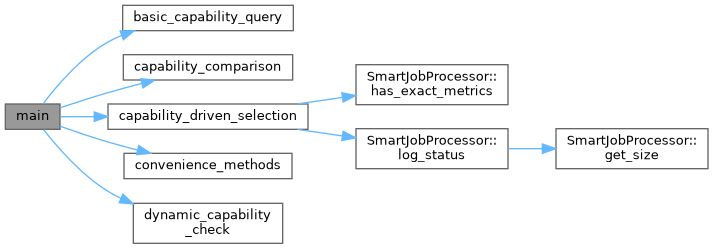

Here is the call graph for this function: