Loading...
Searching...
No Matches
Lock-free node pool for high-performance memory allocation. More...
#include "thread_base/lockfree/memory/node_pool.h"#include "logger/core/logger.h"#include <thread>#include <vector>#include <chrono>#include <random>#include <atomic>#include <memory>#include <iomanip>
Include dependency graph for node_pool_sample.cpp:

Go to the source code of this file.
Classes | |
| struct | TestData |
Functions | |
| void | demonstrate_basic_usage () |
| void | demonstrate_concurrent_usage () |
| void | demonstrate_performance_comparison () |
| void | demonstrate_memory_efficiency () |
| int | main () |
Detailed Description
Lock-free node pool for high-performance memory allocation.
Definition in file node_pool_sample.cpp.
Function Documentation
◆ demonstrate_basic_usage()
| void demonstrate_basic_usage | ( | ) |
Definition at line 38 of file node_pool_sample.cpp.
38 {
39 log_module::write_information("\n=== Basic Node Pool Usage Demo ===");
40
41 // Create a node pool with 2 initial chunks, 512 nodes per chunk
42 node_pool<TestData> pool(2, 512);
43
44 // Show initial statistics
45 auto stats = pool.get_statistics();
46 log_module::write_information("Initial pool statistics:");
47 log_module::write_information(" Total chunks: {}", stats.total_chunks);
48 log_module::write_information(" Total nodes: {}", stats.total_nodes);
49 log_module::write_information(" Allocated nodes: {}", stats.allocated_nodes);
50 log_module::write_information(" Free list size: {}", stats.free_list_size);
51
52 // Allocate some nodes
53 std::vector<TestData*> allocated_nodes;
54 const int NUM_ALLOCATIONS = 100;
55
56 log_module::write_information("\nAllocating {} nodes...", NUM_ALLOCATIONS);
57 for (int i = 0; i < NUM_ALLOCATIONS; ++i) {
58 auto* node = pool.allocate();
59 node->value = i;
60 node->data = i * 3.14;
61 allocated_nodes.push_back(node);
62 }
63
64 // Show statistics after allocation
65 stats = pool.get_statistics();
66 log_module::write_information("After allocation:");
67 log_module::write_information(" Total chunks: {}", stats.total_chunks);
68 log_module::write_information(" Total nodes: {}", stats.total_nodes);
69 log_module::write_information(" Allocated nodes: {}", stats.allocated_nodes);
70 log_module::write_information(" Free list size: {}", stats.free_list_size);
71
72 // Verify data integrity
73 log_module::write_information("\nVerifying data integrity...");
74 bool integrity_ok = true;
75 for (int i = 0; i < NUM_ALLOCATIONS; ++i) {
76 if (allocated_nodes[i]->value != i ||
77 std::abs(allocated_nodes[i]->data - i * 3.14) > 0.001) {
78 integrity_ok = false;
79 break;
80 }
81 }
82 log_module::write_information("Data integrity: {}", integrity_ok ? "OK" : "FAILED");
83
84 // Deallocate half the nodes
85 log_module::write_information("\nDeallocating half the nodes...");
86 for (int i = 0; i < NUM_ALLOCATIONS / 2; ++i) {
87 pool.deallocate(allocated_nodes[i]);
88 allocated_nodes[i] = nullptr;
89 }
90
91 // Show statistics after partial deallocation
92 stats = pool.get_statistics();
93 log_module::write_information("After partial deallocation:");
94 log_module::write_information(" Total chunks: {}", stats.total_chunks);
95 log_module::write_information(" Total nodes: {}", stats.total_nodes);
96 log_module::write_information(" Allocated nodes: {}", stats.allocated_nodes);
97 log_module::write_information(" Free list size: {}", stats.free_list_size);
98
99 // Deallocate remaining nodes
100 for (int i = NUM_ALLOCATIONS / 2; i < NUM_ALLOCATIONS; ++i) {
101 pool.deallocate(allocated_nodes[i]);
102 }
103
104 // Final statistics
105 stats = pool.get_statistics();
106 log_module::write_information("After full deallocation:");
107 log_module::write_information(" Total chunks: {}", stats.total_chunks);
108 log_module::write_information(" Total nodes: {}", stats.total_nodes);
109 log_module::write_information(" Allocated nodes: {}", stats.allocated_nodes);
110 log_module::write_information(" Free list size: {}", stats.free_list_size);
111}
Referenced by main().
Here is the caller graph for this function:

◆ demonstrate_concurrent_usage()
| void demonstrate_concurrent_usage | ( | ) |
- Examples
- node_pool_sample.cpp.
Definition at line 113 of file node_pool_sample.cpp.
113 {
114 log_module::write_information("\n=== Concurrent Usage Demo ===");
115
116 constexpr int NUM_THREADS = 4;
117 constexpr int OPERATIONS_PER_THREAD = 1000;
118 constexpr int INITIAL_CHUNKS = 2;
119 constexpr int CHUNK_SIZE = 256;
120
121 node_pool<TestData> pool(INITIAL_CHUNKS, CHUNK_SIZE);
122
123 std::atomic<int> total_allocations{0};
124 std::atomic<int> total_deallocations{0};
125 std::atomic<int> allocation_failures{0};
126
127 auto start_time = std::chrono::high_resolution_clock::now();
128
129 std::vector<std::thread> threads;
130 threads.reserve(NUM_THREADS);
131
132 // Create worker threads
133 for (int thread_id = 0; thread_id < NUM_THREADS; ++thread_id) {
134 threads.emplace_back([&, thread_id]() {
135 std::random_device rd;
136 std::mt19937 gen(rd());
137 std::uniform_int_distribution<> dis(0, 100);
138
139 std::vector<TestData*> local_nodes;
140 local_nodes.reserve(OPERATIONS_PER_THREAD / 2);
141
142 for (int op = 0; op < OPERATIONS_PER_THREAD; ++op) {
143 if (dis(gen) < 70 || local_nodes.empty()) { // 70% chance to allocate
144 try {
145 auto* node = pool.allocate();
146 node->value = thread_id * 10000 + op;
147 node->data = thread_id + op * 0.001;
148 local_nodes.push_back(node);
149 total_allocations.fetch_add(1, std::memory_order_relaxed);
150 } catch (const std::bad_alloc&) {
151 allocation_failures.fetch_add(1, std::memory_order_relaxed);
152 }
153 } else { // Deallocate
154 if (!local_nodes.empty()) {
155 auto idx = std::uniform_int_distribution<size_t>(0, local_nodes.size() - 1)(gen);
156 pool.deallocate(local_nodes[idx]);
157 local_nodes.erase(local_nodes.begin() + idx);
158 total_deallocations.fetch_add(1, std::memory_order_relaxed);
159 }
160 }
161 }
162
163 // Clean up remaining nodes
164 for (auto* node : local_nodes) {
165 if (node) {
166 pool.deallocate(node);
167 total_deallocations.fetch_add(1, std::memory_order_relaxed);
168 }
169 }
170 });
171 }
172
173 // Wait for all threads to complete
174 for (auto& thread : threads) {
175 thread.join();
176 }
177
178 auto end_time = std::chrono::high_resolution_clock::now();
179 auto duration = std::chrono::duration_cast<std::chrono::milliseconds>(end_time - start_time);
180
181 log_module::write_information("Concurrent operations completed in {} ms", duration.count());
182 log_module::write_information("Total allocations: {}", total_allocations.load());
183 log_module::write_information("Total deallocations: {}", total_deallocations.load());
184 log_module::write_information("Allocation failures: {}", allocation_failures.load());
185
186 // Final pool statistics
187 auto stats = pool.get_statistics();
188 log_module::write_information("Final pool statistics:");
189 log_module::write_information(" Total chunks: {}", stats.total_chunks);
190 log_module::write_information(" Total nodes: {}", stats.total_nodes);
191 log_module::write_information(" Allocated nodes: {}", stats.allocated_nodes);
192 log_module::write_information(" Free list size: {}", stats.free_list_size);
193
194 // Calculate performance
195 int total_ops = total_allocations.load() + total_deallocations.load();
196 double ops_per_second = (double)total_ops / (duration.count() / 1000.0);
197 log_module::write_information("Performance: {} ops/second", static_cast<int>(ops_per_second));
198}
Referenced by main().
Here is the caller graph for this function:

◆ demonstrate_memory_efficiency()
| void demonstrate_memory_efficiency | ( | ) |
- Examples
- node_pool_sample.cpp.
Definition at line 273 of file node_pool_sample.cpp.
273 {
274 log_module::write_information("\n=== Memory Efficiency Demo ===");
275
276 // Small pool for testing
277 node_pool<TestData> small_pool(1, 256);
278 node_pool<TestData> medium_pool(2, 512);
279 node_pool<TestData> large_pool(4, 1024);
280
281 auto show_pool_info = [](const auto& pool, const char* name) {
282 auto stats = pool.get_statistics();
284 log_module::write_information("{}:", name);
285 log_module::write_information(" Total chunks: {}", stats.total_chunks);
286 log_module::write_information(" Total nodes: {}", stats.total_nodes);
287 log_module::write_information(" Memory usage: {} bytes ({:.1f} KB)", memory_usage, memory_usage / 1024.0);
289 };
290
291 show_pool_info(small_pool, "Small pool (1x256)");
292 show_pool_info(medium_pool, "Medium pool (2x512)");
293 show_pool_info(large_pool, "Large pool (4x1024)");
294
295 // Test fragmentation
296 log_module::write_information("Testing fragmentation scenario...");
297 std::vector<TestData*> nodes;
298
299 // Allocate many nodes
300 for (int i = 0; i < 100; ++i) {
301 nodes.push_back(medium_pool.allocate());
302 }
303
304 // Deallocate every other node (create fragmentation)
305 for (size_t i = 0; i < nodes.size(); i += 2) {
306 medium_pool.deallocate(nodes[i]);
307 nodes[i] = nullptr;
308 }
309
310 auto stats = medium_pool.get_statistics();
311 log_module::write_information("After fragmentation:");
312 log_module::write_information(" Allocated nodes: {}", stats.allocated_nodes);
313 log_module::write_information(" Free list size: {}", stats.free_list_size);
314
315 // Allocate new nodes (should reuse freed nodes)
316 int reused_count = 0;
317 for (size_t i = 0; i < nodes.size() && reused_count < 25; i += 2) {
318 if (!nodes[i]) {
319 nodes[i] = medium_pool.allocate();
320 reused_count++;
321 }
322 }
323
324 stats = medium_pool.get_statistics();
325 log_module::write_information("After reuse ({} nodes):", reused_count);
326 log_module::write_information(" Allocated nodes: {}", stats.allocated_nodes);
327 log_module::write_information(" Free list size: {}", stats.free_list_size);
328
329 // Clean up
330 for (auto* node : nodes) {
331 if (node) {
332 medium_pool.deallocate(node);
333 }
334 }
335}
Definition node_pool_sample.cpp:29
Referenced by main().
Here is the caller graph for this function:

◆ demonstrate_performance_comparison()
| void demonstrate_performance_comparison | ( | ) |
- Examples
- node_pool_sample.cpp.
Definition at line 200 of file node_pool_sample.cpp.
200 {
201 log_module::write_information("\n=== Performance Comparison Demo ===");
202
203 constexpr int NUM_OPERATIONS = 100000;
204 constexpr int WARMUP_OPERATIONS = 10000;
205
206 // Test with node pool
207 log_module::write_information("Testing node pool performance...");
208 node_pool<TestData> pool(4, 1024);
209
210 // Warmup
211 std::vector<TestData*> warmup_nodes;
212 for (int i = 0; i < WARMUP_OPERATIONS; ++i) {
213 warmup_nodes.push_back(pool.allocate());
214 }
215 for (auto* node : warmup_nodes) {
216 pool.deallocate(node);
217 }
218
219 auto start_time = std::chrono::high_resolution_clock::now();
220
221 std::vector<TestData*> pool_nodes;
222 pool_nodes.reserve(NUM_OPERATIONS);
223
224 // Allocate
225 for (int i = 0; i < NUM_OPERATIONS; ++i) {
226 pool_nodes.push_back(pool.allocate());
227 }
228
229 // Deallocate
230 for (auto* node : pool_nodes) {
231 pool.deallocate(node);
232 }
233
234 auto end_time = std::chrono::high_resolution_clock::now();
235 auto pool_duration = std::chrono::duration_cast<std::chrono::microseconds>(end_time - start_time);
236
237 // Test with standard allocation
238 log_module::write_information("Testing standard allocation performance...");
239
240 start_time = std::chrono::high_resolution_clock::now();
241
242 std::vector<std::unique_ptr<TestData>> std_nodes;
243 std_nodes.reserve(NUM_OPERATIONS);
244
245 // Allocate
246 for (int i = 0; i < NUM_OPERATIONS; ++i) {
247 std_nodes.push_back(std::make_unique<TestData>());
248 }
249
250 // Deallocate (automatic with unique_ptr)
251 std_nodes.clear();
252
253 end_time = std::chrono::high_resolution_clock::now();
254 auto std_duration = std::chrono::duration_cast<std::chrono::microseconds>(end_time - start_time);
255
256 log_module::write_information("Results:");
257 log_module::write_information(" Node pool: {} μs", pool_duration.count());
258 log_module::write_information(" Standard allocation: {} μs", std_duration.count());
259
260 if (std_duration.count() > 0) {
261 double speedup = (double)std_duration.count() / pool_duration.count();
262 log_module::write_information(" Speedup: {:.2f}x", speedup);
263 }
264
265 // Calculate operations per second
266 double pool_ops_per_sec = (2.0 * NUM_OPERATIONS) / (pool_duration.count() / 1000000.0);
267 double std_ops_per_sec = (2.0 * NUM_OPERATIONS) / (std_duration.count() / 1000000.0);
268
269 log_module::write_information(" Node pool ops/sec: {}", static_cast<int>(pool_ops_per_sec));
270 log_module::write_information(" Standard ops/sec: {}", static_cast<int>(std_ops_per_sec));
271}
Referenced by main().
Here is the caller graph for this function:

◆ main()
| int main | ( | ) |
Definition at line 337 of file node_pool_sample.cpp.
337 {
338 // Initialize logger
339 log_module::start();
340 log_module::console_target(log_module::log_types::Information);
341
342 log_module::write_information("Node Pool Sample");
343 log_module::write_information("================");
344
345 try {
346 demonstrate_basic_usage();
347 demonstrate_concurrent_usage();
350
351 log_module::write_information("\n=== All demos completed successfully! ===");
352
353 } catch (const std::exception& e) {
354 log_module::write_error("Error: {}", e.what());
355 log_module::stop();
356 return 1;
357 }
358
359 // Cleanup logger
360 log_module::stop();
361 return 0;
362}
void demonstrate_memory_efficiency()
Definition node_pool_sample.cpp:273
void demonstrate_performance_comparison()
Definition node_pool_sample.cpp:200
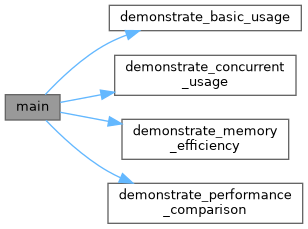
References demonstrate_basic_usage(), demonstrate_concurrent_usage(), demonstrate_memory_efficiency(), and demonstrate_performance_comparison().
Here is the call graph for this function: