Provides utilities for string encoding conversion, Base64 encoding/decoding, and substring operations like splitting or replacing. More...
#include <convert_string.h>
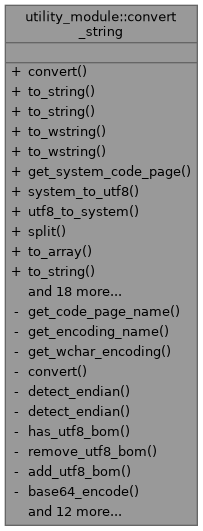
Public Member Functions | |
| template<typename FromType , typename ToType > | |
| auto | convert (const FromType &value, const std::string &from_encoding, const std::string &to_encoding) -> std::tuple< std::optional< ToType >, std::optional< std::string > > |
Static Public Member Functions | |
| static auto | to_string (const std::wstring &value) -> std::tuple< std::optional< std::string >, std::optional< std::string > > |
Converts a std::wstring to a std::string using the system encoding. | |
| static auto | to_string (std::wstring_view value) -> std::tuple< std::optional< std::string >, std::optional< std::string > > |
Converts a std::wstring_view to a std::string using the system encoding. | |
| static auto | to_wstring (const std::string &value) -> std::tuple< std::optional< std::wstring >, std::optional< std::string > > |
Converts a std::string (system-encoded) to a std::wstring. | |
| static auto | to_wstring (std::string_view value) -> std::tuple< std::optional< std::wstring >, std::optional< std::string > > |
Converts a std::string_view (system-encoded) to a std::wstring. | |
| static auto | get_system_code_page () -> int |
| Retrieves the system code page used for conversions. | |
| static auto | system_to_utf8 (const std::string &value) -> std::tuple< std::optional< std::string >, std::optional< std::string > > |
| Converts a system-encoded string to UTF-8. | |
| static auto | utf8_to_system (const std::string &value) -> std::tuple< std::optional< std::string >, std::optional< std::string > > |
| Converts a UTF-8 encoded string to the system encoding. | |
| static auto | split (const std::string &source, const std::string &token) -> std::tuple< std::optional< std::vector< std::string > >, std::optional< std::string > > |
| Splits a string by a given delimiter. | |
| static auto | to_array (const std::string &value) -> std::tuple< std::optional< std::vector< uint8_t > >, std::optional< std::string > > |
| Converts a system-encoded string to a UTF-8 byte array. | |
| static auto | to_string (const std::vector< uint8_t > &value) -> std::tuple< std::optional< std::string >, std::optional< std::string > > |
| Converts a UTF-8 byte array to a system-encoded string. | |
| static auto | to_base64 (const std::vector< uint8_t > &value) -> std::tuple< std::optional< std::string >, std::optional< std::string > > |
| Encodes a byte array into a Base64 string. | |
| static auto | from_base64 (const std::string &base64_str) -> std::tuple< std::vector< uint8_t >, std::optional< std::string > > |
| Decodes a Base64 string into a byte array. | |
| static auto | replace (std::string &source, const std::string &token, const std::string &target) -> std::optional< std::string > |
Replaces all occurrences of token in source with target, in place. | |
| static auto | replace2 (const std::string &source, const std::string &token, const std::string &target) -> std::tuple< std::optional< std::string >, std::optional< std::string > > |
Replaces all occurrences of token in source with target, returning a new string. | |
| static auto | to_string (const std::wstring &value) -> std::tuple< std::optional< std::string >, std::optional< std::string > > |
Converts a std::wstring to a std::string using the system encoding. | |
| static auto | to_string (std::wstring_view value) -> std::tuple< std::optional< std::string >, std::optional< std::string > > |
Converts a std::wstring_view to a std::string using the system encoding. | |
| static auto | to_wstring (const std::string &value) -> std::tuple< std::optional< std::wstring >, std::optional< std::string > > |
Converts a std::string (system-encoded) to a std::wstring. | |
| static auto | to_wstring (std::string_view value) -> std::tuple< std::optional< std::wstring >, std::optional< std::string > > |
Converts a std::string_view (system-encoded) to a std::wstring. | |
| static auto | get_system_code_page () -> int |
| Retrieves the system code page used for conversions. | |
| static auto | system_to_utf8 (const std::string &value) -> std::tuple< std::optional< std::string >, std::optional< std::string > > |
| Converts a system-encoded string to UTF-8. | |
| static auto | utf8_to_system (const std::string &value) -> std::tuple< std::optional< std::string >, std::optional< std::string > > |
| Converts a UTF-8 encoded string to the system encoding. | |
| static auto | split (const std::string &source, const std::string &token) -> std::tuple< std::optional< std::vector< std::string > >, std::optional< std::string > > |
| Splits a string by a given delimiter. | |
| static auto | to_array (const std::string &value) -> std::tuple< std::optional< std::vector< uint8_t > >, std::optional< std::string > > |
| Converts a system-encoded string to a UTF-8 byte array. | |
| static auto | to_string (const std::vector< uint8_t > &value) -> std::tuple< std::optional< std::string >, std::optional< std::string > > |
| Converts a UTF-8 byte array to a system-encoded string. | |
| static auto | to_base64 (const std::vector< uint8_t > &value) -> std::tuple< std::optional< std::string >, std::optional< std::string > > |
| Encodes a byte array into a Base64 string. | |
| static auto | from_base64 (const std::string &base64_str) -> std::tuple< std::vector< uint8_t >, std::optional< std::string > > |
| Decodes a Base64 string into a byte array. | |
| static auto | replace (std::string &source, const std::string &token, const std::string &target) -> std::optional< std::string > |
Replaces all occurrences of token in source with target, in place. | |
| static auto | replace2 (const std::string &source, const std::string &token, const std::string &target) -> std::tuple< std::optional< std::string >, std::optional< std::string > > |
Replaces all occurrences of token in source with target, returning a new string. | |
Private Types | |
| enum class | endian_types { little , big , unknown , little , big , unknown } |
| Possible endianness values for UTF-16 or UTF-32 data. More... | |
| enum class | encoding_types { utf8 , utf16 , utf32 , utf8 , utf16 , utf32 } |
| Supported encoding types for Unicode conversion. More... | |
| enum class | endian_types { little , big , unknown , little , big , unknown } |
| Possible endianness values for UTF-16 or UTF-32 data. More... | |
| enum class | encoding_types { utf8 , utf16 , utf32 , utf8 , utf16 , utf32 } |
| Supported encoding types for Unicode conversion. More... | |
Static Private Member Functions | |
| static auto | get_code_page_name (int code_page) -> std::string |
| Retrieves a textual name for a code page (e.g., "CP_ACP" or a locale-based name). | |
| static auto | get_encoding_name (encoding_types encoding, endian_types endian=endian_types::little) -> std::string |
| Returns the encoding name string for the given encoding type and endianness. | |
| static auto | get_wchar_encoding (endian_types endian=endian_types::little) -> std::string |
| Derives the wchar_t encoding name based on its size and endianness. | |
| template<typename FromType , typename ToType > | |
| static auto | convert (const FromType &value, const std::string &from_encoding, const std::string &to_encoding) -> std::tuple< std::optional< ToType >, std::optional< std::string > > |
| Converts from one encoding to another using simdutf. | |
| static auto | detect_endian (const std::u16string &value) -> endian_types |
| Detects the endianness of a UTF-16 string by checking for BOM or content patterns. | |
| static auto | detect_endian (const std::u32string &value) -> endian_types |
| Detects the endianness of a UTF-32 string by checking for BOM or content patterns. | |
| static auto | has_utf8_bom (const std::string &value) -> bool |
| Checks if a string has a UTF-8 BOM (Byte Order Mark). | |
| static auto | remove_utf8_bom (const std::string &value) -> std::string |
| Removes a leading UTF-8 BOM from a string, if present. | |
| static auto | add_utf8_bom (const std::string &value) -> std::string |
| Adds a UTF-8 BOM to a string if it doesn't already have one. | |
| static auto | base64_encode (const std::vector< uint8_t > &data) -> std::string |
| Encodes a byte array into a Base64 string. | |
| static auto | base64_decode (const std::string &base64_str) -> std::tuple< std::vector< uint8_t >, std::optional< std::string > > |
| Decodes a Base64 string into a byte array. | |
| static auto | get_code_page_name (int code_page) -> std::string |
| Retrieves a textual name for a code page (e.g., "CP_ACP" or a locale-based name). | |
| static auto | get_encoding_name (encoding_types encoding, endian_types endian=endian_types::little) -> std::string |
| Returns the encoding name string for the given encoding type and endianness. | |
| static auto | get_wchar_encoding (endian_types endian=endian_types::little) -> std::string |
| Derives the wchar_t encoding name based on its size and endianness. | |
| template<typename FromType , typename ToType > | |
| static auto | convert (const FromType &value, const std::string &from_encoding, const std::string &to_encoding) -> std::tuple< std::optional< ToType >, std::optional< std::string > > |
| Converts from one encoding to another using simdutf. | |
| static auto | detect_endian (const std::u16string &value) -> endian_types |
| Detects the endianness of a UTF-16 string by checking for BOM or content patterns. | |
| static auto | detect_endian (const std::u32string &value) -> endian_types |
| Detects the endianness of a UTF-32 string by checking for BOM or content patterns. | |
| static auto | has_utf8_bom (const std::string &value) -> bool |
| Checks if a string has a UTF-8 BOM (Byte Order Mark). | |
| static auto | remove_utf8_bom (const std::string &value) -> std::string |
| Removes a leading UTF-8 BOM from a string, if present. | |
| static auto | add_utf8_bom (const std::string &value) -> std::string |
| Adds a UTF-8 BOM to a string if it doesn't already have one. | |
| static auto | base64_encode (const std::vector< uint8_t > &data) -> std::string |
| Encodes a byte array into a Base64 string. | |
| static auto | base64_decode (const std::string &base64_str) -> std::tuple< std::vector< uint8_t >, std::optional< std::string > > |
| Decodes a Base64 string into a byte array. | |
Detailed Description
Provides utilities for string encoding conversion, Base64 encoding/decoding, and substring operations like splitting or replacing.
This class uses simdutf for SIMD-accelerated Unicode transcoding between UTF-8, UTF-16, and UTF-32 on all platforms. It also provides methods to handle Base64 encoding/decoding and some basic string manipulation (split, replace).
Encoding Conversions
- Typically returns a tuple containing either a successful result (
std::optional<T>) and an empty error (std::nullopt), orstd::nulloptwith an error message describing the failure. - BOM (Byte Order Mark) is handled in certain functions for UTF-8, UTF-16, and UTF-32.
Base64
- Encodes and decodes raw byte arrays (
std::vector<uint8_t>).
Usage Example
This class uses simdutf for SIMD-accelerated Unicode transcoding between UTF-8, UTF-16, and UTF-32 on all platforms. It also provides methods to handle Base64 encoding/decoding and some basic string manipulation (split, replace).
Encoding Conversions
- Typically returns a tuple containing either a successful result (
std::optional<T>) and an empty error (std::nullopt), orstd::nulloptwith an error message describing the failure. - BOM (Byte Order Mark) is handled in certain functions for UTF-8, UTF-16, and UTF-32.
Base64
- Encodes and decodes raw byte arrays (
std::vector<uint8_t>).
Usage Example
Definition at line 52 of file convert_string.h.
Member Enumeration Documentation
◆ encoding_types [1/2]
|
strongprivate |
Supported encoding types for Unicode conversion.
| Enumerator | |
|---|---|
| utf8 | UTF-8 encoding. |
| utf16 | UTF-16 encoding. |
| utf32 | UTF-32 encoding. |
| utf8 | UTF-8 encoding. |
| utf16 | UTF-16 encoding. |
| utf32 | UTF-32 encoding. |
Definition at line 222 of file convert_string.h.
◆ encoding_types [2/2]
|
strongprivate |
Supported encoding types for Unicode conversion.
| Enumerator | |
|---|---|
| utf8 | UTF-8 encoding. |
| utf16 | UTF-16 encoding. |
| utf32 | UTF-32 encoding. |
| utf8 | UTF-8 encoding. |
| utf16 | UTF-16 encoding. |
| utf32 | UTF-32 encoding. |
Definition at line 216 of file convert_string.h.
◆ endian_types [1/2]
|
strongprivate |
Possible endianness values for UTF-16 or UTF-32 data.
| Enumerator | |
|---|---|
| little | Little-endian. |
| big | Big-endian. |
| unknown | Unknown or not applicable. |
| little | Little-endian. |
| big | Big-endian. |
| unknown | Unknown or not applicable. |
Definition at line 214 of file convert_string.h.
◆ endian_types [2/2]
|
strongprivate |
Possible endianness values for UTF-16 or UTF-32 data.
| Enumerator | |
|---|---|
| little | Little-endian. |
| big | Big-endian. |
| unknown | Unknown or not applicable. |
| little | Little-endian. |
| big | Big-endian. |
| unknown | Unknown or not applicable. |
Definition at line 208 of file convert_string.h.
Member Function Documentation
◆ add_utf8_bom() [1/2]
|
staticprivate |
Adds a UTF-8 BOM to a string if it doesn't already have one.
- Parameters
-
value The input string (UTF-8 encoded).
- Returns
- A new string guaranteed to have the UTF-8 BOM at the start.
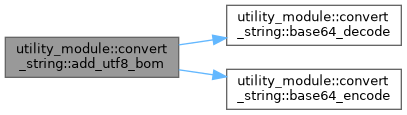
References base64_decode(), and base64_encode().
◆ add_utf8_bom() [2/2]
|
staticprivate |
Adds a UTF-8 BOM to a string if it doesn't already have one.
- Parameters
-
value The input string (UTF-8 encoded).
- Returns
- A new string guaranteed to have the UTF-8 BOM at the start.
◆ base64_decode() [1/2]
|
staticprivate |
Decodes a Base64 string into a byte array.
- Parameters
-
base64_str The Base64 string.
- Returns
- A tuple of:
std::vector<uint8_t>: The decoded bytes (empty on failure).std::optional<std::string>: An error message if decoding fails, otherwisestd::nullopt.
Definition at line 554 of file convert_string.cpp.
◆ base64_decode() [2/2]
|
staticprivate |
Decodes a Base64 string into a byte array.
- Parameters
-
base64_str The Base64 string.
- Returns
- A tuple of:
std::vector<uint8_t>: The decoded bytes (empty on failure).std::optional<std::string>: An error message if decoding fails, otherwisestd::nullopt.
Referenced by add_utf8_bom().

◆ base64_encode() [1/2]
|
staticprivate |
Encodes a byte array into a Base64 string.
- Parameters
-
data The raw byte array.
- Returns
- The Base64-encoded representation.
Definition at line 520 of file convert_string.cpp.
◆ base64_encode() [2/2]
|
staticprivate |
Encodes a byte array into a Base64 string.
- Parameters
-
data The raw byte array.
- Returns
- The Base64-encoded representation.
Referenced by add_utf8_bom().

◆ convert() [1/3]
|
staticprivate |
Converts from one encoding to another using simdutf.
- Template Parameters
-
FromType The input string type. ToType The output string type.
- Parameters
-
value The input string. from_encoding Source encoding name (e.g., "UTF-16LE"). to_encoding Target encoding name (e.g., "UTF-8").
- Returns
- A tuple:
std::optional<ToType>: The converted string on success, orstd::nullopton failure.std::optional<std::string>: The error message if conversion fails.
◆ convert() [2/3]
| auto utility_module::convert_string::convert | ( | const FromType & | value, |
| const std::string & | from_encoding, | ||
| const std::string & | to_encoding ) -> std::tuple<std::optional<ToType>, std::optional<std::string>> |
Definition at line 36 of file convert_string.cpp.
◆ convert() [3/3]
|
staticprivate |
Converts from one encoding to another using simdutf.
- Template Parameters
-
FromType The input string type. ToType The output string type.
- Parameters
-
value The input string. from_encoding Source encoding name (e.g., "UTF-16LE"). to_encoding Target encoding name (e.g., "UTF-8").
- Returns
- A tuple:
std::optional<ToType>: The converted string on success, orstd::nullopton failure.std::optional<std::string>: The error message if conversion fails.
◆ detect_endian() [1/4]
|
staticprivate |
Detects the endianness of a UTF-16 string by checking for BOM or content patterns.
- Parameters
-
value The UTF-16 string.
- Returns
- The detected endianness (little, big, or unknown).
◆ detect_endian() [2/4]
|
staticprivate |
Detects the endianness of a UTF-16 string by checking for BOM or content patterns.
- Parameters
-
value The UTF-16 string.
- Returns
- The detected endianness (little, big, or unknown).
◆ detect_endian() [3/4]
|
staticprivate |
Detects the endianness of a UTF-32 string by checking for BOM or content patterns.
- Parameters
-
value The UTF-32 string.
- Returns
- The detected endianness (little, big, or unknown).
◆ detect_endian() [4/4]
|
staticprivate |
Detects the endianness of a UTF-32 string by checking for BOM or content patterns.
- Parameters
-
value The UTF-32 string.
- Returns
- The detected endianness (little, big, or unknown).
◆ from_base64() [1/2]
|
static |
Decodes a Base64 string into a byte array.
- Parameters
-
base64_str The Base64-encoded string.
- Returns
- A tuple of:
std::vector<uint8_t>: The decoded data. May be empty if decoding fails.std::optional<std::string>: An error message on failure, orstd::nullopton success.
Definition at line 470 of file convert_string.cpp.
◆ from_base64() [2/2]
|
static |
Decodes a Base64 string into a byte array.
- Parameters
-
base64_str The Base64-encoded string.
- Returns
- A tuple of:
std::vector<uint8_t>: The decoded data. May be empty if decoding fails.std::optional<std::string>: An error message on failure, orstd::nullopton success.
◆ get_code_page_name() [1/2]
|
staticprivate |
Retrieves a textual name for a code page (e.g., "CP_ACP" or a locale-based name).
- Parameters
-
code_page The code page integer.
- Returns
- A string representing the code page name, or an empty string if unknown.
Definition at line 374 of file convert_string.cpp.
◆ get_code_page_name() [2/2]
|
staticprivate |
Retrieves a textual name for a code page (e.g., "CP_ACP" or a locale-based name).
- Parameters
-
code_page The code page integer.
- Returns
- A string representing the code page name, or an empty string if unknown.
◆ get_encoding_name() [1/2]
|
staticprivate |
Returns the encoding name string for the given encoding type and endianness.
- Parameters
-
encoding The base encoding (UTF-8, UTF-16, or UTF-32). endian The byte order (little, big) if applicable.
- Returns
- An encoding name string such as "UTF-8" or "UTF-16LE".
Definition at line 248 of file convert_string.cpp.
◆ get_encoding_name() [2/2]
|
staticprivate |
Returns the encoding name string for the given encoding type and endianness.
- Parameters
-
encoding The base encoding (UTF-8, UTF-16, or UTF-32). endian The byte order (little, big) if applicable.
- Returns
- An encoding name string such as "UTF-8" or "UTF-16LE".
◆ get_system_code_page() [1/2]
|
static |
Retrieves the system code page used for conversions.
- Returns
- An integer representing the system code page (e.g., CP_ACP on Windows).
On Unix-like systems, returns UTF-8 (65001) as the default. On Windows, uses GetACP() to detect the system code page.
Definition at line 365 of file convert_string.cpp.
◆ get_system_code_page() [2/2]
|
static |
Retrieves the system code page used for conversions.
- Returns
- An integer representing the system code page (e.g., CP_ACP on Windows).
On Unix-like systems, returns UTF-8 (65001) as the default. On Windows, uses GetACP() to detect the system code page.
◆ get_wchar_encoding() [1/2]
|
staticprivate |
Derives the wchar_t encoding name based on its size and endianness.
- Parameters
-
endian The byte order. Defaults to little-endian.
- Returns
- For example, "UTF-16LE" on Windows or "UTF-32LE" on some Unix-like systems.
Definition at line 274 of file convert_string.cpp.
◆ get_wchar_encoding() [2/2]
|
staticprivate |
Derives the wchar_t encoding name based on its size and endianness.
- Parameters
-
endian The byte order. Defaults to little-endian.
- Returns
- For example, "UTF-16LE" on Windows or "UTF-32LE" on some Unix-like systems.
◆ has_utf8_bom() [1/2]
|
staticprivate |
Checks if a string has a UTF-8 BOM (Byte Order Mark).
- Parameters
-
value The input string (UTF-8 encoded).
- Returns
trueif the string starts with the UTF-8 BOM (0xEF,0xBB,0xBF), elsefalse.
◆ has_utf8_bom() [2/2]
|
staticprivate |
Checks if a string has a UTF-8 BOM (Byte Order Mark).
- Parameters
-
value The input string (UTF-8 encoded).
- Returns
trueif the string starts with the UTF-8 BOM (0xEF,0xBB,0xBF), elsefalse.
◆ remove_utf8_bom() [1/2]
|
staticprivate |
Removes a leading UTF-8 BOM from a string, if present.
- Parameters
-
value The input string (UTF-8 encoded).
- Returns
- A new string without the BOM. If no BOM was present, returns the original string.
◆ remove_utf8_bom() [2/2]
|
staticprivate |
Removes a leading UTF-8 BOM from a string, if present.
- Parameters
-
value The input string (UTF-8 encoded).
- Returns
- A new string without the BOM. If no BOM was present, returns the original string.
◆ replace() [1/2]
|
static |
Replaces all occurrences of token in source with target, in place.
- Parameters
-
source The string to modify. token The substring to find. target The substring to replace tokenwith.
- Returns
std::optional<std::string>containing an error message if replacement fails, orstd::nullopton success.
This function modifies source directly. If token is empty, it returns an error.
Definition at line 476 of file convert_string.cpp.
◆ replace() [2/2]
|
static |
Replaces all occurrences of token in source with target, in place.
- Parameters
-
source The string to modify. token The substring to find. target The substring to replace tokenwith.
- Returns
std::optional<std::string>containing an error message if replacement fails, orstd::nullopton success.
This function modifies source directly. If token is empty, it returns an error.
◆ replace2() [1/2]
|
static |
Replaces all occurrences of token in source with target, returning a new string.
- Parameters
-
source The source string (unchanged). token The substring to find. target The substring to replace tokenwith.
- Returns
- A tuple of:
std::optional<std::string>: The modified string on success.std::optional<std::string>: An error message if replacement fails.
Definition at line 490 of file convert_string.cpp.
◆ replace2() [2/2]
|
static |
Replaces all occurrences of token in source with target, returning a new string.
- Parameters
-
source The source string (unchanged). token The substring to find. target The substring to replace tokenwith.
- Returns
- A tuple of:
std::optional<std::string>: The modified string on success.std::optional<std::string>: An error message if replacement fails.
◆ split() [1/2]
|
static |
Splits a string by a given delimiter.
- Parameters
-
source The source string to split. token The delimiter substring.
- Returns
- A tuple of:
std::optional<std::vector<std::string>>: A vector of tokens on success.std::optional<std::string>: An error message if splitting fails.
If token is empty, splitting cannot proceed and an error is returned.
Definition at line 409 of file convert_string.cpp.
◆ split() [2/2]
|
static |
Splits a string by a given delimiter.
- Parameters
-
source The source string to split. token The delimiter substring.
- Returns
- A tuple of:
std::optional<std::vector<std::string>>: A vector of tokens on success.std::optional<std::string>: An error message if splitting fails.
If token is empty, splitting cannot proceed and an error is returned.
◆ system_to_utf8() [1/2]
|
static |
Converts a system-encoded string to UTF-8.
- Parameters
-
value The input string in system encoding.
- Returns
- A tuple of:
std::optional<std::string>: The UTF-8 encoded string on success.std::optional<std::string>: An error message on failure.
Definition at line 385 of file convert_string.cpp.
◆ system_to_utf8() [2/2]
|
static |
Converts a system-encoded string to UTF-8.
- Parameters
-
value The input string in system encoding.
- Returns
- A tuple of:
std::optional<std::string>: The UTF-8 encoded string on success.std::optional<std::string>: An error message on failure.
◆ to_array() [1/2]
|
static |
Converts a system-encoded string to a UTF-8 byte array.
- Parameters
-
value The input string in system encoding.
- Returns
- A tuple of:
std::optional<std::vector<uint8_t>>: The UTF-8 byte array on success.std::optional<std::string>: An error message on failure.
Definition at line 433 of file convert_string.cpp.
◆ to_array() [2/2]
|
static |
Converts a system-encoded string to a UTF-8 byte array.
- Parameters
-
value The input string in system encoding.
- Returns
- A tuple of:
std::optional<std::vector<uint8_t>>: The UTF-8 byte array on success.std::optional<std::string>: An error message on failure.
◆ to_base64() [1/2]
|
static |
Encodes a byte array into a Base64 string.
- Parameters
-
value The raw byte array to encode.
- Returns
- A tuple of:
std::optional<std::string>: The Base64-encoded string on success.std::optional<std::string>: An error message if encoding fails.
Typically, Base64 encoding should not fail unless the input is extremely large and memory allocation fails.
Definition at line 456 of file convert_string.cpp.
◆ to_base64() [2/2]
|
static |
Encodes a byte array into a Base64 string.
- Parameters
-
value The raw byte array to encode.
- Returns
- A tuple of:
std::optional<std::string>: The Base64-encoded string on success.std::optional<std::string>: An error message if encoding fails.
Typically, Base64 encoding should not fail unless the input is extremely large and memory allocation fails.
◆ to_string() [1/6]
|
static |
Converts a UTF-8 byte array to a system-encoded string.
- Parameters
-
value The input byte array.
- Returns
- A tuple with:
std::optional<std::string>: The system-encoded string on success.std::optional<std::string>: An error message on failure.
Definition at line 447 of file convert_string.cpp.
◆ to_string() [2/6]
|
static |
Converts a UTF-8 byte array to a system-encoded string.
- Parameters
-
value The input byte array.
- Returns
- A tuple with:
std::optional<std::string>: The system-encoded string on success.std::optional<std::string>: An error message on failure.
◆ to_string() [3/6]
|
static |
Converts a std::wstring to a std::string using the system encoding.
- Parameters
-
value The wide-string input.
- Returns
- A tuple of:
std::optional<std::string>: The converted narrow string on success, orstd::nullopton failure.std::optional<std::string>: The error message if conversion fails, otherwisestd::nullopt.
Uses simdutf for SIMD-accelerated UTF-8/UTF-16/UTF-32 transcoding on all platforms.
Definition at line 188 of file convert_string.cpp.
◆ to_string() [4/6]
|
static |
Converts a std::wstring to a std::string using the system encoding.
- Parameters
-
value The wide-string input.
- Returns
- A tuple of:
std::optional<std::string>: The converted narrow string on success, orstd::nullopton failure.std::optional<std::string>: The error message if conversion fails, otherwisestd::nullopt.
Uses simdutf for SIMD-accelerated UTF-8/UTF-16/UTF-32 transcoding on all platforms.
◆ to_string() [5/6]
|
static |
Converts a std::wstring_view to a std::string using the system encoding.
- Parameters
-
value The wide-string view.
- Returns
- Same tuple semantics as
to_string(const std::wstring&).
This is a convenience overload for handling string views without copying the entire wide string first.
Definition at line 203 of file convert_string.cpp.
◆ to_string() [6/6]
|
static |
Converts a std::wstring_view to a std::string using the system encoding.
- Parameters
-
value The wide-string view.
- Returns
- Same tuple semantics as
to_string(const std::wstring&).
This is a convenience overload for handling string views without copying the entire wide string first.
◆ to_wstring() [1/4]
|
static |
Converts a std::string (system-encoded) to a std::wstring.
- Parameters
-
value The narrow string in system encoding.
- Returns
- A tuple containing:
std::optional<std::wstring>: The converted wide string on success.std::optional<std::string>: An error message if conversion fails.
Definition at line 218 of file convert_string.cpp.
◆ to_wstring() [2/4]
|
static |
Converts a std::string (system-encoded) to a std::wstring.
- Parameters
-
value The narrow string in system encoding.
- Returns
- A tuple containing:
std::optional<std::wstring>: The converted wide string on success.std::optional<std::string>: An error message if conversion fails.
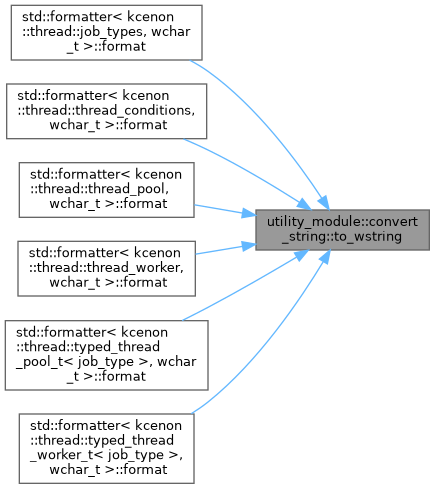
Referenced by std::formatter< kcenon::thread::job_types, wchar_t >::format(), std::formatter< kcenon::thread::thread_conditions, wchar_t >::format(), std::formatter< kcenon::thread::thread_pool, wchar_t >::format(), std::formatter< kcenon::thread::thread_worker, wchar_t >::format(), std::formatter< kcenon::thread::typed_thread_pool_t< job_type >, wchar_t >::format(), and std::formatter< kcenon::thread::typed_thread_worker_t< job_type >, wchar_t >::format().
◆ to_wstring() [3/4]
|
static |
Converts a std::string_view (system-encoded) to a std::wstring.
- Parameters
-
value The narrow string view in system encoding.
- Returns
- Same tuple semantics as
to_wstring(const std::string&).
Definition at line 233 of file convert_string.cpp.
◆ to_wstring() [4/4]
|
static |
Converts a std::string_view (system-encoded) to a std::wstring.
- Parameters
-
value The narrow string view in system encoding.
- Returns
- Same tuple semantics as
to_wstring(const std::string&).
◆ utf8_to_system() [1/2]
|
static |
Converts a UTF-8 encoded string to the system encoding.
- Parameters
-
value The UTF-8 encoded input string.
- Returns
- Same tuple semantics as
system_to_utf8().
Definition at line 397 of file convert_string.cpp.
◆ utf8_to_system() [2/2]
|
static |
Converts a UTF-8 encoded string to the system encoding.
- Parameters
-
value The UTF-8 encoded input string.
- Returns
- Same tuple semantics as
system_to_utf8().
The documentation for this class was generated from the following files:
- utilities/include/convert_string.h
- include/kcenon/thread/utils/convert_string.h
- src/utils/convert_string.cpp