NUMA (Non-Uniform Memory Access) topology information. More...
#include <numa_topology.h>
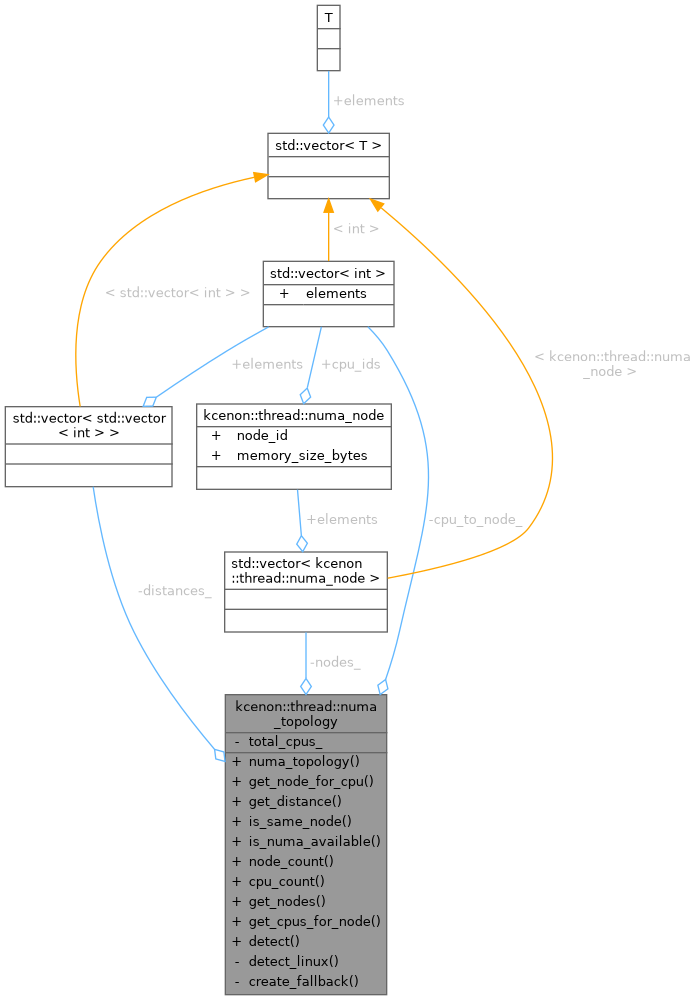
Public Member Functions | |
| numa_topology ()=default | |
| Default constructor - creates an empty topology. | |
| auto | get_node_for_cpu (int cpu_id) const -> int |
| Get the NUMA node for a given CPU. | |
| auto | get_distance (int node1, int node2) const -> int |
| Get the distance between two NUMA nodes. | |
| auto | is_same_node (int cpu1, int cpu2) const -> bool |
| Check if two CPUs are on the same NUMA node. | |
| auto | is_numa_available () const -> bool |
| Check if NUMA is available on this system. | |
| auto | node_count () const -> std::size_t |
| Get the number of NUMA nodes. | |
| auto | cpu_count () const -> std::size_t |
| Get the total number of CPUs. | |
| auto | get_nodes () const -> const std::vector< numa_node > & |
| Get all NUMA nodes. | |
| auto | get_cpus_for_node (int node_id) const -> std::vector< int > |
| Get CPUs belonging to a specific node. | |
Static Public Member Functions | |
| static auto | detect () -> numa_topology |
| Detect and return the system's NUMA topology. | |
Static Private Member Functions | |
| static auto | detect_linux () -> numa_topology |
| Detect topology on Linux using sysfs. | |
| static auto | create_fallback () -> numa_topology |
| Create fallback single-node topology. | |
Private Attributes | |
| std::vector< numa_node > | nodes_ |
| All NUMA nodes. | |
| std::vector< int > | cpu_to_node_ |
| CPU ID -> NUMA node mapping. | |
| std::vector< std::vector< int > > | distances_ |
| Inter-node distances. | |
| std::size_t | total_cpus_ {0} |
| Total CPU count. | |
Detailed Description
NUMA (Non-Uniform Memory Access) topology information.
This class provides information about the system's NUMA topology, including the number of NUMA nodes, which CPUs belong to which nodes, and the distances between nodes.
Thread Safety
All methods are thread-safe after construction. The topology is detected once during construction and remains immutable.
Platform Support
- Linux: Full support via /sys/devices/system/node
- macOS: Falls back to single-node topology (no NUMA on macOS)
- Windows: Falls back to single-node topology (could be extended)
Usage Example
Definition at line 67 of file numa_topology.h.
Constructor & Destructor Documentation
◆ numa_topology()
|
default |
Default constructor - creates an empty topology.
Member Function Documentation
◆ cpu_count()
|
nodiscard |
Get the total number of CPUs.
- Returns
- Total CPU count
Definition at line 81 of file numa_topology.cpp.
References total_cpus_.
◆ create_fallback()
|
staticprivate |
Create fallback single-node topology.
- Returns
- Single-node topology with all CPUs
Definition at line 274 of file numa_topology.cpp.
References kcenon::thread::numa_node::cpu_ids, cpu_to_node_, distances_, kcenon::thread::numa_node::memory_size_bytes, kcenon::thread::numa_node::node_id, nodes_, and total_cpus_.
◆ detect()
|
staticnodiscard |
Detect and return the system's NUMA topology.
- Returns
- numa_topology object with detected information
This static method detects the NUMA topology of the current system. On non-NUMA systems or unsupported platforms, it returns a single-node topology with all CPUs.
Definition at line 21 of file numa_topology.cpp.
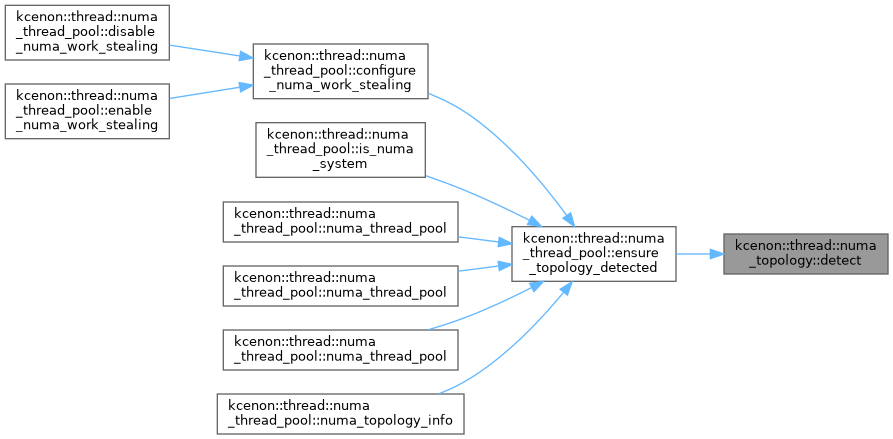
Referenced by kcenon::thread::numa_thread_pool::ensure_topology_detected().
◆ detect_linux()
|
staticprivate |
Detect topology on Linux using sysfs.
◆ get_cpus_for_node()
|
nodiscard |
Get CPUs belonging to a specific node.
- Parameters
-
node_id NUMA node ID
- Returns
- Vector of CPU IDs, empty if node not found
Definition at line 91 of file numa_topology.cpp.
◆ get_distance()
|
nodiscard |
Get the distance between two NUMA nodes.
- Parameters
-
node1 First NUMA node ID node2 Second NUMA node ID
- Returns
- Distance value (10 = local, higher = farther), or -1 if invalid
The distance is a relative measure where:
- 10 typically means local (same node)
- Higher values indicate greater latency/bandwidth cost
Definition at line 40 of file numa_topology.cpp.
◆ get_node_for_cpu()
|
nodiscard |
Get the NUMA node for a given CPU.
- Parameters
-
cpu_id The CPU identifier
- Returns
- NUMA node ID, or -1 if CPU not found
Definition at line 31 of file numa_topology.cpp.
◆ get_nodes()
|
nodiscard |
Get all NUMA nodes.
- Returns
- Vector of numa_node structures
Definition at line 86 of file numa_topology.cpp.
References nodes_.
◆ is_numa_available()
|
nodiscard |
Check if NUMA is available on this system.
- Returns
- true if system has multiple NUMA nodes
Definition at line 71 of file numa_topology.cpp.
References nodes_.
Referenced by kcenon::thread::numa_thread_pool::is_numa_system().

◆ is_same_node()
|
nodiscard |
Check if two CPUs are on the same NUMA node.
- Parameters
-
cpu1 First CPU ID cpu2 Second CPU ID
- Returns
- true if both CPUs are on the same node
Definition at line 58 of file numa_topology.cpp.
◆ node_count()
|
nodiscard |
Get the number of NUMA nodes.
- Returns
- Number of NUMA nodes
Definition at line 76 of file numa_topology.cpp.
References nodes_.
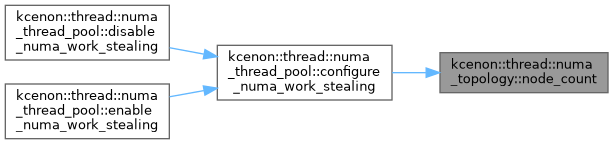
Referenced by kcenon::thread::numa_thread_pool::configure_numa_work_stealing().
Member Data Documentation
◆ cpu_to_node_
|
private |
CPU ID -> NUMA node mapping.
Definition at line 145 of file numa_topology.h.
Referenced by create_fallback().
◆ distances_
|
private |
Inter-node distances.
Definition at line 146 of file numa_topology.h.
Referenced by create_fallback().
◆ nodes_
|
private |
All NUMA nodes.
Definition at line 144 of file numa_topology.h.
Referenced by create_fallback(), get_nodes(), is_numa_available(), and node_count().
◆ total_cpus_
|
private |
Total CPU count.
Definition at line 147 of file numa_topology.h.
Referenced by cpu_count(), and create_fallback().
The documentation for this class was generated from the following files:
- include/kcenon/thread/stealing/numa_topology.h
- src/stealing/numa_topology.cpp