Lock-free work-stealing deque based on Chase-Lev algorithm. More...
#include <work_stealing_deque.h>
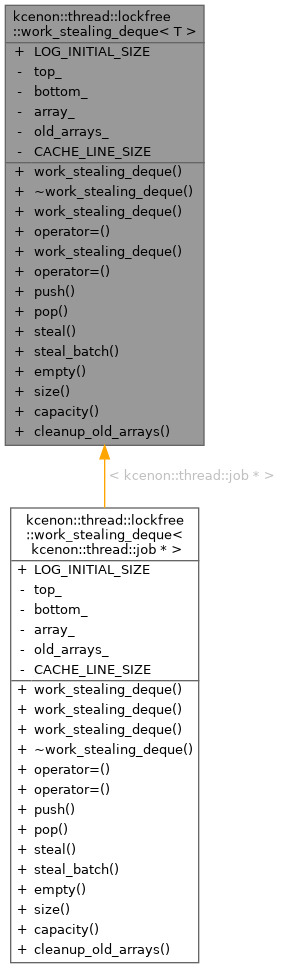
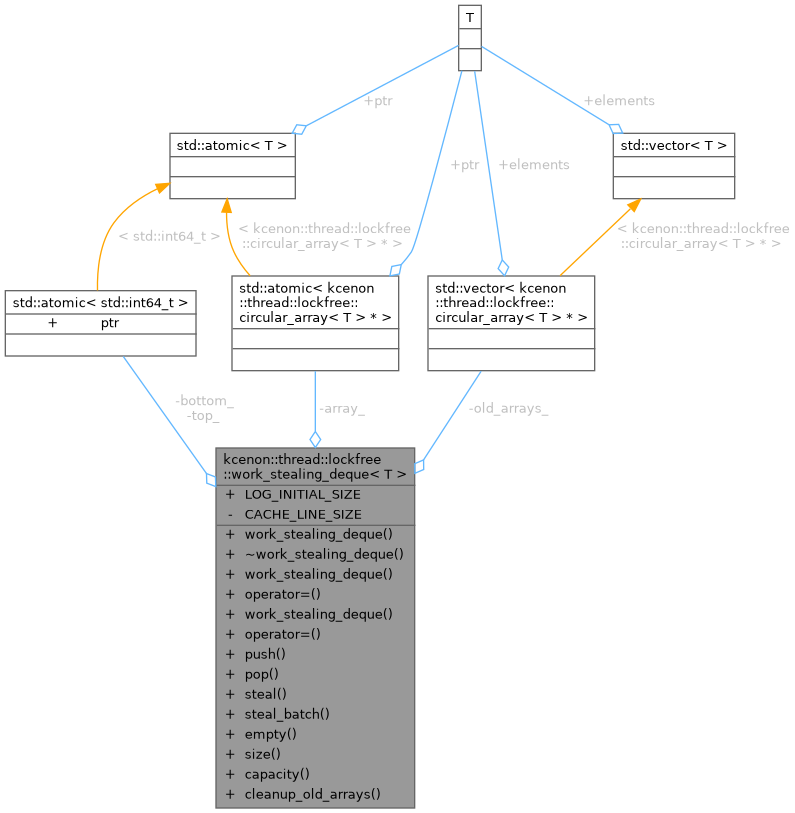
Public Member Functions | |
| work_stealing_deque (std::size_t log_initial_size=LOG_INITIAL_SIZE) | |
| Constructs an empty work-stealing deque. | |
| ~work_stealing_deque () | |
| Destructor - cleans up the circular array. | |
| work_stealing_deque (const work_stealing_deque &)=delete | |
| work_stealing_deque & | operator= (const work_stealing_deque &)=delete |
| work_stealing_deque (work_stealing_deque &&)=delete | |
| work_stealing_deque & | operator= (work_stealing_deque &&)=delete |
| void | push (T item) |
| Push an element onto the bottom of the deque (owner only) | |
| std::optional< T > | pop () |
| Pop an element from the bottom of the deque (owner only) | |
| std::optional< T > | steal () |
| Steal an element from the top of the deque (thief threads) | |
| std::vector< T > | steal_batch (std::size_t max_count) |
| Steal multiple elements from the top of the deque (thief threads) | |
| bool | empty () const noexcept |
| Check if the deque appears empty. | |
| std::size_t | size () const noexcept |
| Get approximate size of the deque. | |
| std::size_t | capacity () const noexcept |
| Get the capacity of the current array. | |
| void | cleanup_old_arrays () |
| Clear all old arrays (for memory cleanup) | |
Static Public Attributes | |
| static constexpr std::size_t | LOG_INITIAL_SIZE = 5 |
| Default initial log capacity (2^LOG_INITIAL_SIZE = 32 elements) | |
Private Attributes | |
| std::atomic< std::int64_t > | top_ |
| std::atomic< std::int64_t > | bottom_ |
| std::atomic< circular_array< T > * > | array_ |
| std::vector< circular_array< T > * > | old_arrays_ |
Static Private Attributes | |
| static constexpr std::size_t | CACHE_LINE_SIZE = 64 |
Detailed Description
class kcenon::thread::lockfree::work_stealing_deque< T >
Lock-free work-stealing deque based on Chase-Lev algorithm.
This class implements a work-stealing deque (double-ended queue) using the Chase-Lev algorithm. It provides efficient local operations for the owner thread (push/pop) and concurrent stealing for other threads.
Key Features:
- Owner-side push/pop: LIFO order for cache locality
- Thief-side steal: FIFO order for fairness
- Lock-free operations with proper memory ordering
- Dynamic resizing when full
Algorithm Reference: "Dynamic Circular Work-Stealing Deque" (Chase & Lev, 2005)
Memory Layout:
Thread Safety:
- push(): Single-threaded (owner only)
- pop(): Single-threaded (owner only)
- steal(): Multi-threaded (any thief)
- empty()/size(): Any thread (approximate)
- Template Parameters
-
T Element type (must be pointer or trivially copyable)
- Note
- For use with job*, ensure T = job*
Definition at line 36 of file numa_work_stealer.h.
Constructor & Destructor Documentation
◆ work_stealing_deque() [1/3]
|
inlineexplicit |
Constructs an empty work-stealing deque.
- Parameters
-
log_initial_size Initial capacity as log base 2 (default: 5, i.e., 32 elements)
Definition at line 156 of file work_stealing_deque.h.
◆ ~work_stealing_deque()
|
inline |
Destructor - cleans up the circular array.
Definition at line 165 of file work_stealing_deque.h.
References kcenon::thread::lockfree::work_stealing_deque< T >::array_.
◆ work_stealing_deque() [2/3]
|
delete |
◆ work_stealing_deque() [3/3]
|
delete |
Member Function Documentation
◆ capacity()
|
inlinenodiscardnoexcept |
Get the capacity of the current array.
- Returns
- Current capacity
Definition at line 375 of file work_stealing_deque.h.
References kcenon::thread::lockfree::work_stealing_deque< T >::array_.
◆ cleanup_old_arrays()
|
inline |
Clear all old arrays (for memory cleanup)
- Note
- Should only be called when no operations are in progress. Typically called during shutdown or periodic cleanup.
Definition at line 385 of file work_stealing_deque.h.
References kcenon::thread::lockfree::work_stealing_deque< T >::old_arrays_.
◆ empty()
|
inlinenodiscardnoexcept |
Check if the deque appears empty.
- Returns
- true if the deque appears empty, false otherwise
- Note
- This is a snapshot view; the deque may change immediately after. Use for hints only, not for synchronization.
Definition at line 352 of file work_stealing_deque.h.
References kcenon::thread::lockfree::work_stealing_deque< T >::bottom_, and kcenon::thread::lockfree::work_stealing_deque< T >::top_.
◆ operator=() [1/2]
|
delete |
◆ operator=() [2/2]
|
delete |
◆ pop()
|
inlinenodiscard |
Pop an element from the bottom of the deque (owner only)
- Returns
- The popped element, or std::nullopt if empty
Time Complexity: O(1)
- Note
- This method should only be called by the owner thread. Uses LIFO order for better cache locality.
Definition at line 214 of file work_stealing_deque.h.
References kcenon::thread::lockfree::work_stealing_deque< T >::array_, kcenon::thread::lockfree::work_stealing_deque< T >::bottom_, kcenon::thread::lockfree::circular_array< T >::get(), and kcenon::thread::lockfree::work_stealing_deque< T >::top_.

◆ push()
|
inline |
Push an element onto the bottom of the deque (owner only)
- Parameters
-
item Element to push
Time Complexity: O(1) amortized (O(n) when resizing)
- Note
- This method should only be called by the owner thread. Calling from multiple threads results in undefined behavior.
Definition at line 184 of file work_stealing_deque.h.
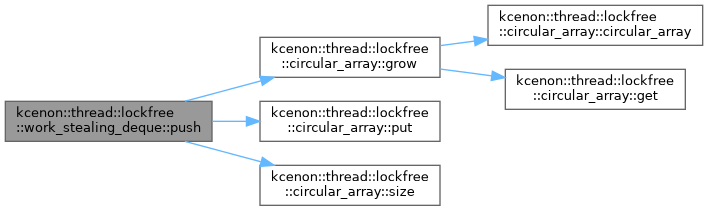
References kcenon::thread::lockfree::work_stealing_deque< T >::array_, kcenon::thread::lockfree::work_stealing_deque< T >::bottom_, kcenon::thread::lockfree::circular_array< T >::grow(), kcenon::thread::lockfree::work_stealing_deque< T >::old_arrays_, kcenon::thread::lockfree::circular_array< T >::put(), kcenon::thread::lockfree::circular_array< T >::size(), and kcenon::thread::lockfree::work_stealing_deque< T >::top_.
◆ size()
|
inlinenodiscardnoexcept |
Get approximate size of the deque.
- Returns
- Approximate number of elements
- Note
- This is a best-effort estimate due to concurrent modifications.
Definition at line 364 of file work_stealing_deque.h.
References kcenon::thread::lockfree::work_stealing_deque< T >::bottom_, and kcenon::thread::lockfree::work_stealing_deque< T >::top_.
◆ steal()
|
inlinenodiscard |
Steal an element from the top of the deque (thief threads)
- Returns
- The stolen element, or std::nullopt if empty or contention
Time Complexity: O(1)
- Note
- This method can be called concurrently by multiple thief threads. Uses FIFO order for fairness.
Definition at line 253 of file work_stealing_deque.h.
References kcenon::thread::lockfree::work_stealing_deque< T >::array_, kcenon::thread::lockfree::work_stealing_deque< T >::bottom_, kcenon::thread::lockfree::circular_array< T >::get(), and kcenon::thread::lockfree::work_stealing_deque< T >::top_.

◆ steal_batch()
|
inlinenodiscard |
Steal multiple elements from the top of the deque (thief threads)
- Parameters
-
max_count Maximum number of elements to steal
- Returns
- Vector of stolen elements (may be empty or smaller than max_count)
Time Complexity: O(max_count)
This method attempts to steal up to max_count elements atomically. The batch steal uses a CAS loop to claim a range of elements from the top.
Key behaviors:
- Returns empty vector if deque is empty or contention prevents stealing
- May return fewer elements than requested if deque has fewer elements
- All returned elements are guaranteed to have been successfully claimed
- Uses FIFO order (oldest elements first)
Memory Ordering:
- Uses seq_cst for top CAS to ensure proper synchronization
- Uses acquire/release for reading bottom and array
- Note
- This method can be called concurrently by multiple thief threads. Batch stealing is more efficient than repeated single steals when multiple items need to be transferred.
Definition at line 299 of file work_stealing_deque.h.
References kcenon::thread::lockfree::work_stealing_deque< T >::array_, kcenon::thread::lockfree::work_stealing_deque< T >::bottom_, kcenon::thread::lockfree::circular_array< T >::get(), and kcenon::thread::lockfree::work_stealing_deque< T >::top_.

Member Data Documentation
◆ array_
|
private |
Definition at line 398 of file work_stealing_deque.h.
Referenced by kcenon::thread::lockfree::work_stealing_deque< T >::capacity(), kcenon::thread::lockfree::work_stealing_deque< T >::pop(), kcenon::thread::lockfree::work_stealing_deque< T >::push(), kcenon::thread::lockfree::work_stealing_deque< T >::steal(), kcenon::thread::lockfree::work_stealing_deque< T >::steal_batch(), and kcenon::thread::lockfree::work_stealing_deque< T >::~work_stealing_deque().
◆ bottom_
|
private |
Definition at line 397 of file work_stealing_deque.h.
Referenced by kcenon::thread::lockfree::work_stealing_deque< T >::empty(), kcenon::thread::lockfree::work_stealing_deque< T >::pop(), kcenon::thread::lockfree::work_stealing_deque< T >::push(), kcenon::thread::lockfree::work_stealing_deque< T >::size(), kcenon::thread::lockfree::work_stealing_deque< T >::steal(), and kcenon::thread::lockfree::work_stealing_deque< T >::steal_batch().
◆ CACHE_LINE_SIZE
|
staticconstexprprivate |
Definition at line 394 of file work_stealing_deque.h.
◆ LOG_INITIAL_SIZE
|
staticconstexpr |
Default initial log capacity (2^LOG_INITIAL_SIZE = 32 elements)
Definition at line 150 of file work_stealing_deque.h.
◆ old_arrays_
|
private |
Definition at line 401 of file work_stealing_deque.h.
Referenced by kcenon::thread::lockfree::work_stealing_deque< T >::cleanup_old_arrays(), and kcenon::thread::lockfree::work_stealing_deque< T >::push().
◆ top_
|
private |
Definition at line 396 of file work_stealing_deque.h.
Referenced by kcenon::thread::lockfree::work_stealing_deque< T >::empty(), kcenon::thread::lockfree::work_stealing_deque< T >::pop(), kcenon::thread::lockfree::work_stealing_deque< T >::push(), kcenon::thread::lockfree::work_stealing_deque< T >::size(), kcenon::thread::lockfree::work_stealing_deque< T >::steal(), and kcenon::thread::lockfree::work_stealing_deque< T >::steal_batch().
The documentation for this class was generated from the following files:
- include/kcenon/thread/lockfree/work_stealing_deque.h
- include/kcenon/thread/stealing/numa_work_stealer.h