Domain managing hazard pointers and retirement for a specific type. More...
#include <hazard_pointer.h>
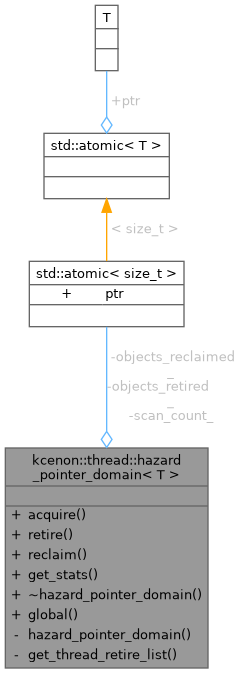
Classes | |
| struct | stats |
| Get statistics. More... | |
| struct | thread_retire_list |
Public Member Functions | |
| hazard_pointer | acquire () |
| Acquire a hazard pointer for this domain. | |
| void | retire (T *ptr) |
| Retire an object for later reclamation. | |
| size_t | reclaim () |
| Force reclamation scan (optional, for testing) | |
| stats | get_stats () const |
| ~hazard_pointer_domain () | |
| Destructor - ensures all retire objects are reclaimed. | |
Static Public Member Functions | |
| static hazard_pointer_domain & | global () |
| Get the global domain instance for type T. | |
Private Member Functions | |
| hazard_pointer_domain ()=default | |
Static Private Member Functions | |
| static thread_retire_list & | get_thread_retire_list () |
Private Attributes | |
| std::atomic< size_t > | objects_retired_ {0} |
| std::atomic< size_t > | objects_reclaimed_ {0} |
| std::atomic< size_t > | scan_count_ {0} |
Detailed Description
class kcenon::thread::hazard_pointer_domain< T >
Domain managing hazard pointers and retirement for a specific type.
- Template Parameters
-
T Type of objects protected by this domain
Definition at line 165 of file hazard_pointer.h.
Constructor & Destructor Documentation
◆ ~hazard_pointer_domain()
| kcenon::thread::hazard_pointer_domain< T >::~hazard_pointer_domain | ( | ) |
Destructor - ensures all retire objects are reclaimed.
Definition at line 292 of file hazard_pointer.h.
◆ hazard_pointer_domain()
|
privatedefault |
Member Function Documentation
◆ acquire()
|
inline |
Acquire a hazard pointer for this domain.
- Returns
- Hazard pointer that will automatically release on destruction
Definition at line 175 of file hazard_pointer.h.
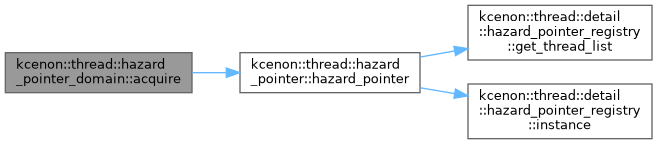
References kcenon::thread::hazard_pointer::hazard_pointer().
◆ get_stats()
| auto kcenon::thread::hazard_pointer_domain< T >::get_stats | ( | ) | const |
Definition at line 281 of file hazard_pointer.h.
References kcenon::thread::detail::hazard_pointer_registry::instance(), and kcenon::thread::detail::thread_hazard_list::MAX_HAZARDS_PER_THREAD.

◆ get_thread_retire_list()
|
inlinestaticprivate |
Definition at line 230 of file hazard_pointer.h.
◆ global()
|
inlinestatic |
Get the global domain instance for type T.
Definition at line 168 of file hazard_pointer.h.
◆ reclaim()
| size_t kcenon::thread::hazard_pointer_domain< T >::reclaim | ( | ) |
Force reclamation scan (optional, for testing)
- Returns
- Number of objects reclaimed
Definition at line 261 of file hazard_pointer.h.
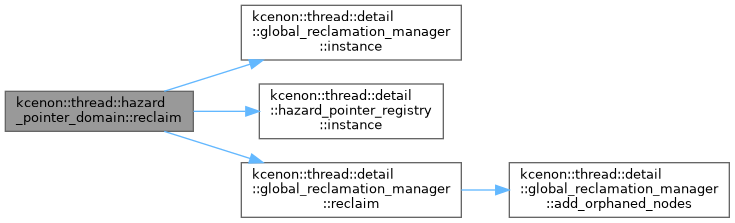
References kcenon::thread::detail::global_reclamation_manager::instance(), kcenon::thread::detail::hazard_pointer_registry::instance(), and kcenon::thread::detail::global_reclamation_manager::reclaim().
◆ retire()
| void kcenon::thread::hazard_pointer_domain< T >::retire | ( | T * | ptr | ) |
Retire an object for later reclamation.
- Parameters
-
ptr Pointer to object to retire
- Note
- Object will be deleted when no hazard pointers protect it
Definition at line 244 of file hazard_pointer.h.
Member Data Documentation
◆ objects_reclaimed_
|
mutableprivate |
Definition at line 237 of file hazard_pointer.h.
◆ objects_retired_
|
mutableprivate |
Definition at line 236 of file hazard_pointer.h.
◆ scan_count_
|
mutableprivate |
Definition at line 238 of file hazard_pointer.h.
The documentation for this class was generated from the following file:
- include/kcenon/thread/core/hazard_pointer.h