Loading...
Searching...
No Matches
Minimal TCP echo server using the facade API. More...
#include <kcenon/network/facade/tcp_facade.h>#include <kcenon/network/interfaces/i_session.h>#include <atomic>#include <chrono>#include <csignal>#include <iostream>#include <map>#include <mutex>#include <string>#include <thread>
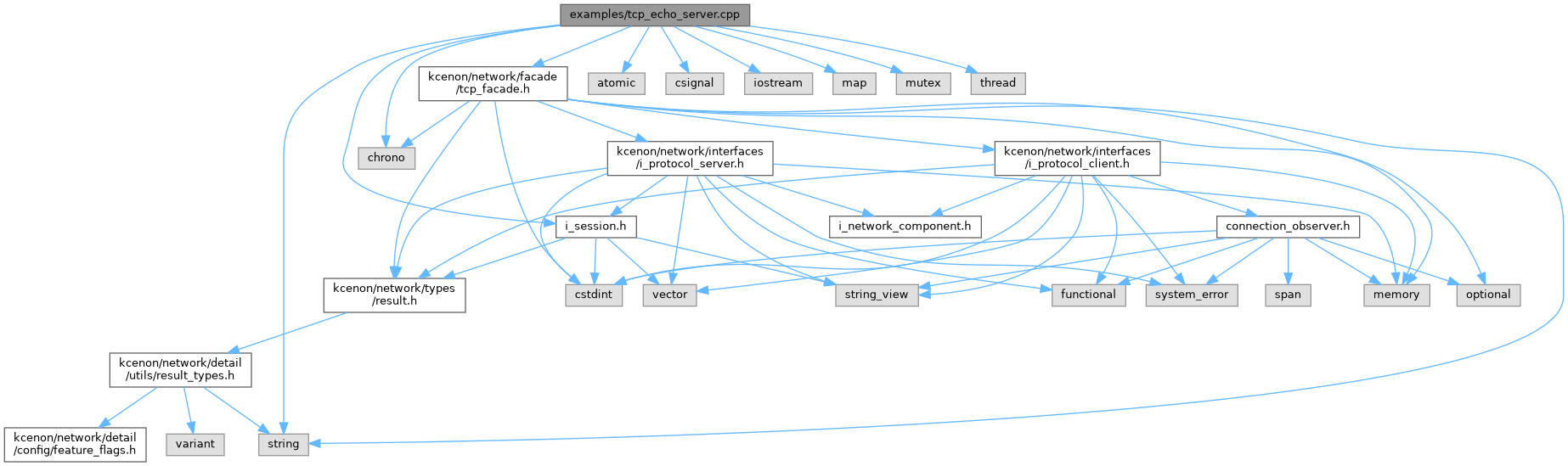
Include dependency graph for tcp_echo_server.cpp:
Go to the source code of this file.
Functions | |
| void | signal_handler (int) |
| int | main () |
Variables | |
| static std::atomic< bool > | g_running {true} |
Detailed Description
Minimal TCP echo server using the facade API.
Definition in file tcp_echo_server.cpp.
Function Documentation
◆ main()
| int main | ( | ) |
Definition at line 52 of file tcp_echo_server.cpp.
52 {
53 std::cout << "=== TCP Echo Server Example ===" << std::endl;
54
55 // Register signal handler for graceful shutdown
56 std::signal(SIGINT, signal_handler);
57 std::signal(SIGTERM, signal_handler);
58
59 // Create TCP facade and server
61 constexpr uint16_t port = 9000;
62
64 .port = port,
65 .server_id = "EchoServer",
66 });
67
68 // Thread-safe session storage for echoing data back
69 std::mutex sessions_mutex;
70 std::map<std::string, std::shared_ptr<interfaces::i_session>> sessions;
71
72 // Track new connections
73 server->set_connection_callback(
74 [&sessions, &sessions_mutex](std::shared_ptr<interfaces::i_session> session) {
75 std::lock_guard<std::mutex> lock(sessions_mutex);
76 std::string id(session->id());
77 sessions[id] = session;
78 std::cout << "[Server] Client connected: " << id << std::endl;
79 });
80
81 // Track disconnections
82 server->set_disconnection_callback(
83 [&sessions, &sessions_mutex](std::string_view session_id) {
84 std::lock_guard<std::mutex> lock(sessions_mutex);
85 sessions.erase(std::string(session_id));
86 std::cout << "[Server] Client disconnected: " << session_id << std::endl;
87 });
88
89 // Echo received data back to the sender
90 server->set_receive_callback(
91 [&sessions, &sessions_mutex](std::string_view session_id,
92 const std::vector<uint8_t>& data) {
95 << std::endl;
96
97 // Find the session and echo data back
98 std::shared_ptr<interfaces::i_session> session;
99 {
100 std::lock_guard<std::mutex> lock(sessions_mutex);
101 auto it = sessions.find(std::string(session_id));
102 if (it != sessions.end()) {
103 session = it->second;
104 }
105 }
106
107 if (session) {
108 auto result = session->send(std::vector<uint8_t>(data));
109 if (result.is_err()) {
110 std::cerr << "[Server] Echo failed: " << result.error().message
111 << std::endl;
112 }
113 }
114 });
115
116 // Log errors
117 server->set_error_callback(
118 [](std::string_view session_id, std::error_code ec) {
119 std::cerr << "[Server] Error on " << session_id << ": " << ec.message()
120 << std::endl;
121 });
122
123 // Start the server
125 if (result.is_err()) {
126 std::cerr << "Failed to start server: " << result.error().message << std::endl;
127 return 1;
128 }
129
130 std::cout << "[Server] Listening on port " << port << std::endl;
131 std::cout << "[Server] Press Ctrl+C to stop." << std::endl;
132
133 // Main loop: wait until shutdown signal
135 std::this_thread::sleep_for(std::chrono::milliseconds(100));
136 }
137
138 // Graceful shutdown
139 std::cout << "\n[Server] Shutting down..." << std::endl;
141 if (stop_result.is_err()) {
142 std::cerr << "[Server] Stop error: " << stop_result.error().message << std::endl;
143 }
144
145 std::cout << "[Server] Stopped." << std::endl;
146 return 0;
147}
Simplified facade for creating TCP clients and servers.
Definition tcp_facade.h:95
References g_running, kcenon::network::message, and signal_handler().
Here is the call graph for this function:

◆ signal_handler()
| void signal_handler | ( | int | ) |
Definition at line 48 of file tcp_echo_server.cpp.
References g_running.
Referenced by main().
Here is the caller graph for this function:

Variable Documentation
◆ g_running
|
static |
Definition at line 46 of file tcp_echo_server.cpp.
46{true};
Referenced by main(), and signal_handler().