Functions | |
| auto | create_connection (std::string_view id="") -> std::unique_ptr< unified::i_connection > |
| Creates a WebSocket connection (not yet started) | |
| auto | connect (std::string_view url, std::string_view id="") -> std::unique_ptr< unified::i_connection > |
| Creates and starts a WebSocket connection in one call. | |
| auto | connect (const unified::endpoint_info &endpoint, std::string_view path="/", std::string_view id="") -> std::unique_ptr< unified::i_connection > |
| Creates and starts a WebSocket connection using endpoint info. | |
| auto | create_listener (std::string_view id="") -> std::unique_ptr< unified::i_listener > |
| Creates a WebSocket listener (not yet listening) | |
| auto | listen (const unified::endpoint_info &bind_address, std::string_view path="/", std::string_view id="") -> std::unique_ptr< unified::i_listener > |
| Creates and starts a WebSocket listener in one call. | |
| auto | listen (uint16_t port, std::string_view path="/", std::string_view id="") -> std::unique_ptr< unified::i_listener > |
| Creates and starts a WebSocket listener on a specific port. | |
Function Documentation
◆ connect() [1/2]
|
nodiscard |
Creates and starts a WebSocket connection using endpoint info.
- Parameters
-
endpoint The endpoint with host and port path The WebSocket path (default: "/") id Optional unique identifier for the connection
- Returns
- Unique pointer to an i_connection instance (connecting)
This overload is useful when host and port are known separately. The connection will use plain WebSocket (ws://).
Usage Example
Definition at line 47 of file websocket.cpp.
◆ connect() [2/2]
|
nodiscard |
Creates and starts a WebSocket connection in one call.
- Parameters
-
url The WebSocket URL to connect to (ws:// or wss://) id Optional unique identifier for the connection
- Returns
- Unique pointer to an i_connection instance (connecting)
This is a convenience function that creates a WebSocket connection and immediately initiates the connection with the specified URL.
URL Format
ws://host:port/path- Plain WebSocketwss://host:port/path- Secure WebSocket (TLS)- Port defaults to 80 for ws:// and 443 for wss:// if not specified
Usage Example
Definition at line 39 of file websocket.cpp.
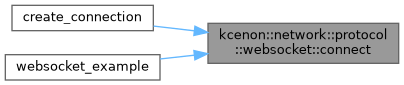
References create_connection().
Referenced by create_connection(), and websocket_example().

◆ create_connection()
|
nodiscard |
Creates a WebSocket connection (not yet started)
- Parameters
-
id Optional unique identifier for the connection
- Returns
- Unique pointer to an i_connection instance
The returned connection is not started. Call connect() with a URL to establish the WebSocket connection.
WebSocket Semantics
WebSocket is a full-duplex protocol over TCP. The connection starts with an HTTP upgrade handshake.
- connect() accepts URLs like "ws://host:port/path" or "wss://host:port/path"
- is_connected() returns true after successful handshake
- send() sends binary frames (use underlying client for text)
Usage Example
Definition at line 33 of file websocket.cpp.
Referenced by connect().

◆ create_listener()
|
nodiscard |
Creates a WebSocket listener (not yet listening)
- Parameters
-
id Optional unique identifier for the listener
- Returns
- Unique pointer to an i_listener instance
The returned listener is not listening. Call start() to begin accepting WebSocket connections.
WebSocket Server Semantics
WebSocket servers accept HTTP upgrade requests and establish full-duplex connections with clients.
- on_accept is called when a WebSocket handshake completes
- connection_id uniquely identifies each connected client
- send_to() sends data to specific clients
- broadcast() sends data to all connected clients
Usage Example
Definition at line 59 of file websocket.cpp.
◆ listen() [1/2]
|
nodiscard |
Creates and starts a WebSocket listener in one call.
- Parameters
-
bind_address The local address to bind to path The WebSocket path to handle (default: "/") id Optional unique identifier for the listener
- Returns
- Unique pointer to an i_listener instance (listening)
This is a convenience function that creates a listener and immediately starts listening on the specified address.
Usage Example
Definition at line 65 of file websocket.cpp.
Referenced by create_listener(), listen(), and websocket_server_example().

◆ listen() [2/2]
|
nodiscard |
Creates and starts a WebSocket listener on a specific port.
- Parameters
-
port The port number to listen on path The WebSocket path to handle (default: "/") id Optional unique identifier for the listener
- Returns
- Unique pointer to an i_listener instance (listening)
Convenience overload that binds to all interfaces (0.0.0.0).
Definition at line 77 of file websocket.cpp.
References listen().