Functions | |
| auto | create_connection (std::string_view id="") -> std::unique_ptr< unified::i_connection > |
| Creates a UDP connection (not yet started) | |
| auto | connect (const unified::endpoint_info &endpoint, std::string_view id="") -> std::unique_ptr< unified::i_connection > |
| Creates and starts a UDP connection in one call. | |
| auto | connect (std::string_view url, std::string_view id="") -> std::unique_ptr< unified::i_connection > |
| Creates and starts a UDP connection using URL format. | |
| auto | create_listener (std::string_view id="") -> std::unique_ptr< unified::i_listener > |
| Creates a UDP listener (not yet listening) | |
| auto | listen (const unified::endpoint_info &bind_address, std::string_view id="") -> std::unique_ptr< unified::i_listener > |
| Creates and starts a UDP listener in one call. | |
| auto | listen (uint16_t port, std::string_view id="") -> std::unique_ptr< unified::i_listener > |
| Creates and starts a UDP listener on a specific port. | |
Function Documentation
◆ connect() [1/2]
|
nodiscard |
Creates and starts a UDP connection in one call.
- Parameters
-
endpoint The target endpoint to send datagrams to id Optional unique identifier for the connection
- Returns
- Unique pointer to an i_connection instance (running)
This is a convenience function that creates a UDP connection and immediately starts it with the specified target endpoint.
Usage Example
Definition at line 39 of file udp.cpp.
References create_connection().
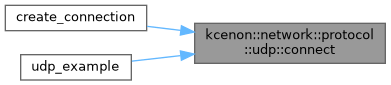
Referenced by create_connection(), and udp_example().

◆ connect() [2/2]
|
nodiscard |
Creates and starts a UDP connection using URL format.
- Parameters
-
url The URL to connect to (format: "udp://host:port" or "host:port") id Optional unique identifier for the connection
- Returns
- Unique pointer to an i_connection instance (running)
Definition at line 48 of file udp.cpp.
References create_connection().

◆ create_connection()
|
nodiscard |
Creates a UDP connection (not yet started)
- Parameters
-
id Optional unique identifier for the connection
- Returns
- Unique pointer to an i_connection instance
The returned connection is not started. Call connect() to set the target endpoint and start the UDP client.
UDP Semantics
Unlike TCP, UDP is connectionless. The "connection" object manages a UDP socket that sends datagrams to a configured target endpoint.
- connect() sets the target and starts the client
- is_connected() returns true while the client is running
- send() sends datagrams to the target endpoint
Usage Example
Definition at line 33 of file udp.cpp.
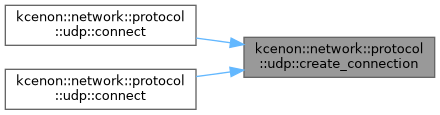
Referenced by connect(), and connect().
◆ create_listener()
|
nodiscard |
Creates a UDP listener (not yet listening)
- Parameters
-
id Optional unique identifier for the listener
- Returns
- Unique pointer to an i_listener instance
The returned listener is not listening. Call start() to begin receiving datagrams.
UDP Semantics
Unlike TCP, UDP servers don't accept connections. Instead, they receive datagrams from any sender. The listener tracks unique sender endpoints as virtual "connections" for convenience.
- on_accept is called when a new sender endpoint is seen
- connection_id is formatted as "address:port"
- send_to() sends datagrams back to specific endpoints
Usage Example
Definition at line 56 of file udp.cpp.
Referenced by listen().

◆ listen() [1/2]
|
nodiscard |
Creates and starts a UDP listener in one call.
- Parameters
-
bind_address The local address to bind to id Optional unique identifier for the listener
- Returns
- Unique pointer to an i_listener instance (listening)
This is a convenience function that creates a listener and immediately starts listening on the specified address.
Usage Example
Definition at line 62 of file udp.cpp.
References create_listener().
Referenced by create_listener(), listen(), and udp_server_example().


◆ listen() [2/2]
|
nodiscard |
Creates and starts a UDP listener on a specific port.
- Parameters
-
port The port number to listen on id Optional unique identifier for the listener
- Returns
- Unique pointer to an i_listener instance (listening)
Convenience overload that binds to all interfaces (0.0.0.0).
Definition at line 70 of file udp.cpp.
References listen().