Functions | |
| auto | create_connection (std::string_view id="") -> std::unique_ptr< unified::i_connection > |
| Creates a TCP connection (not yet connected) | |
| auto | connect (const unified::endpoint_info &endpoint, std::string_view id="") -> std::unique_ptr< unified::i_connection > |
| Creates and connects a TCP connection in one call. | |
| auto | connect (std::string_view url, std::string_view id="") -> std::unique_ptr< unified::i_connection > |
| Creates and connects a TCP connection using URL format. | |
| auto | create_listener (std::string_view id="") -> std::unique_ptr< unified::i_listener > |
| Creates a TCP listener (not yet listening) | |
| auto | listen (const unified::endpoint_info &bind_address, std::string_view id="") -> std::unique_ptr< unified::i_listener > |
| Creates and starts a TCP listener in one call. | |
| auto | listen (uint16_t port, std::string_view id="") -> std::unique_ptr< unified::i_listener > |
| Creates and starts a TCP listener on a specific port. | |
Function Documentation
◆ connect() [1/2]
|
nodiscard |
Creates and connects a TCP connection in one call.
- Parameters
-
endpoint The remote endpoint to connect to id Optional unique identifier for the connection
- Returns
- Unique pointer to an i_connection instance (connecting or connected)
This is a convenience function that creates a connection and immediately initiates the connection to the specified endpoint.
Usage Example
Definition at line 39 of file tcp.cpp.
References create_connection().
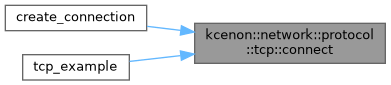
Referenced by create_connection(), and tcp_example().

◆ connect() [2/2]
|
nodiscard |
Creates and connects a TCP connection using URL format.
- Parameters
-
url The URL to connect to (format: "tcp://host:port" or "host:port") id Optional unique identifier for the connection
- Returns
- Unique pointer to an i_connection instance (connecting or connected)
Definition at line 48 of file tcp.cpp.
References create_connection().

◆ create_connection()
|
nodiscard |
Creates a TCP connection (not yet connected)
- Parameters
-
id Optional unique identifier for the connection
- Returns
- Unique pointer to an i_connection instance
The returned connection is not connected. Call connect() to establish the connection to a remote endpoint.
Usage Example
Definition at line 33 of file tcp.cpp.
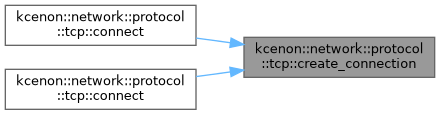
Referenced by connect(), and connect().
◆ create_listener()
|
nodiscard |
Creates a TCP listener (not yet listening)
- Parameters
-
id Optional unique identifier for the listener
- Returns
- Unique pointer to an i_listener instance
The returned listener is not listening. Call start() to begin accepting connections.
Usage Example
Definition at line 56 of file tcp.cpp.
Referenced by listen().

◆ listen() [1/2]
|
nodiscard |
Creates and starts a TCP listener in one call.
- Parameters
-
bind_address The local address to bind to id Optional unique identifier for the listener
- Returns
- Unique pointer to an i_listener instance (listening)
This is a convenience function that creates a listener and immediately starts listening on the specified address.
Usage Example
Definition at line 62 of file tcp.cpp.
References create_listener().
Referenced by create_listener(), listen(), and tcp_server_example().


◆ listen() [2/2]
|
nodiscard |
Creates and starts a TCP listener on a specific port.
- Parameters
-
port The port number to listen on id Optional unique identifier for the listener
- Returns
- Unique pointer to an i_listener instance (listening)
Convenience overload that binds to all interfaces (0.0.0.0).
Definition at line 70 of file tcp.cpp.
References listen().