Loading...
Searching...
No Matches
legacy_example::i_client Class Referenceabstract
Collaboration diagram for legacy_example::i_client:
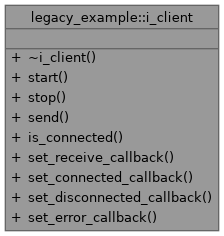
Public Types | |
| using | receive_callback_t = std::function<void(const std::vector<uint8_t>&)> |
| using | connected_callback_t = std::function<void()> |
| using | disconnected_callback_t = std::function<void()> |
| using | error_callback_t = std::function<void(std::error_code)> |
Public Member Functions | |
| virtual | ~i_client ()=default |
| virtual bool | start (std::string_view host, uint16_t port)=0 |
| virtual bool | stop ()=0 |
| virtual bool | send (std::vector< uint8_t > &&data)=0 |
| virtual bool | is_connected () const =0 |
| virtual void | set_receive_callback (receive_callback_t callback)=0 |
| virtual void | set_connected_callback (connected_callback_t callback)=0 |
| virtual void | set_disconnected_callback (disconnected_callback_t callback)=0 |
| virtual void | set_error_callback (error_callback_t callback)=0 |
Detailed Description
LEGACY PATTERN: Protocol-specific interface usage
Problems with this approach:
- Must learn different interfaces for each protocol
- Code is tightly coupled to specific protocol
- Changing protocols requires significant refactoring
- More interfaces to test and maintain
Definition at line 46 of file legacy_client_example.cpp.
Member Typedef Documentation
◆ connected_callback_t
| using legacy_example::i_client::connected_callback_t = std::function<void()> |
Definition at line 51 of file legacy_client_example.cpp.
◆ disconnected_callback_t
| using legacy_example::i_client::disconnected_callback_t = std::function<void()> |
Definition at line 52 of file legacy_client_example.cpp.
◆ error_callback_t
| using legacy_example::i_client::error_callback_t = std::function<void(std::error_code)> |
Definition at line 53 of file legacy_client_example.cpp.
◆ receive_callback_t
| using legacy_example::i_client::receive_callback_t = std::function<void(const std::vector<uint8_t>&)> |
Definition at line 50 of file legacy_client_example.cpp.
Constructor & Destructor Documentation
◆ ~i_client()
|
virtualdefault |
Member Function Documentation
◆ is_connected()
|
pure virtual |
◆ send()
|
pure virtual |
◆ set_connected_callback()
|
pure virtual |
◆ set_disconnected_callback()
|
pure virtual |
◆ set_error_callback()
|
pure virtual |
◆ set_receive_callback()
|
pure virtual |
◆ start()
|
pure virtual |
◆ stop()
|
pure virtual |
The documentation for this class was generated from the following file:
- examples/migration/legacy_client_example.cpp