A wrapper around ASIO UDP socket with OpenSSL DTLS encryption. More...
#include <dtls_socket.h>
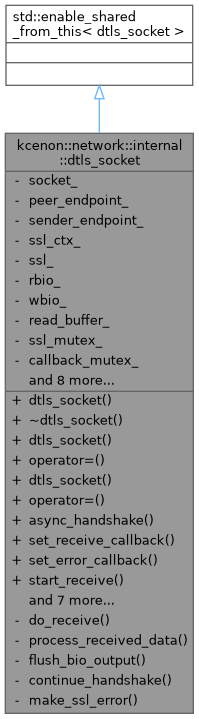
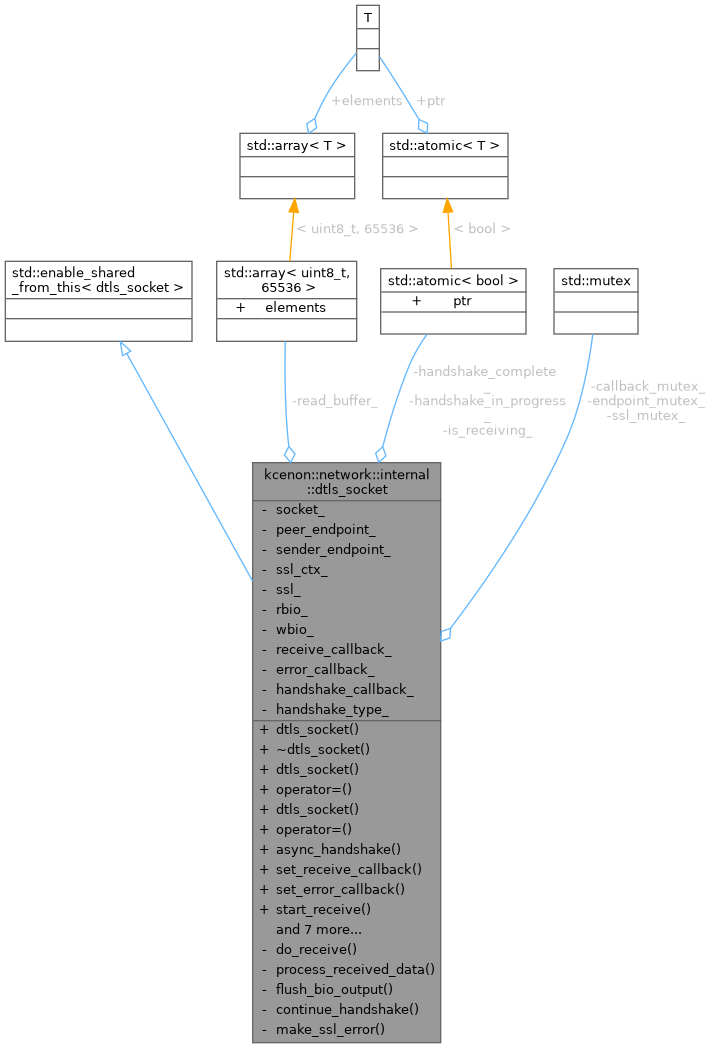
Public Types | |
| enum class | handshake_type { client , server } |
| Handshake type enumeration. More... | |
Public Member Functions | |
| ~dtls_socket () | |
| Destructor. Cleans up OpenSSL resources. | |
| dtls_socket (const dtls_socket &)=delete | |
| dtls_socket & | operator= (const dtls_socket &)=delete |
| dtls_socket (dtls_socket &&)=delete | |
| dtls_socket & | operator= (dtls_socket &&)=delete |
| auto | async_handshake (handshake_type type, std::function< void(std::error_code)> handler) -> void |
| Performs asynchronous DTLS handshake. | |
| auto | set_receive_callback (std::function< void(const std::vector< uint8_t > &, const asio::ip::udp::endpoint &)> callback) -> void |
| Sets a callback to receive decrypted inbound datagrams. | |
| auto | set_error_callback (std::function< void(std::error_code)> callback) -> void |
| Sets a callback to handle socket errors. | |
| auto | start_receive () -> void |
| Begins the continuous asynchronous receive loop. | |
| auto | stop_receive () -> void |
| Stops the receive loop. | |
| auto | deliver_encrypted (const std::vector< uint8_t > &data, const asio::ip::udp::endpoint &sender) -> void |
| Injects an already-received encrypted datagram for DTLS processing. | |
| auto | async_send (std::vector< uint8_t > &&data, std::function< void(std::error_code, std::size_t)> handler) -> void |
| Initiates an asynchronous encrypted send. | |
| auto | async_send_to (std::vector< uint8_t > &&data, const asio::ip::udp::endpoint &endpoint, std::function< void(std::error_code, std::size_t)> handler) -> void |
| Initiates an asynchronous encrypted send to a specific endpoint. | |
| auto | set_peer_endpoint (const asio::ip::udp::endpoint &endpoint) -> void |
| Sets the peer endpoint for connected mode. | |
| auto | peer_endpoint () const -> asio::ip::udp::endpoint |
| Returns the peer endpoint. | |
| auto | socket () -> asio::ip::udp::socket & |
| Provides direct access to the underlying UDP socket. | |
| auto | is_handshake_complete () const -> bool |
| Checks if the DTLS handshake is complete. | |
Static Public Member Functions | |
| static Result< std::shared_ptr< dtls_socket > > | create (asio::ip::udp::socket socket, SSL_CTX *ssl_ctx) |
Constructs a dtls_socket with an existing UDP socket. | |
Private Member Functions | |
| dtls_socket (asio::ip::udp::socket socket, SSL *ssl, BIO *rbio, BIO *wbio) | |
| auto | do_receive () -> void |
| Internal function to handle the receive logic. | |
| auto | process_received_data (const std::vector< uint8_t > &data, const asio::ip::udp::endpoint &sender) -> void |
| Processes received encrypted data through DTLS. | |
| auto | flush_bio_output () -> void |
| Flushes pending DTLS output to the network. | |
| auto | continue_handshake () -> void |
| Continues the handshake process. | |
| auto | make_ssl_error () const -> std::error_code |
| Creates an OpenSSL error code from the current error state. | |
Private Attributes | |
| asio::ip::udp::socket | socket_ |
| asio::ip::udp::endpoint | peer_endpoint_ |
| asio::ip::udp::endpoint | sender_endpoint_ |
| SSL_CTX * | ssl_ctx_ |
| SSL * | ssl_ |
| BIO * | rbio_ |
| BIO * | wbio_ |
| std::array< uint8_t, 65536 > | read_buffer_ |
| std::mutex | ssl_mutex_ |
| std::mutex | callback_mutex_ |
| std::mutex | endpoint_mutex_ |
| std::function< void(const std::vector< uint8_t > &, const asio::ip::udp::endpoint &)> | receive_callback_ |
| std::function< void(std::error_code)> | error_callback_ |
| std::function< void(std::error_code)> | handshake_callback_ |
| std::atomic< bool > | is_receiving_ {false} |
| std::atomic< bool > | handshake_complete_ {false} |
| std::atomic< bool > | handshake_in_progress_ {false} |
| handshake_type | handshake_type_ {handshake_type::client} |
Detailed Description
A wrapper around ASIO UDP socket with OpenSSL DTLS encryption.
Key Features
- Provides DTLS (Datagram TLS) encryption over UDP transport.
- Uses OpenSSL's DTLS implementation with memory BIOs for async I/O.
- Exposes
set_receive_callback()to handle decrypted inbound datagrams andset_error_callback()for error handling. start_receive()begins an ongoing loop of receiving encrypted datagrams.async_send()encrypts and sends data to the configured peer.
Thread Safety
- All public methods are thread-safe. Callback registration is protected by callback_mutex_.
- ASIO operations are serialized through the io_context.
- OpenSSL operations are protected by ssl_mutex_.
- The provided callbacks will be invoked on an ASIO worker thread; ensure that your callback logic is thread-safe if it shares data.
DTLS Characteristics
- Provides confidentiality and integrity for UDP datagrams.
- Handles packet loss and reordering during handshake.
- Message boundaries are preserved (each receive is one datagram).
- Suitable for real-time applications requiring encryption.
Definition at line 49 of file dtls_socket.h.
Member Enumeration Documentation
◆ handshake_type
|
strong |
Handshake type enumeration.
| Enumerator | |
|---|---|
| client | Client-side handshake |
| server | Server-side handshake |
Definition at line 55 of file dtls_socket.h.
Constructor & Destructor Documentation
◆ ~dtls_socket()
| kcenon::network::internal::dtls_socket::~dtls_socket | ( | ) |
Destructor. Cleans up OpenSSL resources.
Definition at line 89 of file dtls_socket.cpp.
References ssl_, and stop_receive().

◆ dtls_socket() [1/3]
|
delete |
◆ dtls_socket() [2/3]
|
delete |
◆ dtls_socket() [3/3]
|
private |
Definition at line 80 of file dtls_socket.cpp.
Member Function Documentation
◆ async_handshake()
| auto kcenon::network::internal::dtls_socket::async_handshake | ( | handshake_type | type, |
| std::function< void(std::error_code)> | handler ) -> void |
Performs asynchronous DTLS handshake.
- Parameters
-
type Handshake type (client or server) handler Completion handler with signature void(std::error_code)
Must be called before start_receive() or async_send(). The handshake involves multiple round-trips over UDP.
Definition at line 100 of file dtls_socket.cpp.
◆ async_send()
| auto kcenon::network::internal::dtls_socket::async_send | ( | std::vector< uint8_t > && | data, |
| std::function< void(std::error_code, std::size_t)> | handler ) -> void |
Initiates an asynchronous encrypted send.
- Parameters
-
data The plaintext data to encrypt and send (moved for efficiency). handler A completion handler with signature void(std::error_code, std::size_t)invoked upon completion.
The data is encrypted using DTLS before transmission.
- Note
- Data is moved (not copied) to avoid memory allocation overhead.
Definition at line 396 of file dtls_socket.cpp.
◆ async_send_to()
| auto kcenon::network::internal::dtls_socket::async_send_to | ( | std::vector< uint8_t > && | data, |
| const asio::ip::udp::endpoint & | endpoint, | ||
| std::function< void(std::error_code, std::size_t)> | handler ) -> void |
Initiates an asynchronous encrypted send to a specific endpoint.
- Parameters
-
data The plaintext data to encrypt and send (moved for efficiency). endpoint The target endpoint. handler A completion handler invoked upon completion.
Useful for server responding to different clients.
Definition at line 409 of file dtls_socket.cpp.
◆ continue_handshake()
|
private |
Continues the handshake process.
Definition at line 128 of file dtls_socket.cpp.
◆ create()
|
staticnodiscard |
Constructs a dtls_socket with an existing UDP socket.
- Parameters
-
socket An asio::ip::udp::socketthat must be open.ssl_ctx The OpenSSL SSL_CTX configured for DTLS.
The socket should be connected (for client) or bound (for server) before calling handshake methods.
Definition at line 42 of file dtls_socket.cpp.
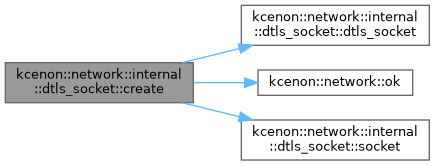
References dtls_socket(), kcenon::network::protocols::quic::error, kcenon::network::error_codes::common_errors::internal_error, kcenon::network::ok(), and socket().
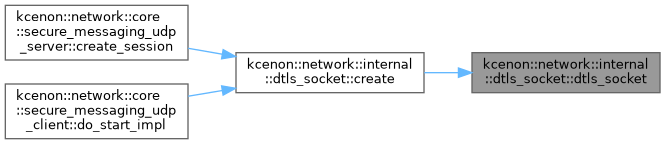
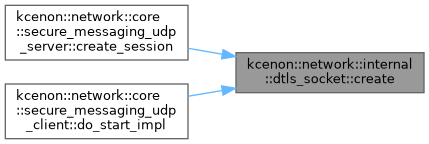
Referenced by kcenon::network::core::secure_messaging_udp_server::create_session(), and kcenon::network::core::secure_messaging_udp_client::do_start_impl().
◆ deliver_encrypted()
| auto kcenon::network::internal::dtls_socket::deliver_encrypted | ( | const std::vector< uint8_t > & | data, |
| const asio::ip::udp::endpoint & | sender ) -> void |
Injects an already-received encrypted datagram for DTLS processing.
Intended for a server that owns the underlying UDP socket and demultiplexes datagrams to per-client sessions itself, instead of letting each dtls_socket drive its own receive loop via start_receive(). The bytes are fed through the read BIO exactly as the internal receive loop would: an in-progress handshake is advanced, and once the handshake is complete the record is decrypted and the application payload is delivered to the receive callback.
Safe to call with malformed, truncated, or pre-handshake records: such data is processed best-effort and dropped without invoking the receive callback when it does not yield a complete decrypted record.
- Parameters
-
data The encrypted datagram bytes received from the peer. sender The endpoint the datagram was received from.
Definition at line 269 of file dtls_socket.cpp.
◆ do_receive()
|
private |
Internal function to handle the receive logic.
Definition at line 222 of file dtls_socket.cpp.
◆ flush_bio_output()
|
private |
Flushes pending DTLS output to the network.
Definition at line 355 of file dtls_socket.cpp.
◆ is_handshake_complete()
|
inline |
Checks if the DTLS handshake is complete.
- Returns
- true if handshake completed successfully.
Definition at line 200 of file dtls_socket.h.
References handshake_complete_.
◆ make_ssl_error()
|
private |
Creates an OpenSSL error code from the current error state.
- Returns
- std::error_code representing the SSL error.
Definition at line 497 of file dtls_socket.cpp.
◆ operator=() [1/2]
|
delete |
◆ operator=() [2/2]
|
delete |
◆ peer_endpoint()
| auto kcenon::network::internal::dtls_socket::peer_endpoint | ( | ) | const -> asio::ip::udp::endpoint |
Returns the peer endpoint.
- Returns
- The configured peer endpoint.
Definition at line 491 of file dtls_socket.cpp.
References endpoint_mutex_, and peer_endpoint_.
◆ process_received_data()
|
private |
Processes received encrypted data through DTLS.
- Parameters
-
data The encrypted datagram. sender The sender's endpoint.
Definition at line 283 of file dtls_socket.cpp.
◆ set_error_callback()
| auto kcenon::network::internal::dtls_socket::set_error_callback | ( | std::function< void(std::error_code)> | callback | ) | -> void |
Sets a callback to handle socket errors.
- Parameters
-
callback A function with signature void(std::error_code), invoked when any asynchronous operation fails.
If no callback is set, errors are not explicitly handled here.
Definition at line 201 of file dtls_socket.cpp.
◆ set_peer_endpoint()
| auto kcenon::network::internal::dtls_socket::set_peer_endpoint | ( | const asio::ip::udp::endpoint & | endpoint | ) | -> void |
Sets the peer endpoint for connected mode.
- Parameters
-
endpoint The peer's UDP endpoint.
Definition at line 485 of file dtls_socket.cpp.
◆ set_receive_callback()
| auto kcenon::network::internal::dtls_socket::set_receive_callback | ( | std::function< void(const std::vector< uint8_t > &, const asio::ip::udp::endpoint &)> | callback | ) | -> void |
Sets a callback to receive decrypted inbound datagrams.
- Parameters
-
callback A function with signature void(const std::vector<uint8_t>&, const asio::ip::udp::endpoint&), called whenever a datagram is successfully received and decrypted.
If no callback is set, received data is effectively discarded.
Definition at line 193 of file dtls_socket.cpp.
◆ socket()
|
inline |
Provides direct access to the underlying UDP socket.
- Returns
- A reference to the wrapped
asio::ip::udp::socket.
Definition at line 194 of file dtls_socket.h.
References socket_.
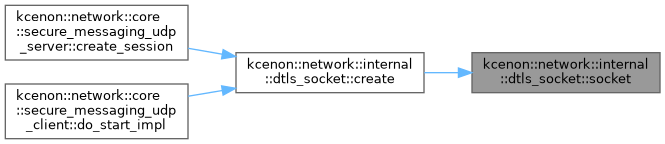
Referenced by create().
◆ start_receive()
| auto kcenon::network::internal::dtls_socket::start_receive | ( | ) | -> void |
Begins the continuous asynchronous receive loop.
Once called, the class repeatedly receives encrypted datagrams, decrypts them, and invokes the receive callback. If an error occurs, the error callback is triggered.
Definition at line 208 of file dtls_socket.cpp.
◆ stop_receive()
| auto kcenon::network::internal::dtls_socket::stop_receive | ( | ) | -> void |
Stops the receive loop.
Definition at line 217 of file dtls_socket.cpp.
Referenced by ~dtls_socket().

Member Data Documentation
◆ callback_mutex_
|
private |
Protects callback registration.
Definition at line 250 of file dtls_socket.h.
◆ endpoint_mutex_
|
private |
Protects endpoint access.
Definition at line 251 of file dtls_socket.h.
Referenced by peer_endpoint().
◆ error_callback_
|
private |
Error callback.
Definition at line 256 of file dtls_socket.h.
◆ handshake_callback_
|
private |
Handshake completion callback.
Definition at line 258 of file dtls_socket.h.
◆ handshake_complete_
|
private |
Handshake completed flag.
Definition at line 261 of file dtls_socket.h.
Referenced by is_handshake_complete().
◆ handshake_in_progress_
|
private |
◆ handshake_type_
|
private |
◆ is_receiving_
|
private |
◆ peer_endpoint_
|
private |
Peer endpoint for connected mode.
Definition at line 239 of file dtls_socket.h.
Referenced by peer_endpoint().
◆ rbio_
|
private |
Read BIO (memory).
Definition at line 244 of file dtls_socket.h.
◆ read_buffer_
|
private |
Buffer for receiving datagrams.
Definition at line 247 of file dtls_socket.h.
◆ receive_callback_
|
private |
Inbound data callback.
Definition at line 254 of file dtls_socket.h.
◆ sender_endpoint_
|
private |
Sender endpoint for receives.
Definition at line 240 of file dtls_socket.h.
◆ socket_
|
private |
◆ ssl_
|
private |
◆ ssl_ctx_
|
private |
OpenSSL context (not owned).
Definition at line 242 of file dtls_socket.h.
◆ ssl_mutex_
|
private |
Protects SSL operations.
Definition at line 249 of file dtls_socket.h.
◆ wbio_
|
private |
Write BIO (memory).
Definition at line 245 of file dtls_socket.h.
The documentation for this class was generated from the following files:
- src/internal/tcp/dtls_socket.h
- src/internal/dtls_socket.cpp