Simplified facade for creating WebSocket clients and servers. More...
#include <websocket_facade.h>
Classes | |
| struct | client_config |
| Configuration for creating a WebSocket client. More... | |
| struct | server_config |
| Configuration for creating a WebSocket server. More... | |
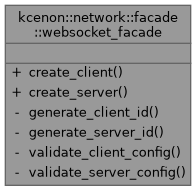
Public Member Functions | |
| auto | create_client (const client_config &config) const -> Result< std::shared_ptr< interfaces::i_protocol_client > > |
| Creates a WebSocket client with the specified configuration. | |
| auto | create_server (const server_config &config) const -> Result< std::shared_ptr< interfaces::i_protocol_server > > |
| Creates a WebSocket server with the specified configuration. | |
Static Private Member Functions | |
| static auto | generate_client_id () -> std::string |
| Generates a unique client ID. | |
| static auto | generate_server_id () -> std::string |
| Generates a unique server ID. | |
| static auto | validate_client_config (const client_config &config) -> VoidResult |
| Validates client configuration. | |
| static auto | validate_server_config (const server_config &config) -> VoidResult |
| Validates server configuration. | |
Detailed Description
Simplified facade for creating WebSocket clients and servers.
This facade provides a simple, unified API for creating WebSocket protocol clients and servers, hiding the complexity of underlying implementation from the user.
Design Goals
- Simplicity: No template parameters or protocol tags
- Consistency: Same API pattern across all protocol facades
- Type Safety: Returns unified protocol interfaces (i_protocol_client/i_protocol_server)
- Zero Cost: No performance overhead compared to direct instantiation
Thread Safety
All methods are thread-safe and can be called concurrently.
Usage Example
- Examples
- websocket_chat.cpp.
Definition at line 76 of file websocket_facade.h.
Member Function Documentation
◆ create_client()
|
nodiscard |
Creates a WebSocket client with the specified configuration.
- Parameters
-
config Client configuration.
- Returns
- Result containing shared pointer to i_protocol_client, or error.
Behavior
- Creates a WebSocket client adapter wrapping messaging_ws_client
- Client ID is auto-generated if not provided
- Default ping interval is 30 seconds
- Returns unified i_protocol_client interface for protocol-agnostic usage
Protocol-Specific Notes
- send() sends data as binary WebSocket frames
- For text messages or WebSocket-specific features, cast to i_websocket_client
Error Conditions
- Returns error if ping_interval is zero or negative
- Examples
- websocket_chat.cpp.
Definition at line 68 of file websocket_facade.cpp.
References code, config, kcenon::network::error, and kcenon::network::ok().
Referenced by run_client().


◆ create_server()
|
nodiscard |
Creates a WebSocket server with the specified configuration.
- Parameters
-
config Server configuration.
- Returns
- Result containing shared pointer to i_protocol_server, or error.
Behavior
- Creates a WebSocket server adapter wrapping messaging_ws_server
- Server ID is auto-generated if not provided
- Server must be started manually using start() method
- Returns unified i_protocol_server interface for protocol-agnostic usage
Protocol-Specific Notes
- Receive callback delivers binary data via the unified interface
- For text messages or WebSocket-specific features, cast to i_websocket_server
Error Conditions
- Returns error if port is 0 or > 65535
- Returns error if path is empty or does not start with '/'
- Examples
- websocket_chat.cpp.
Definition at line 87 of file websocket_facade.cpp.
References code, config, kcenon::network::error, and kcenon::network::ok().
Referenced by run_server().


◆ generate_client_id()
|
staticnodiscardprivate |
Generates a unique client ID.
Definition at line 27 of file websocket_facade.cpp.
◆ generate_server_id()
|
staticnodiscardprivate |
Generates a unique server ID.
Definition at line 35 of file websocket_facade.cpp.
◆ validate_client_config()
|
staticprivate |
Validates client configuration.
Definition at line 43 of file websocket_facade.cpp.
References config, kcenon::network::error_void(), and kcenon::network::ok().

◆ validate_server_config()
|
staticprivate |
Validates server configuration.
Definition at line 53 of file websocket_facade.cpp.
References config, kcenon::network::error_void(), and kcenon::network::ok().

The documentation for this class was generated from the following files:
- include/kcenon/network/facade/websocket_facade.h
- src/facade/websocket_facade.cpp