Namespaces | |
| namespace | detail |
Classes | |
| struct | statistics |
| Statistical summary for a collection of values. More... | |
Functions | |
| template<typename T > | |
| T | percentile (const std::vector< T > &sorted_values, double percentile_value) |
| template<typename T > | |
| statistics< T > | compute_sorted (const std::vector< T > &sorted_values) |
| Compute statistics from sorted values. | |
| template<typename T > | |
| statistics< T > | compute (const std::vector< T > &values) |
| template<typename T > | |
| statistics< T > | compute_inplace (std::vector< T > &values) |
| Compute statistics in place (modifies input) | |
Function Documentation
◆ compute()
| statistics< T > kcenon::monitoring::stats::compute | ( | const std::vector< T > & | values | ) |
- Examples
- /home/runner/work/monitoring_system/monitoring_system/include/kcenon/monitoring/utils/statistics.h.
Definition at line 228 of file statistics.h.
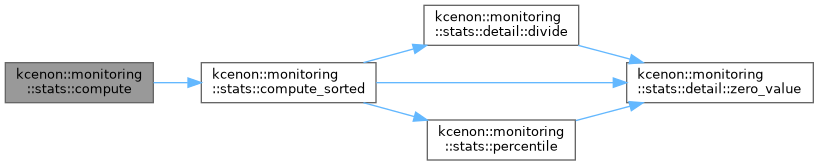
References compute_sorted().
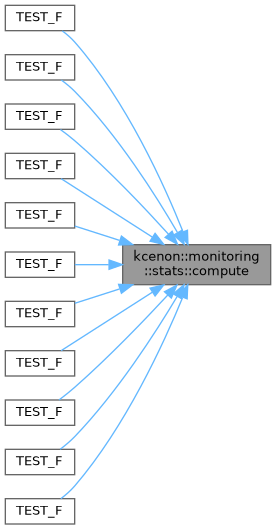
Referenced by TEST_F(), TEST_F(), TEST_F(), TEST_F(), TEST_F(), TEST_F(), TEST_F(), TEST_F(), TEST_F(), TEST_F(), and TEST_F().
◆ compute_inplace()
| statistics< T > kcenon::monitoring::stats::compute_inplace | ( | std::vector< T > & | values | ) |
Compute statistics in place (modifies input)
This is more efficient when you don't need to preserve the original order.
- Template Parameters
-
T Value type
- Parameters
-
values Vector of values (will be sorted in place)
- Returns
- statistics<T> containing all computed statistics
- Examples
- /home/runner/work/monitoring_system/monitoring_system/include/kcenon/monitoring/utils/statistics.h.
Definition at line 248 of file statistics.h.
References compute_sorted().
Referenced by TEST_F().


◆ compute_sorted()
| statistics< T > kcenon::monitoring::stats::compute_sorted | ( | const std::vector< T > & | sorted_values | ) |
Compute statistics from sorted values.
This is more efficient when you already have sorted data.
- Template Parameters
-
T Value type
- Parameters
-
sorted_values Vector of sorted values (ascending order)
- Returns
- statistics<T> containing all computed statistics
- Examples
- /home/runner/work/monitoring_system/monitoring_system/include/kcenon/monitoring/utils/statistics.h.
Definition at line 173 of file statistics.h.
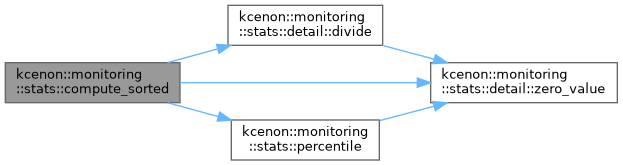
References kcenon::monitoring::stats::statistics< T >::count, kcenon::monitoring::stats::detail::divide(), percentile(), and kcenon::monitoring::stats::detail::zero_value().
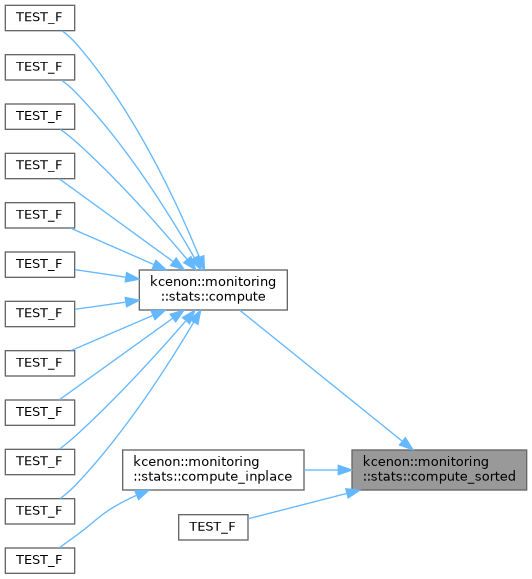
Referenced by compute(), compute_inplace(), and TEST_F().
◆ percentile()
| T kcenon::monitoring::stats::percentile | ( | const std::vector< T > & | sorted_values, |
| double | percentile_value ) |
- Examples
- /home/runner/work/monitoring_system/monitoring_system/include/kcenon/monitoring/utils/statistics.h.
Definition at line 130 of file statistics.h.
References kcenon::monitoring::stats::detail::is_chrono_duration_v, and kcenon::monitoring::stats::detail::zero_value().
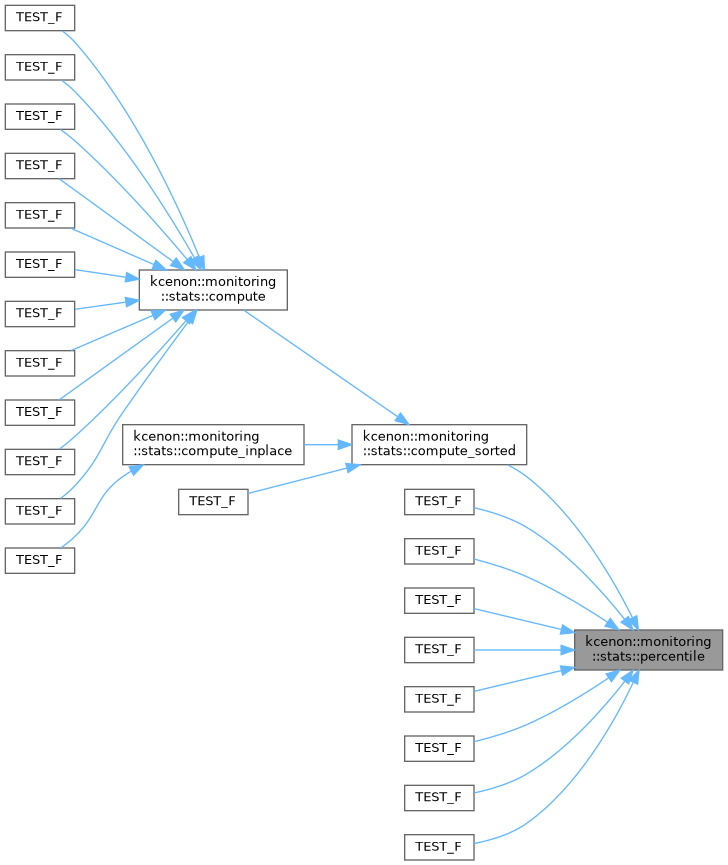
Referenced by compute_sorted(), TEST_F(), TEST_F(), TEST_F(), TEST_F(), TEST_F(), TEST_F(), TEST_F(), and TEST_F().