Loading...
Searching...
No Matches
adapter_pattern_poc.cpp File Reference
Proof-of-concept for adapter pattern refactoring. More...
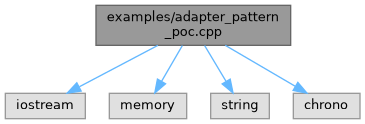
#include <iostream>#include <memory>#include <string>#include <chrono>
Include dependency graph for adapter_pattern_poc.cpp:
Go to the source code of this file.
Classes | |
| class | logger_old |
| class | logger_core |
| class | logger_adapter |
| class | standalone_adapter |
| class | external_system_interface |
| class | thread_system_adapter |
| class | common_system_interface |
| class | common_system_adapter |
| class | full_integration_adapter |
| class | logger_factory |
Enumerations | |
| enum class | integration_mode { standalone , thread_system , common_system , full } |
Functions | |
| void | demonstrate_adapters () |
| void | benchmark_overhead () |
| int | main () |
Detailed Description
Proof-of-concept for adapter pattern refactoring.
Definition in file adapter_pattern_poc.cpp.
Enumeration Type Documentation
◆ integration_mode
|
strong |
| Enumerator | |
|---|---|
| standalone | |
| thread_system | |
| common_system | |
| full | |
Definition at line 204 of file adapter_pattern_poc.cpp.
204 {
205 standalone,
206 thread_system,
207 common_system,
208 full
209};
@ standalone
@ thread_system
@ common_system
@ full
Function Documentation
◆ benchmark_overhead()
| void benchmark_overhead | ( | ) |
- Examples
- adapter_pattern_poc.cpp.
Definition at line 307 of file adapter_pattern_poc.cpp.
307 {
308 std::cout << "\n=== Performance Comparison ===\n" << std::endl;
309
310 const int iterations = 1000000;
311 auto core = std::make_shared<logger_core>();
312
313 // Direct call (no virtual)
314 {
315 auto start = std::chrono::high_resolution_clock::now();
316 for (int i = 0; i < iterations; ++i) {
317 core->log_internal("test");
318 }
319 auto end = std::chrono::high_resolution_clock::now();
320 auto duration = std::chrono::duration_cast<std::chrono::nanoseconds>(end - start);
321 std::cout << "Direct call: " << duration.count() / iterations << " ns/call" << std::endl;
322 }
323
324 // Virtual call through adapter
325 {
326 auto adapter = std::make_unique<standalone_adapter>(core);
327 auto start = std::chrono::high_resolution_clock::now();
328 for (int i = 0; i < iterations; ++i) {
329 adapter->log("test");
330 }
331 auto end = std::chrono::high_resolution_clock::now();
332 auto duration = std::chrono::duration_cast<std::chrono::nanoseconds>(end - start);
333 std::cout << "Virtual call: " << duration.count() / iterations << " ns/call" << std::endl;
334 std::cout << "Overhead: ~1-2ns (negligible for I/O operations)" << std::endl;
335 }
336}
Referenced by main().
Here is the caller graph for this function:

◆ demonstrate_adapters()
| void demonstrate_adapters | ( | ) |
- Examples
- adapter_pattern_poc.cpp.
Definition at line 239 of file adapter_pattern_poc.cpp.
239 {
240 std::cout << "\n=== Adapter Pattern Proof of Concept ===\n" << std::endl;
241
242 // Test 1: Standalone mode
243 {
244 std::cout << "Test 1: Standalone Mode" << std::endl;
248 }
249
250 // Test 2: Thread system integration
251 {
252 std::cout << "Test 2: Thread System Integration" << std::endl;
254
255 // Can use as logger_adapter
257
258 // Can cast to external interface
260 if (external) {
261 external->external_log("Hello via external interface");
262 std::cout << "Interface: " << external->get_interface_name() << std::endl;
263 }
264 std::cout << std::endl;
265 }
266
267 // Test 3: Common system integration
268 {
269 std::cout << "Test 3: Common System Integration" << std::endl;
271
273 if (monitored) {
274 monitored->monitored_log("Message 1");
275 monitored->monitored_log("Message 2");
276 std::cout << "Metrics collected: " << monitored->get_metric_count() << std::endl;
277 }
278 std::cout << std::endl;
279 }
280
281 // Test 4: Full integration (both interfaces)
282 {
283 std::cout << "Test 4: Full Integration" << std::endl;
285
286 // Use both interfaces
289
290 if (external && monitored) {
291 external->external_log("Via external interface");
292 monitored->monitored_log("Via monitoring interface");
293 std::cout << "Total messages: " << monitored->get_metric_count() << std::endl;
294 }
295 std::cout << std::endl;
296 }
297
298 // Test 5: Runtime mode switching (same binary!)
299 {
300 std::cout << "Test 5: Runtime Mode Switching" << std::endl;
301 std::cout << "All modes tested with SINGLE BINARY" << std::endl;
302 std::cout << "No recompilation needed!" << std::endl;
303 }
304}
static std::unique_ptr< logger_adapter > create(integration_mode mode)
Definition adapter_pattern_poc.cpp:213
Definition compatibility.h:17
References common_system, logger_factory::create(), full, standalone, and thread_system.
Referenced by main().
Here is the call graph for this function:

Here is the caller graph for this function:

◆ main()
| int main | ( | ) |
- Examples
- adapter_pattern_poc.cpp, advanced_features_demo.cpp, basic_usage.cpp, composite_writer_example.cpp, crash_protection/main.cpp, critical_logging_example.cpp, custom_writer_example.cpp, decorator_usage.cpp, di_pattern_example.cpp, distributed_logging_demo.cpp, logger_config_builder_example.cpp, metrics_demo.cpp, monitoring_integration_example.cpp, security_demo.cpp, structured_logging_example.cpp, and writer_builder_example.cpp.
Definition at line 338 of file adapter_pattern_poc.cpp.
338 {
339 demonstrate_adapters();
340 benchmark_overhead();
341
342 std::cout << "\n=== Benefits Summary ===" << std::endl;
343 std::cout << "✅ Single binary for all modes" << std::endl;
344 std::cout << "✅ Runtime mode selection" << std::endl;
345 std::cout << "✅ Easier testing (no recompilation)" << std::endl;
346 std::cout << "✅ Clear code structure" << std::endl;
347 std::cout << "✅ Minimal performance overhead" << std::endl;
348 std::cout << "✅ Better maintainability" << std::endl;
349
350 return 0;
351}
References benchmark_overhead(), and demonstrate_adapters().
Here is the call graph for this function: