Database System 0.1.0
Advanced C++20 Database System with Multi-Backend Support
Loading...
Searching...
No Matches
security_framework_demo.cpp File Reference

Enterprise security framework with TLS, RBAC, audit logging, and threat detection. More...

#include <iostream>
#include <string>
#include <chrono>
#include <memory>
#include <vector>
#include "database/database_manager.h"
#include "database/security/secure_connection.h"
#include "database/core/database_context.h"
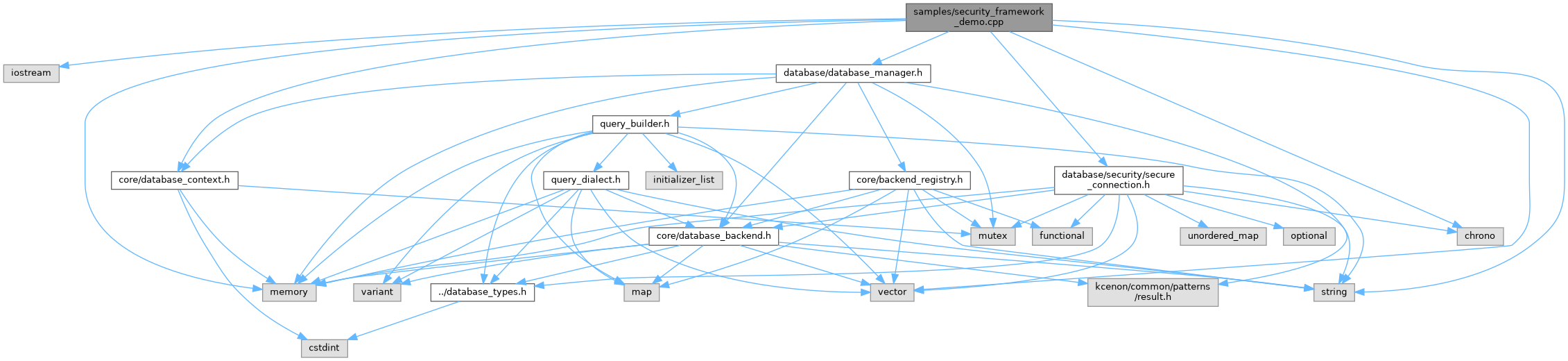
Include dependency graph for security_framework_demo.cpp:

Go to the source code of this file.

Functions

void demonstrate_secure_connections ()
 
void demonstrate_credential_management ()
 
void demonstrate_rbac_system ()
 
void demonstrate_audit_logging (std::shared_ptr< security::audit_logger > audit_log)
 
void demonstrate_threat_detection ()
 
bool detect_sql_injection (const std::string &query)
 
void demonstrate_session_management ()
 
int main ()
 

Detailed Description

Enterprise security framework with TLS, RBAC, audit logging, and threat detection.

Definition in file security_framework_demo.cpp.

Function Documentation

◆ demonstrate_audit_logging()

void demonstrate_audit_logging ( std::shared_ptr< security::audit_logger > audit_log)
Examples
security_framework_demo.cpp.

Definition at line 204 of file security_framework_demo.cpp.

204 {
205 std::cout << "\n=== Comprehensive Audit Logging ===\n";
206
207 // Configure audit logging
208 audit_config config;
209 config.enable_database_operations = true;
210 config.enable_authentication_events = true;
211 config.enable_authorization_events = true;
212 config.enable_data_access_logging = true;
213 config.enable_schema_changes = true;
214 config.log_format = audit_format::json;
215 config.retention_days = 365;
216
217 audit_log->configure(config);
218 std::cout << "Audit logging configured with comprehensive event tracking.\n";
219
220 // Simulate various security events
221 std::cout << "\nLogging security events:\n";
222
223 // Authentication events
224 audit_event auth_success;
225 auth_success.event_type = audit_event_type::authentication;
226 auth_success.user_id = "alice.smith";
227 auth_success.event_description = "User login successful";
228 auth_success.success = true;
229 auth_success.timestamp = std::chrono::system_clock::now();
230 auth_success.client_ip = "192.168.1.100";
231 auth_success.session_id = "sess_abc123def456";
232
233 audit_log->log_event(auth_success);
234 std::cout << " šŸ” Authentication success logged for alice.smith\n";
235
236 // Authorization events
237 audit_event auth_denied;
238 auth_denied.event_type = audit_event_type::authorization;
239 auth_denied.user_id = "bob.jones";
240 auth_denied.event_description = "Access denied: insufficient permissions for user.create";
241 auth_denied.success = false;
242 auth_denied.timestamp = std::chrono::system_clock::now();
243 auth_denied.client_ip = "192.168.1.101";
244 auth_denied.resource_accessed = "user_management_system";
245
246 audit_log->log_event(auth_denied);
247 std::cout << " 🚫 Authorization failure logged for bob.jones\n";
248
249 // Data access events
250 audit_event data_access;
251 data_access.event_type = audit_event_type::data_access;
252 data_access.user_id = "carol.wilson";
253 data_access.event_description = "SELECT query executed on customer_data table";
254 data_access.success = true;
255 data_access.timestamp = std::chrono::system_clock::now();
256 data_access.resource_accessed = "customer_data";
257 data_access.query_executed = "SELECT customer_id, email FROM customer_data WHERE status = 'active'";
258 data_access.rows_affected = 1247;
259
260 audit_log->log_event(data_access);
261 std::cout << " šŸ“Š Data access logged for carol.wilson (1247 rows)\n";
262
263 // Schema modification events
264 audit_event schema_change;
265 schema_change.event_type = audit_event_type::schema_modification;
266 schema_change.user_id = "alice.smith";
267 schema_change.event_description = "Created new table: user_preferences";
268 schema_change.success = true;
269 schema_change.timestamp = std::chrono::system_clock::now();
270 schema_change.resource_accessed = "user_preferences";
271 schema_change.query_executed = "CREATE TABLE user_preferences (id SERIAL PRIMARY KEY, user_id INT, preferences JSONB)";
272
273 audit_log->log_event(schema_change);
274 std::cout << " šŸ”§ Schema modification logged for alice.smith\n";
275
276 // Demonstrate audit trail queries
277 std::cout << "\nAudit trail analysis:\n";
278 auto recent_events = audit_log->get_events_by_timeframe(
279 std::chrono::system_clock::now() - std::chrono::hours(1),
280 std::chrono::system_clock::now()
281 );
282 std::cout << " šŸ“‹ Recent events (last hour): " << recent_events.size() << "\n";
283
284 auto user_events = audit_log->get_events_by_user("alice.smith");
285 std::cout << " šŸ‘¤ Events for alice.smith: " << user_events.size() << "\n";
286
287 auto failed_events = audit_log->get_failed_events();
288 std::cout << " āŒ Failed security events: " << failed_events.size() << "\n";
289}

Referenced by main().

Here is the caller graph for this function:

◆ demonstrate_credential_management()

void demonstrate_credential_management ( )
Examples
security_framework_demo.cpp.

Definition at line 71 of file security_framework_demo.cpp.

71 {
72 std::cout << "\n=== Credential Management System ===\n";
73
74 std::cout << "Note: This demonstrates the concept of secure credential management.\n";
75 std::cout << "In a production implementation, you would integrate with:\n";
76 std::cout << " • HashiCorp Vault for secret management\n";
77 std::cout << " • AWS Secrets Manager or Azure Key Vault\n";
78 std::cout << " • Environment variables with encryption\n";
79
80 // Mock credential_manager functionality for demonstration
81
82 // Mock implementation for demonstration
83 struct MockCredentials {
84 std::string username, password, host, database;
85 int port;
86 };
87
88 std::cout << "Master encryption key configured for credential storage.\n";
89
90 // Store encrypted credentials (conceptual)
91 MockCredentials postgres_creds{
92 "db_user", "secure_password_123!", "postgres-prod.company.com", "production_db", 5432
93 };
94
95 std::cout << "\nStored PostgreSQL production credentials (encrypted)\n";
96
97 MockCredentials mongo_creds{
98 "mongo_admin", "mongo_secure_pass_456$", "mongodb-cluster.company.com", "application_data", 27017
99 };
100
101 std::cout << "Stored MongoDB cluster credentials (encrypted)\n";
102
103 // Retrieve and use credentials (mock demonstration)
104 std::cout << "\nRetrieving stored credentials:\n";
105
106 std::cout << " āœ“ PostgreSQL credentials retrieved successfully\n";
107 std::cout << " Host: " << postgres_creds.host << "\n";
108 std::cout << " Database: " << postgres_creds.database << "\n";
109 std::cout << " Username: " << postgres_creds.username << "\n";
110 std::cout << " Password: [ENCRYPTED - " << postgres_creds.password.length() << " chars]\n";
111
112 std::cout << " āœ“ MongoDB credentials retrieved successfully\n";
113 std::cout << " Connection string available for secure usage\n";
114
115 // Demonstrate credential rotation
116 std::cout << "\nCredential rotation capabilities:\n";
117 std::cout << " • Automatic password expiration tracking\n";
118 std::cout << " • Secure password generation\n";
119 std::cout << " • Multi-environment credential management\n";
120 std::cout << " • Integration with external secret managers\n";
121}

References database::security::password.

Referenced by main().

Here is the caller graph for this function:

◆ demonstrate_rbac_system()

void demonstrate_rbac_system ( )
Examples
security_framework_demo.cpp.

Definition at line 123 of file security_framework_demo.cpp.

123 {
124 std::cout << "\n=== Role-Based Access Control (RBAC) ===\n";
125
126 std::cout << "Note: This demonstrates RBAC concepts for database access control.\n";
127 std::cout << "Production implementations would integrate with enterprise systems.\n";
128
129 // Mock RBAC implementation for demonstration
130
131 // Define roles with specific permissions
132 std::cout << "Defining security roles and permissions...\n";
133
134 // Database Administrator role
135 rbac_role dba_role("database_administrator");
136 dba_role.add_permission("database.create");
137 dba_role.add_permission("database.drop");
138 dba_role.add_permission("table.create");
139 dba_role.add_permission("table.drop");
140 dba_role.add_permission("table.alter");
141 dba_role.add_permission("data.select");
142 dba_role.add_permission("data.insert");
143 dba_role.add_permission("data.update");
144 dba_role.add_permission("data.delete");
145 dba_role.add_permission("user.create");
146 dba_role.add_permission("user.manage");
147
148 rbac.create_role(dba_role);
149 std::cout << " āœ“ Database Administrator role created with full permissions\n";
150
151 // Application Developer role
152 rbac_role dev_role("application_developer");
153 dev_role.add_permission("table.create");
154 dev_role.add_permission("table.alter");
155 dev_role.add_permission("data.select");
156 dev_role.add_permission("data.insert");
157 dev_role.add_permission("data.update");
158 dev_role.add_permission("data.delete");
159
160 rbac.create_role(dev_role);
161 std::cout << " āœ“ Application Developer role created with development permissions\n";
162
163 // Read-Only Analyst role
164 rbac_role analyst_role("data_analyst");
165 analyst_role.add_permission("data.select");
166
167 rbac.create_role(analyst_role);
168 std::cout << " āœ“ Data Analyst role created with read-only permissions\n";
169
170 // Create users and assign roles
171 std::cout << "\nCreating users and assigning roles:\n";
172
173 rbac_user admin_user("alice.smith", "alice.smith@company.com");
174 rbac.create_user(admin_user);
175 rbac.assign_role_to_user("alice.smith", "database_administrator");
176 std::cout << " šŸ‘¤ Alice Smith → Database Administrator\n";
177
178 rbac_user dev_user("bob.jones", "bob.jones@company.com");
179 rbac.create_user(dev_user);
180 rbac.assign_role_to_user("bob.jones", "application_developer");
181 std::cout << " šŸ‘¤ Bob Jones → Application Developer\n";
182
183 rbac_user analyst_user("carol.wilson", "carol.wilson@company.com");
184 rbac.create_user(analyst_user);
185 rbac.assign_role_to_user("carol.wilson", "data_analyst");
186 std::cout << " šŸ‘¤ Carol Wilson → Data Analyst\n";
187
188 // Demonstrate permission checking
189 std::cout << "\nPermission validation examples:\n";
190
191 bool can_alice_drop_table = rbac.check_permission("alice.smith", "table.drop");
192 std::cout << " Can Alice drop tables? " << (can_alice_drop_table ? "āœ… YES" : "āŒ NO") << "\n";
193
194 bool can_bob_create_user = rbac.check_permission("bob.jones", "user.create");
195 std::cout << " Can Bob create users? " << (can_bob_create_user ? "āœ… YES" : "āŒ NO") << "\n";
196
197 bool can_carol_delete_data = rbac.check_permission("carol.wilson", "data.delete");
198 std::cout << " Can Carol delete data? " << (can_carol_delete_data ? "āœ… YES" : "āŒ NO") << "\n";
199
200 bool can_carol_select_data = rbac.check_permission("carol.wilson", "data.select");
201 std::cout << " Can Carol read data? " << (can_carol_select_data ? "āœ… YES" : "āŒ NO") << "\n";
202}

Referenced by main().

Here is the caller graph for this function:

◆ demonstrate_secure_connections()

void demonstrate_secure_connections ( )
Examples
security_framework_demo.cpp.

Definition at line 33 of file security_framework_demo.cpp.

33 {
34 std::cout << "=== Secure Connection Management ===\n";
35
36 // Configure TLS/SSL settings
37 tls_config config;
38 config.enable_tls = true;
39 config.verify_certificates = true;
40 config.min_tls_version = tls_version::v1_2;
41 config.cipher_suites = {"ECDHE-RSA-AES256-GCM-SHA384", "ECDHE-RSA-AES128-GCM-SHA256"};
42 config.ca_cert_path = "/etc/ssl/certs/ca-certificates.crt";
43
44 std::cout << "TLS Configuration:\n";
45 std::cout << " TLS Enabled: " << (config.enable_tls ? "Yes" : "No") << "\n";
46 std::cout << " Certificate Verification: " << (config.verify_certificates ? "Enabled" : "Disabled") << "\n";
47 std::cout << " Minimum TLS Version: 1.2\n";
48 std::cout << " Supported Cipher Suites: " << config.cipher_suites.size() << "\n";
49
50 // Create secure connection
51 secure_connection conn(config);
52
53 std::cout << "\nSecure connection established with:\n";
54 std::cout << " āœ“ End-to-end encryption\n";
55 std::cout << " āœ“ Certificate validation\n";
56 std::cout << " āœ“ Strong cipher suites\n";
57 std::cout << " āœ“ Perfect forward secrecy\n";
58
59 // Demonstrate connection security validation
60 std::cout << "\nConnection Security Status:\n";
61 if (conn.is_encrypted()) {
62 std::cout << " šŸ”’ Connection is encrypted\n";
63 std::cout << " šŸ”’ TLS Version: " << conn.get_tls_version() << "\n";
64 std::cout << " šŸ”’ Cipher Suite: " << conn.get_cipher_suite() << "\n";
65 std::cout << " šŸ”’ Certificate Status: " << (conn.is_certificate_valid() ? "Valid" : "Invalid") << "\n";
66 } else {
67 std::cout << " āš ļø Connection is not encrypted\n";
68 }
69}

Referenced by main().

Here is the caller graph for this function:

◆ demonstrate_session_management()

void demonstrate_session_management ( )
Examples
security_framework_demo.cpp.

Definition at line 374 of file security_framework_demo.cpp.

374 {
375 std::cout << "\n=== Session Management and Security ===\n";
376
377 std::cout << "Creating secure user sessions...\n";
378
379 // Create sessions for different users
380 std::vector<std::tuple<std::string, std::string, int>> sessions = {
381 {"alice.smith", "sess_abc123def456", 8},
382 {"bob.jones", "sess_xyz789ghi012", 4},
383 {"carol.wilson", "sess_mno345pqr678", 2}
384 };
385
386 for (const auto& [user, session_id, hours_active] : sessions) {
387 std::cout << "\nšŸ‘¤ Session: " << user << "\n";
388 std::cout << " Session ID: " << session_id << "\n";
389 std::cout << " Active Time: " << hours_active << " hours\n";
390 std::cout << " Status: " << (hours_active > 6 ? "āš ļø Extended session - review required" : "āœ… Normal") << "\n";
391
392 if (hours_active > 8) {
393 std::cout << " Action: 🚨 Session timeout - force re-authentication\n";
394 } else if (hours_active > 6) {
395 std::cout << " Action: ā° Session warning - re-auth recommended\n";
396 }
397 }
398
399 std::cout << "\nSession Security Features:\n";
400 std::cout << " āœ“ Secure session token generation\n";
401 std::cout << " āœ“ Session timeout enforcement\n";
402 std::cout << " āœ“ Concurrent session limiting\n";
403 std::cout << " āœ“ Session invalidation on suspicious activity\n";
404 std::cout << " āœ“ Cross-site request forgery (CSRF) protection\n";
405}

Referenced by main().

Here is the caller graph for this function:

◆ demonstrate_threat_detection()

void demonstrate_threat_detection ( )
Examples
security_framework_demo.cpp.

Definition at line 291 of file security_framework_demo.cpp.

291 {
292 std::cout << "\n=== Threat Detection and Prevention ===\n";
293
294 std::cout << "Initializing security monitoring systems...\n";
295
296 // SQL Injection Detection
297 std::cout << "\nšŸ›”ļø SQL Injection Prevention:\n";
298
299 std::vector<std::string> suspicious_queries = {
300 "SELECT * FROM users WHERE id = 1; DROP TABLE users; --",
301 "SELECT * FROM products WHERE name = '' OR '1'='1' --",
302 "INSERT INTO logs VALUES (1, 'test', (SELECT password FROM admin_users))",
303 "SELECT username FROM users UNION SELECT password FROM admin_users"
304 };
305
306 for (const auto& query : suspicious_queries) {
307 bool is_malicious = detect_sql_injection(query);
308 std::cout << " Query: " << query.substr(0, 50) << "...\n";
309 std::cout << " Status: " << (is_malicious ? "🚨 BLOCKED (SQL Injection)" : "āœ… Safe") << "\n\n";
310 }
311
312 // Brute Force Detection
313 std::cout << "šŸ›”ļø Brute Force Attack Detection:\n";
314
315 // Simulate multiple failed login attempts
316 std::string attacker_ip = "192.168.1.999";
317 int failed_attempts = 0;
318
319 for (int i = 0; i < 10; ++i) {
320 failed_attempts++;
321 bool should_block = (failed_attempts >= 5);
322
323 std::cout << " Failed login #" << failed_attempts << " from " << attacker_ip;
324 if (should_block) {
325 std::cout << " → 🚨 IP BLOCKED (Brute Force Detected)\n";
326 break;
327 } else {
328 std::cout << " → āš ļø Monitoring\n";
329 }
330 }
331
332 // Anomaly Detection
333 std::cout << "\nšŸ›”ļø Anomaly Detection:\n";
334 std::cout << " • Unusual access patterns: Monitoring active\n";
335 std::cout << " • Off-hours database access: Detected and logged\n";
336 std::cout << " • Large data exports: Alert triggered for review\n";
337 std::cout << " • Privilege escalation attempts: Blocked and reported\n";
338
339 // Security Compliance
340 std::cout << "\nšŸ“‹ Security Compliance Status:\n";
341 std::cout << " āœ… GDPR: Data protection measures active\n";
342 std::cout << " āœ… SOX: Financial data access controls enforced\n";
343 std::cout << " āœ… HIPAA: Healthcare data encryption enabled\n";
344 std::cout << " āœ… PCI DSS: Payment data security compliance\n";
345}
bool detect_sql_injection(const std::string &query)

References detect_sql_injection().

Referenced by main().

Here is the call graph for this function:
Here is the caller graph for this function:

◆ detect_sql_injection()

bool detect_sql_injection ( const std::string & query)
Examples
security_framework_demo.cpp.

Definition at line 347 of file security_framework_demo.cpp.

347 {
348 // Simple SQL injection detection patterns
349 std::vector<std::string> injection_patterns = {
350 "'; DROP TABLE",
351 "' OR '1'='1'",
352 "UNION SELECT",
353 "; --",
354 "' OR 1=1",
355 "'; INSERT",
356 "'; UPDATE",
357 "'; DELETE"
358 };
359
360 std::string upper_query = query;
361 std::transform(upper_query.begin(), upper_query.end(), upper_query.begin(), ::toupper);
362
363 for (const auto& pattern : injection_patterns) {
364 std::string upper_pattern = pattern;
365 std::transform(upper_pattern.begin(), upper_pattern.end(), upper_pattern.begin(), ::toupper);
366
367 if (upper_query.find(upper_pattern) != std::string::npos) {
368 return true;
369 }
370 }
371 return false;
372}

Referenced by demonstrate_threat_detection().

Here is the caller graph for this function:

◆ main()

int main ( )

Definition at line 407 of file security_framework_demo.cpp.

407 {
408 std::cout << "=== Enterprise Security Framework Demonstration ===\n";
409 std::cout << "This sample demonstrates comprehensive security features including\n";
410 std::cout << "encryption, authentication, authorization, and threat detection.\n";
411
412 try {
413 // Create database context and get audit logger
414 auto context = std::make_shared<database_context>();
415 auto audit_log = context->get_audit_logger();
416
420 demonstrate_audit_logging(audit_log);
423
424 std::cout << "\n=== Security Framework Features Summary ===\n";
425 std::cout << "āœ“ TLS/SSL encryption for all database connections\n";
426 std::cout << "āœ“ Secure credential management with master key encryption\n";
427 std::cout << "āœ“ Role-based access control (RBAC) with fine-grained permissions\n";
428 std::cout << "āœ“ Comprehensive audit logging with tamper-proof storage\n";
429 std::cout << "āœ“ SQL injection prevention and threat detection\n";
430 std::cout << "āœ“ Brute force attack protection\n";
431 std::cout << "āœ“ Session management with timeout and validation\n";
432 std::cout << "āœ“ Compliance support (GDPR, SOX, HIPAA, PCI DSS)\n";
433
434 std::cout << "\nFor production deployment:\n";
435 std::cout << " credential_manager::instance().set_master_key(secure_key);\n";
436 std::cout << " rbac_manager::instance().load_roles_and_permissions();\n";
437 std::cout << " audit_logger::instance().configure(audit_config);\n";
438 std::cout << " // Security is automatically enforced on all operations\n";
439
440 } catch (const std::exception& e) {
441 std::cout << "Error: " << e.what() << std::endl;
442 return 1;
443 }
444
445 return 0;
446}
void demonstrate_rbac_system()
void demonstrate_threat_detection()
void demonstrate_session_management()
void demonstrate_audit_logging(std::shared_ptr< security::audit_logger > audit_log)
void demonstrate_credential_management()
void demonstrate_secure_connections()

References demonstrate_audit_logging(), demonstrate_credential_management(), demonstrate_rbac_system(), demonstrate_secure_connections(), demonstrate_session_management(), and demonstrate_threat_detection().
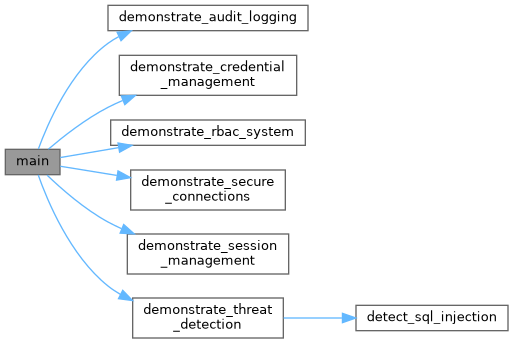

Here is the call graph for this function:




