Classes | |
| class | entity_base |
| Base class for all ORM entities. More... | |
| class | entity_manager |
| Manages entity metadata and provides factory methods. More... | |
| class | entity_metadata |
| Metadata for entire entities including table mapping and relationships. More... | |
| class | field_accessor |
| Template class for type-safe field access. More... | |
| class | field_metadata |
| Metadata for entity fields including constraints and relationships. More... | |
| struct | is_entity |
| struct | is_entity< T, std::void_t< typename T::primary_key_type, decltype(std::declval< T >().table_name()), decltype(std::declval< T >().get_metadata()) > > |
| class | query_builder |
| Template query builder for type-safe ORM queries. More... | |
Enumerations | |
| enum class | field_constraint { none = 0 , primary_key = 1 , not_null = 2 , unique = 4 , auto_increment = 8 , index = 16 , foreign_key = 32 , default_now = 64 } |
Functions | |
| field_constraint | operator| (field_constraint a, field_constraint b) |
| bool | has_constraint (field_constraint constraints, field_constraint check) |
| field_constraint | primary_key () |
| field_constraint | not_null () |
| field_constraint | unique () |
| field_constraint | auto_increment () |
| field_constraint | default_now () |
| field_constraint | index (const std::string &name="") |
| field_constraint | foreign_key (const std::string &table, const std::string &field) |
Variables | |
| template<typename T > | |
| constexpr bool | is_entity_v = is_entity<T>::value |
| template<typename T > | |
| constexpr bool | is_field_type_v |
Enumeration Type Documentation
◆ field_constraint
|
strong |
| Enumerator | |
|---|---|
| none | |
| primary_key | |
| not_null | |
| unique | |
| auto_increment | |
| index | |
| foreign_key | |
| default_now | |
Definition at line 54 of file entity.h.
Function Documentation
◆ auto_increment()
|
inline |
- Examples
- /home/runner/work/database_system/database_system/database/orm/entity.h, and orm_framework_demo.cpp.
Definition at line 303 of file entity.h.
References auto_increment.
Referenced by TEST_F().

◆ default_now()
|
inline |
- Examples
- /home/runner/work/database_system/database_system/database/orm/entity.h, and orm_framework_demo.cpp.
Definition at line 304 of file entity.h.
References default_now.
Referenced by TEST_F().

◆ foreign_key()
|
inline |
Definition at line 310 of file entity.h.
References foreign_key.
◆ has_constraint()
|
inline |
Definition at line 69 of file entity.h.
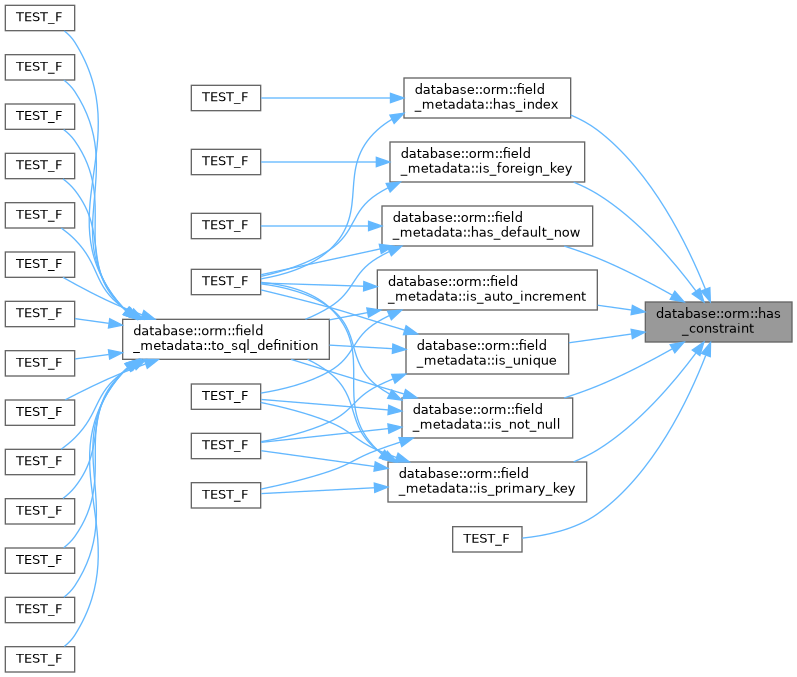
Referenced by database::orm::field_metadata::has_default_now(), database::orm::field_metadata::has_index(), database::orm::field_metadata::is_auto_increment(), database::orm::field_metadata::is_foreign_key(), database::orm::field_metadata::is_not_null(), database::orm::field_metadata::is_primary_key(), database::orm::field_metadata::is_unique(), and TEST_F().
◆ index()
|
inline |
◆ not_null()
|
inline |
- Examples
- /home/runner/work/database_system/database_system/database/orm/entity.h, and orm_framework_demo.cpp.
Definition at line 301 of file entity.h.
References not_null.
Referenced by TEST_F().

◆ operator|()
|
inline |
◆ primary_key()
|
inline |
- Examples
- /home/runner/work/database_system/database_system/database/orm/entity.h, and orm_framework_demo.cpp.
Definition at line 300 of file entity.h.
References primary_key.
Referenced by TEST_F().

◆ unique()
|
inline |
- Examples
- /home/runner/work/database_system/database_system/database/orm/entity.h, and orm_framework_demo.cpp.
Definition at line 302 of file entity.h.
References unique.
Referenced by TEST_F().

Variable Documentation
◆ is_entity_v
|
inlineconstexpr |
◆ is_field_type_v
|
inlineconstexpr |