High-performance asynchronous executor using thread_system. More...
#include <async_operations.h>
Public Member Functions | |
| async_executor (size_t thread_count=std::thread::hardware_concurrency(), const thread_context_type &=thread_context_type()) | |
| Constructs an async executor with specified thread count. | |
| ~async_executor () | |
| async_executor (const async_executor &)=delete | |
| async_executor & | operator= (const async_executor &)=delete |
| async_executor (async_executor &&)=delete | |
| async_executor & | operator= (async_executor &&)=delete |
| template<typename F , typename... Args> requires concepts::SubmittableTask<F, Args...> | |
| auto | submit (F &&func, Args &&... args) -> std::future< std::invoke_result_t< F, Args... > > |
| Submits a task for asynchronous execution. | |
| void | shutdown () |
| Gracefully shuts down the executor. | |
| void | wait_for_completion () |
| Waits for all pending tasks to complete. | |
| size_t | pending_tasks () const |
| Returns the number of pending tasks. | |
| size_t | thread_count () const |
| Returns the number of worker threads. | |
| constexpr bool | is_using_thread_system () const |
| Checks if using thread_system implementation. | |
Private Member Functions | |
| void | worker_thread () |
Private Attributes | |
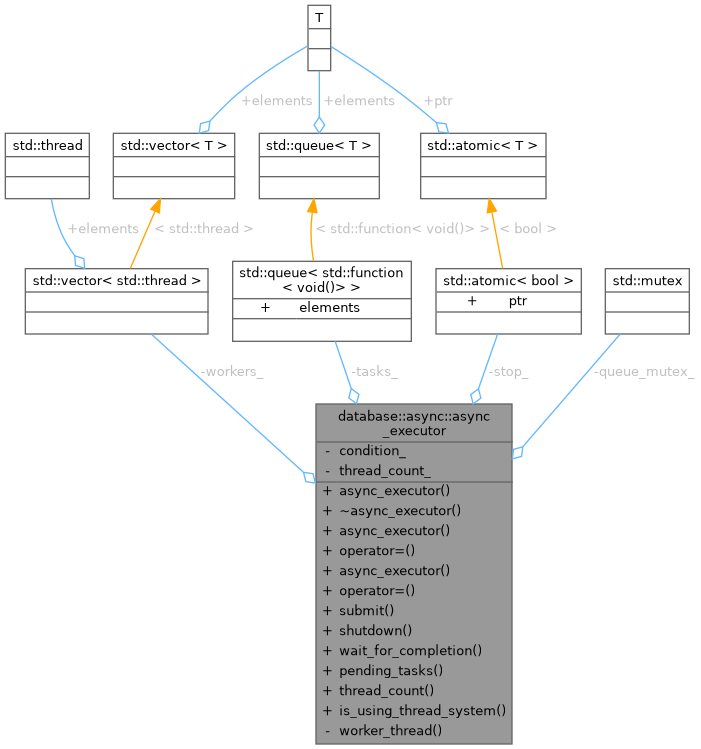
| std::vector< std::thread > | workers_ |
| std::queue< std::function< void()> > | tasks_ |
| std::mutex | queue_mutex_ |
| std::condition_variable | condition_ |
| std::atomic< bool > | stop_ |
| size_t | thread_count_ |
Detailed Description
High-performance asynchronous executor using thread_system.
This executor leverages thread_system's advanced features when available:
- Adaptive job queue (mutex ↔ lock-free automatic switching)
- Sub-microsecond latency (77ns job scheduling)
- 1.16M+ jobs/second throughput
- Integrated monitoring and logging
When USE_THREAD_SYSTEM is not defined, falls back to std::thread implementation.
Thread Safety
All methods are thread-safe and can be called from multiple threads.
Performance
- Throughput: 1.16M+ jobs/s (vs ~50K with std::thread)
- Latency: 77ns scheduling (vs 2-5μs with std::thread)
- Scalability: Linear scaling up to hardware concurrency
- Examples
- async_executor_demo.cpp, and async_operations_demo.cpp.
Definition at line 328 of file async_operations.h.
Constructor & Destructor Documentation
◆ async_executor() [1/3]
|
inlineexplicit |
Constructs an async executor with specified thread count.
- Parameters
-
thread_count Number of worker threads (defaults to hardware concurrency) context Thread context for logging/monitoring (optional)
Definition at line 362 of file async_operations.h.
References thread_count_, worker_thread(), and workers_.

◆ ~async_executor()
|
inline |
Definition at line 375 of file async_operations.h.
References shutdown().

◆ async_executor() [2/3]
|
delete |
◆ async_executor() [3/3]
|
delete |
Member Function Documentation
◆ is_using_thread_system()
|
inlineconstexpr |
Checks if using thread_system implementation.
- Examples
- /home/runner/work/database_system/database_system/database/async/async_operations.h, and async_executor_demo.cpp.
Definition at line 510 of file async_operations.h.
References database::async::using_thread_system.
Referenced by demonstrate_basic_usage(), and demonstrate_high_throughput().

◆ operator=() [1/2]
|
delete |
◆ operator=() [2/2]
|
delete |
◆ pending_tasks()
|
inline |
Returns the number of pending tasks.
Definition at line 488 of file async_operations.h.
References queue_mutex_, and tasks_.
Referenced by demonstrate_shutdown().

◆ shutdown()
|
inline |
Gracefully shuts down the executor.
Definition at line 441 of file async_operations.h.
References condition_, queue_mutex_, stop_, worker(), and workers_.
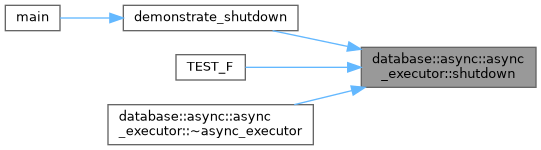
Referenced by demonstrate_shutdown(), TEST_F(), and ~async_executor().

◆ submit()
requires concepts::SubmittableTask<F, Args...>
|
inline |
Submits a task for asynchronous execution.
- Template Parameters
-
F Callable type - constrained by SubmittableTask concept Args Argument types
- Parameters
-
func The callable to execute args Arguments to pass to the callable
- Returns
- std::future with the result of the callable
- Examples
- /home/runner/work/database_system/database_system/database/async/async_operations.h, and async_executor_demo.cpp.
Definition at line 395 of file async_operations.h.
References condition_, queue_mutex_, stop_, and tasks_.
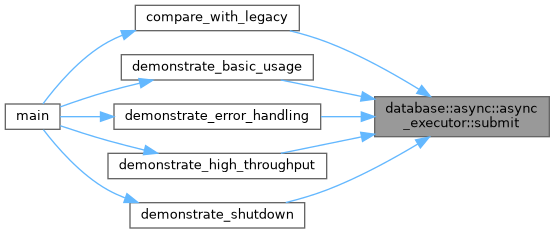
Referenced by compare_with_legacy(), demonstrate_basic_usage(), demonstrate_error_handling(), demonstrate_high_throughput(), and demonstrate_shutdown().
◆ thread_count()
|
inline |
Returns the number of worker threads.
- Examples
- /home/runner/work/database_system/database_system/database/async/async_operations.h, and async_executor_demo.cpp.
Definition at line 503 of file async_operations.h.
References thread_count_.
Referenced by demonstrate_basic_usage(), and TEST_F().

◆ wait_for_completion()
|
inline |
Waits for all pending tasks to complete.
Definition at line 465 of file async_operations.h.
References queue_mutex_, and tasks_.
Referenced by demonstrate_high_throughput().

◆ worker_thread()
|
inlineprivate |
Definition at line 519 of file async_operations.h.
References condition_, queue_mutex_, stop_, and tasks_.
Referenced by async_executor().

Member Data Documentation
◆ condition_
|
private |
Definition at line 548 of file async_operations.h.
Referenced by shutdown(), submit(), and worker_thread().
◆ queue_mutex_
|
mutableprivate |
Definition at line 547 of file async_operations.h.
Referenced by pending_tasks(), shutdown(), submit(), wait_for_completion(), and worker_thread().
◆ stop_
|
private |
Definition at line 549 of file async_operations.h.
Referenced by shutdown(), submit(), and worker_thread().
◆ tasks_
|
private |
Definition at line 546 of file async_operations.h.
Referenced by pending_tasks(), submit(), wait_for_completion(), and worker_thread().
◆ thread_count_
|
private |
Definition at line 550 of file async_operations.h.
Referenced by async_executor(), and thread_count().
◆ workers_
|
private |
Definition at line 545 of file async_operations.h.
Referenced by async_executor(), and shutdown().
The documentation for this class was generated from the following file:
- database/async/async_operations.h