Loading...
Searching...
No Matches
#include <kcenon/common/interfaces/monitoring/health_check.h>#include <kcenon/common/patterns/result.h>#include <chrono>#include <iostream>#include <memory>#include <string>#include <vector>
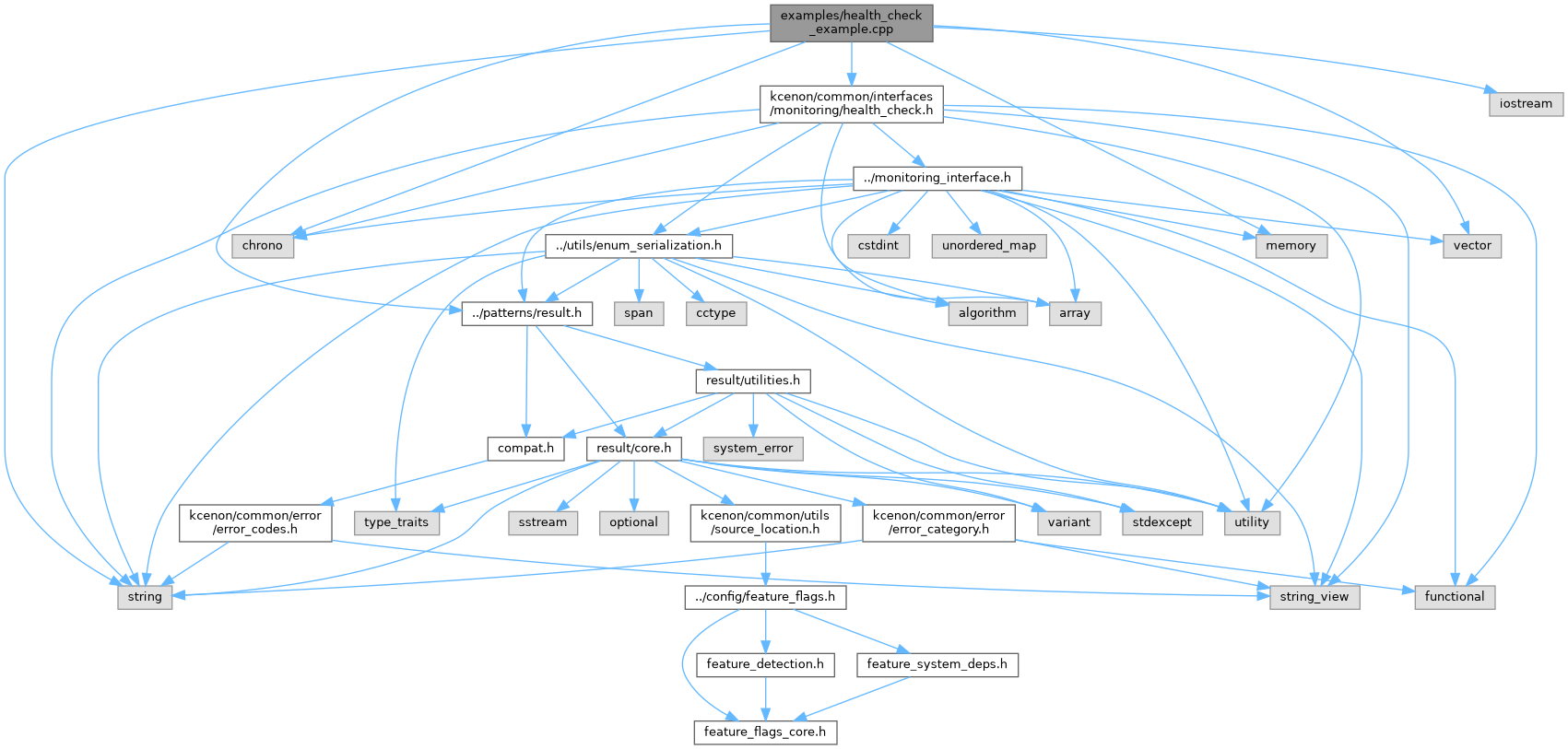
Include dependency graph for health_check_example.cpp:
Go to the source code of this file.
Classes | |
| class | app_liveness_check |
| class | cache_readiness_check |
| class | database_dependency_check |
Functions | |
| std::string | status_string (health_status status) |
| int | main () |
Function Documentation
◆ main()
| int main | ( | ) |
Definition at line 124 of file health_check_example.cpp.
125{
126 std::cout << "=== Health Check Example ===\n\n";
127
128 // 1. Health check type utilities
129 std::cout << "1. Health check types:\n";
133
135 if (parsed.is_ok())
136 {
138 }
139
140 // 2. Create health checks
141 std::cout << "\n2. Running health checks:\n";
142 std::vector<std::unique_ptr<health_check>> checks;
143 checks.push_back(std::make_unique<app_liveness_check>());
144 checks.push_back(std::make_unique<cache_readiness_check>(true));
145 checks.push_back(std::make_unique<database_dependency_check>(true));
146
147 bool all_healthy = true;
148 for (const auto& hc : checks)
149 {
150 auto result = hc->check();
153 << " (critical=" << (hc->is_critical() ? "yes" : "no")
154 << ", timeout=" << hc->get_timeout().count() << "ms)\n";
155
156 if (result.status == health_status::unhealthy && hc->is_critical())
157 {
158 all_healthy = false;
159 }
160 }
161
162 std::cout << "\n Overall: " << (all_healthy ? "HEALTHY" : "UNHEALTHY") << "\n";
163
164 // 3. Simulate a failure scenario
165 std::cout << "\n3. Simulating database failure:\n";
167 auto result = db_down.check();
169 << result.message << "\n";
170
171 std::cout << "\nDone.\n";
172 return 0;
173}
Result< health_check_type > health_check_type_from_string(const std::string &str)
Convert string to health check type.
Definition health_check.h:72
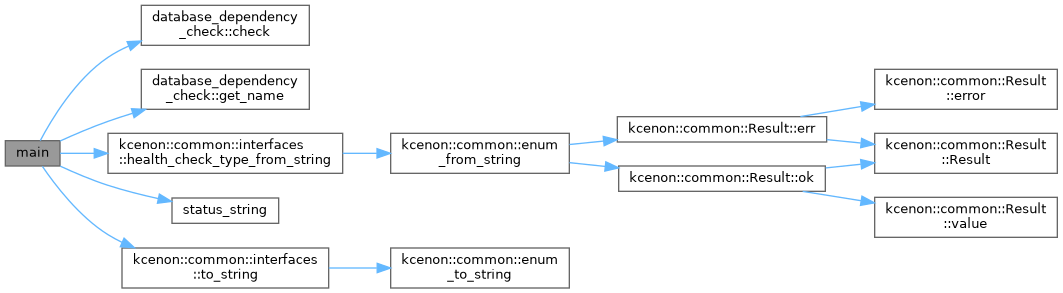
References database_dependency_check::check(), database_dependency_check::get_name(), kcenon::common::interfaces::health_check_type_from_string(), status_string(), and kcenon::common::interfaces::to_string().
Here is the call graph for this function:
◆ status_string()
| std::string status_string | ( | health_status | status | ) |
- Examples
- health_check_example.cpp.
Definition at line 109 of file health_check_example.cpp.
110{
111 switch (status)
112 {
113 case health_status::healthy:
114 return "HEALTHY";
115 case health_status::degraded:
116 return "DEGRADED";
117 case health_status::unhealthy:
118 return "UNHEALTHY";
119 default:
120 return "UNKNOWN";
121 }
122}
Referenced by main().
Here is the caller graph for this function: