System Overview
Container System is a high-performance, type-safe C++20 container framework with SIMD-accelerated serialization. It provides intuitive abstractions for structured data management, enabling developers to build thread-safe applications with efficient binary, JSON, XML, and MessagePack serialization.
As a Tier 1 library in the kcenon ecosystem, Container System builds on common_system and serves as the data exchange format for network_system, database_system, and pacs_system.
Key Features
| Category | Feature | Description |
| Types | 16 Value Types | null, bool, char, int8–uint64, float, double, string, bytes, container, array |
| Serialization | Multi-Format | Binary, JSON, XML, and MessagePack via strategy pattern |
| Performance | SIMD Acceleration | ARM NEON and x86 AVX2 auto-detected at build time |
| Concurrency | Thread Safety | thread_safe_container with RCU-based lock-free reads |
| Memory | Memory Pool | Custom pool_allocator for small-object allocation |
| Async | Coroutines | C++20 task<T>, generator<T>, async_container |
| Builder | Fluent API | messaging_container_builder with method chaining |
Value Type Reference
| Type | Code | Description | Size |
null_value | '0' | Null/empty value | 0 bytes |
bool_value | '1' | Boolean true/false | 1 byte |
char_value | '2' | Single character | 1 byte |
int8_value | '3' | 8-bit signed integer | 1 byte |
uint8_value | '4' | 8-bit unsigned integer | 1 byte |
int16_value | '5' | 16-bit signed integer | 2 bytes |
uint16_value | '6' | 16-bit unsigned integer | 2 bytes |
int32_value | '7' | 32-bit signed integer | 4 bytes |
uint32_value | '8' | 32-bit unsigned integer | 4 bytes |
int64_value | '9' | 64-bit signed integer | 8 bytes |
uint64_value | 'a' | 64-bit unsigned integer | 8 bytes |
float_value | 'b' | 32-bit floating point | 4 bytes |
double_value | 'c' | 64-bit floating point | 8 bytes |
bytes_value | 'd' | Raw byte array | Variable |
container_value | 'e' | Nested container | Variable |
string_value | 'f' | UTF-8 string | Variable |
Architecture Diagram
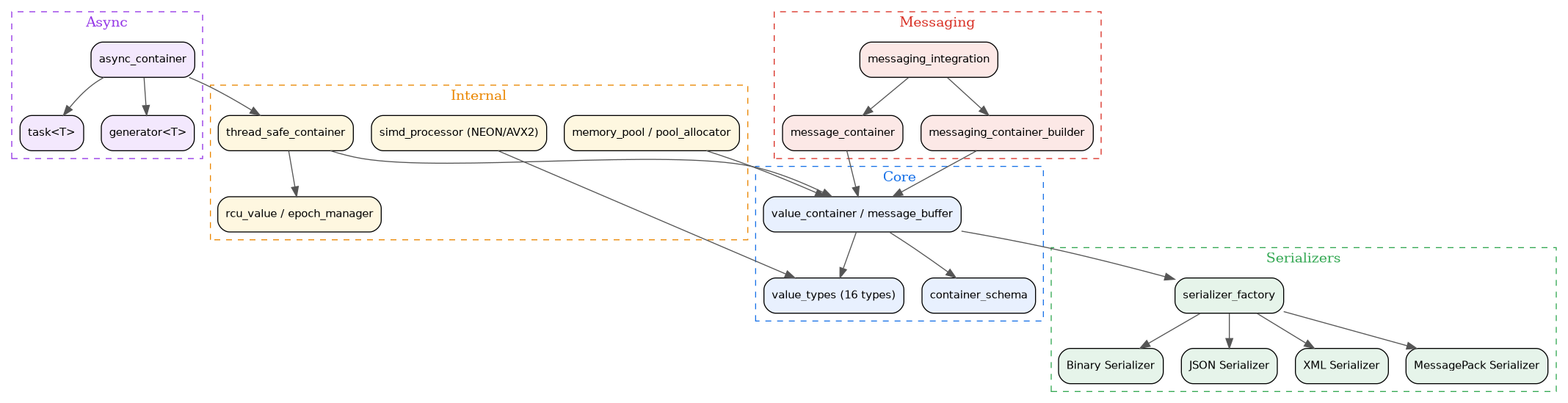
The framework is organized into layers. Higher layers depend on lower layers, but never the reverse.
Quick Start
A minimal example creating a container, adding values, and serializing:
#include <container/container.h>
using namespace container_module;
auto container = std::make_shared<value_container>();
container->set_source("client_01", "session_123");
container->set_target("server", "main_handler");
container->set_message_type("user_data");
auto values = std::vector<std::shared_ptr<value>>{
value_factory::create("user_id", int64_value, "12345"),
value_factory::create("username", string_value, "john_doe"),
value_factory::create("balance", double_value, "1500.75"),
value_factory::create("active", bool_value, "true")
};
container->set_values(values);
std::string serialized = container->serialize();
auto restored = std::make_shared<value_container>(serialized);
auto username = restored->get_value("username");
return 0;
}
Builder pattern with method chaining:
#include <container/integration/messaging_integration.h>
using namespace container_module::integration;
auto container = messaging_container_builder()
.source("client_01", "session_123")
.target("server", "main_handler")
.message_type("user_data")
.add_value("user_id", 12345)
.add_value("username", std::string("john_doe"))
.add_value("balance", 1500.75)
.add_value("active", true)
.optimize_for_speed()
.build();
Installation
CMake FetchContent (Recommended)
include(FetchContent)
FetchContent_Declare(
container_system
GIT_REPOSITORY https://github.com/kcenon/container_system.git
GIT_TAG v0.1.0
)
FetchContent_MakeAvailable(container_system)
target_link_libraries(your_target PRIVATE ContainerSystem::container)
vcpkg
vcpkg install kcenon-container-system
find_package(ContainerSystem REQUIRED)
target_link_libraries(your_target PRIVATE ContainerSystem::container)
Manual Build
git clone https://github.com/kcenon/container_system.git
cd container_system
cmake -S . -B build -DCMAKE_BUILD_TYPE=Release
cmake --build build
Module Overview
| Module | Directory | Key Headers | Description |
| Core | core/ | value_container.h, value_types.h, value_factory.h | Container foundation, 16 value types, factory utilities |
| Serializers | core/serializers/ | binary_serializer.h, json_serializer.h, xml_serializer.h, msgpack_serializer.h | Multi-format serialization via strategy pattern |
| Internal | internal/ | thread_safe_container.h, simd_processor.h, rcu_value.h, memory_pool.h | Thread safety, SIMD acceleration, RCU reads, memory pooling |
| Async | internal/async/ | task.h, generator.h, async_container.h | C++20 coroutine support for asynchronous container operations |
| Messaging | messaging/ | message_container.h | Domain-specific messaging container |
| Integration | integration/ | messaging_integration.h, messaging_container_builder.h | Builder pattern and messaging system hooks |
| Utilities | utilities/ | string_conversion.h | String conversion and core utility functions |
Performance Benchmarks
| Operation | Throughput | Notes |
| Container creation | 5M containers/sec | Empty containers |
| Value addition | 15M string values/sec | Single-threaded |
| Binary serialization | 2M containers/sec | 1 KB containers |
| JSON serialization | 800K containers/sec | 1 KB containers |
| SIMD numeric ops | 25M operations/sec | ARM NEON / x86 AVX2 |
| Metric | Size |
| Empty container | ~128 bytes baseline |
| String value | ~64 bytes + string length |
| Numeric value | ~48 bytes per value |
| Binary overhead | ~10% |
| JSON overhead | ~40% |
Examples
Learning Resources
New to Container System? Start with the tutorials below and keep the FAQ and troubleshooting guide handy as you build.
Related Systems
Container System is a Tier 1 data serialization layer in the kcenon ecosystem. It depends on common_system and is consumed by higher-tier systems: